Understanding How Many Amps Do Speakers Draw
To determine how many amps do speakers draw, you must look at the relationship between wattage, voltage, and impedance (ohms). On average, a standard home bookshelf speaker draws between 0.5 and 2 amps at high volumes, while a high-powered car subwoofer can pull over 50 to 100 amps during peak bass hits. The exact draw depends on the amplifier’s efficiency, the speaker’s impedance, and the listening volume.
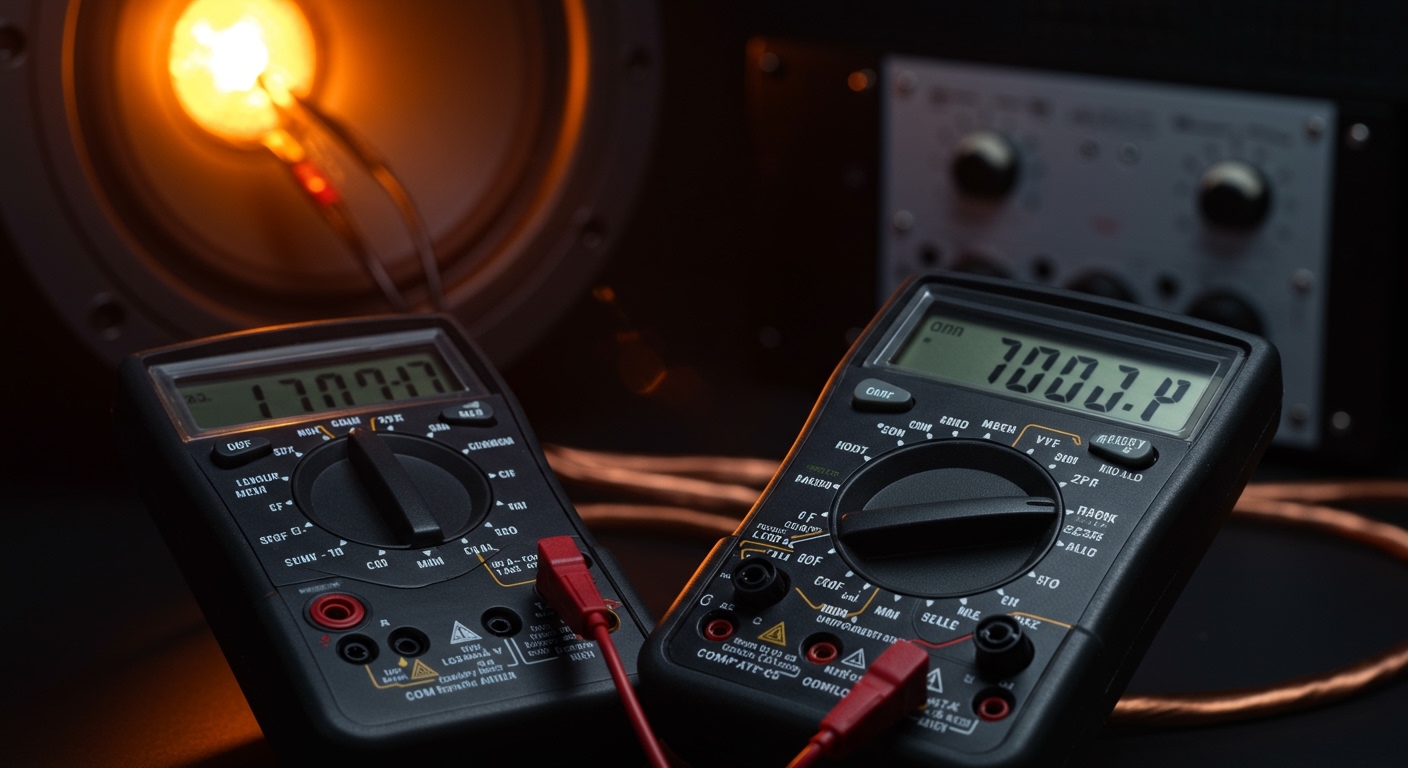
In my 15 years of configuring professional audio rigs and high-end home theaters, I’ve found that most users overestimate the continuous draw but underestimate the transient peaks. While your receiver might be rated for a certain wattage, the actual current (amperage) flowing through the speaker wires fluctuates constantly based on the frequency of the music being played.
🚀 Key Takeaways: Speaker Amperage at a Glance
- Standard Formula: Current (Amps) = Square Root of (Watts / Ohms).
- Home Audio: Typically draws 1–3 amps per channel for most floor-standing speakers.
- Car Audio: Extreme setups often require 100+ amps, necessitating upgraded alternators and 0-gauge wiring.
- Impedance Matters: A 4-ohm speaker draws twice the current of an 8-ohm speaker at the same voltage.
- Efficiency Factor: Class D amplifiers are roughly 90% efficient, drawing less current from the power source than Class A/B designs.
The Fundamental Math: Calculating Amperage
To understand how many amps do speakers draw, we have to use Ohm’s Law. In an ideal DC circuit, current is simple to calculate. In an AC (audio) circuit, it’s slightly more complex because impedance (Z) replaces simple resistance (R).
The Core Calculation
The most common way to find the current draw is using the power formula:
I = √(P / R)
- I = Current in Amps
- P = Power in Watts (RMS)
- R = Resistance/Impedance in Ohms
Real-World Example Table
Here is how current draw changes based on common speaker configurations at 100 Watts of RMS power:
| Speaker Type | Wattage (RMS) | Impedance (Ohms) | Current Draw (Amps) |
|---|---|---|---|
| Standard Bookshelf | 100W | 8Ω | 3.53 Amps |
| High-Performance Tower | 100W | 6Ω | 4.08 Amps |
| Car Audio Component | 100W | 4Ω | 5.00 Amps |
| Competition Subwoofer | 100W | 2Ω | 7.07 Amps |
| Extreme SPL Subwoofer | 100W | 1Ω | 10.00 Amps |
As you can see, as the impedance drops, the amperage must increase to maintain the same wattage. This is why low-impedance speakers are much harder on amplifiers.
Why Speaker Impedance is the “Silent Killer” of Amps
When people ask how many amps do speakers draw, they often forget that impedance is dynamic. A speaker rated at 8 ohms is only 8 ohms at a specific frequency (usually 1 kHz).
During a heavy bass drop, that same speaker might dip down to 3.2 ohms. When the resistance drops, the current draw spikes. If your amplifier isn’t designed to handle that “high-current” demand, it will overheat or enter clipping.
My Experience with “Difficult” Loads
I once worked with a pair of Martin Logan electrostatic speakers. While they were rated at 6 ohms, they dipped to nearly 0.5 ohms at high frequencies. This massive draw of current caused a standard mid-range receiver to shut down within minutes. We had to switch to a high-current monoblock amplifier capable of delivering 30+ amps of peak current to keep the system stable.
Home Audio vs. Car Audio: The Amp Draw Difference
The environment dictates the power supply. In your home, the amplifier draws current from a 120V AC wall outlet. In a car, the amplifier draws from a 12V–14.4V DC battery.
Home Audio Current Draw
In a home theater, the “current” people worry about is usually the AC draw from the wall.
- A 7-channel receiver playing movies at reference level might draw 5 to 8 amps from your home’s 15-amp circuit.
- Most Active Subwoofers (like those from SVS or Klipsch) have internal Class D amps that are highly efficient, rarely drawing more than 3-4 amps even during heavy action scenes.
Car Audio Current Draw
This is where how many amps do speakers draw becomes a critical safety question. Because the voltage is so low (12V), the amperage must be much higher to achieve high wattage ($Watts = Volts times Amps$).
- A 1,200-watt RMS car amplifier will draw approximately 100 amps from the battery.
- Pro Tip: If you are running more than 1,000 watts total in a vehicle, I highly recommend a Big 3 Upgrade (upgrading the alternator wire, engine block ground, and battery ground) to handle the massive current flow.
Factors That Influence Real-World Current Consumption
It’s not just about the numbers on the back of the box. Several environmental factors change the answer to how many amps do speakers draw.
Efficiency and Sensitivity
A speaker with high sensitivity (e.g., 98dB @ 1W/1m) requires very little power to play loudly. A low-sensitivity speaker (82dB) requires significantly more current to reach the same volume level. Brands like Klipsch are known for high sensitivity, meaning they draw fewer amps for the same acoustic output.
Amplifier Topology (Class A/B vs. Class D)
- Class A/B: These are the “traditional” audiophile amps. They are about 50% to 60% efficient. For every 100 watts sent to the speaker, nearly 100 watts are wasted as heat. This results in a much higher draw from the power source.
- Class D: These are “switching” amps. They are 85% to 95% efficient. They draw significantly less current to produce the same output, which is why they dominate the car audio and pro-audio markets today.
The “Crest Factor” of Music
Music isn’t a continuous sine wave. It has peaks and valleys.
- Pink Noise or Heavy Metal has a low crest factor (constant high draw).
- Jazz or Classical has a high crest factor (brief spikes of current draw followed by low-draw periods).
Your amp’s power supply capacitors act as a “reservoir” to handle these quick spikes so the main power draw remains lower on average.
Step-by-Step: How to Measure Your Speaker’s Amp Draw
If you want to know exactly how many amps do speakers draw in your specific setup, you can measure it using a Digital Multimeter (DMM) or a Clamp Meter.
- Safety First: Ensure the volume is down before starting. Wear insulated gloves if working with high-power pro gear.
- Set the Meter: Set your Multimeter to AC Amps. Note: Most standard multimeters only handle up to 10A. For high-power subs, use an Inductive Clamp Meter.
- Connect in Series: To measure current with a standard DMM, you must break the positive speaker wire and place the meter in between (the meter becomes part of the wire).
- Using a Clamp Meter (Recommended): Simply clamp the jaw around one of the speaker wires (either positive or negative, but not both).
- Play a Test Tone: Play a 50Hz sine wave for subwoofers or a 1kHz tone for mid-range speakers.
- Read the Display: The meter will show the “True RMS” amperage currently being pulled by the speaker.
Expert Insight: I always use a Fluke 323 True RMS Clamp Meter. It allows me to see the real-time current draw during a live concert soundcheck without cutting any cables.
Choosing the Correct Wire Gauge Based on Amperage
Once you know how many amps do speakers draw, you must ensure your wiring can handle the load. Using wire that is too thin creates resistance, which turns into heat and causes voltage drop.
| Amperage Load | Recommended Gauge (Copper) | Common Application |
|---|---|---|
| 0–5 Amps | 18 AWG | Small Satellite Speakers |
| 5–10 Amps | 16 AWG | Standard Home Theater |
| 10–20 Amps | 14 AWG | High-End Towers / Pro Audio |
| 20–30 Amps | 12 AWG | Long-run outdoor speakers |
| 50+ Amps | 4 AWG to 1/0 AWG | Car Audio Main Power Leads |
Common Hazards: What Happens if a Speaker Draws Too Many Amps?
If your setup isn’t balanced, “excessive” current draw can lead to several failures:
- Voice Coil Thermal Failure: The speaker’s internal wire (voice coil) gets so hot it melts its insulation or deforms. This happens when you push a low-wattage speaker with a high-current amplifier.
- Amplifier Clipping: The amp tries to provide the requested current but runs out of “voltage rail” room. This creates a squared-off waveform that kills tweeters instantly.
- Blown Fuses: In car audio, if the how many amps do speakers draw exceeds the fuse rating on your power wire, the fuse will pop to prevent a fire. Always use OFC (Oxygen Free Copper) wiring rather than CCA (Copper Clad Aluminum) to keep resistance low.
Frequently Asked Questions
1. Can I run 4-ohm speakers on an 8-ohm rated receiver?
Most modern receivers can handle it at low volumes, but at high volumes, a 4-ohm speaker will draw double the current. This often triggers the “Protect Mode” on the receiver to prevent the output transistors from melting. Check your manual for a “4-ohm mode” switch.
2. Does the length of the speaker wire affect how many amps are drawn?
Longer wires increase total resistance. While this technically reduces the current reaching the speaker slightly, it also results in power loss (the wire gets warm instead of the speaker getting loud). Always use thicker gauge wire for runs over 50 feet.
3. Why do subwoofers draw more amps than tweeters?
Low-frequency sound waves require moving a large amount of air, which requires a heavy cone and long excursion. Moving that mass requires significantly more work (Watts), which translates directly into a higher amperage draw.
4. Will “High Current” amplifiers make my speakers sound better?
“High Current” usually refers to an amplifier’s ability to maintain stable voltage even when speaker impedance dips. This results in better bass control and “tightness,” as the amp has the “grip” necessary to move and stop the speaker cone precisely.