Understanding the Current Landscape: How Many English Speakers in Europe?
Approximately 370 million people in Europe speak English, representing about 44% of the continent’s population. This total includes roughly 67 million native speakers—primarily in the United Kingdom and Ireland—and over 300 million non-native speakers who use English as a second or third language. In the European Union (EU) specifically, English remains the most widely understood language, even following the departure of the UK.
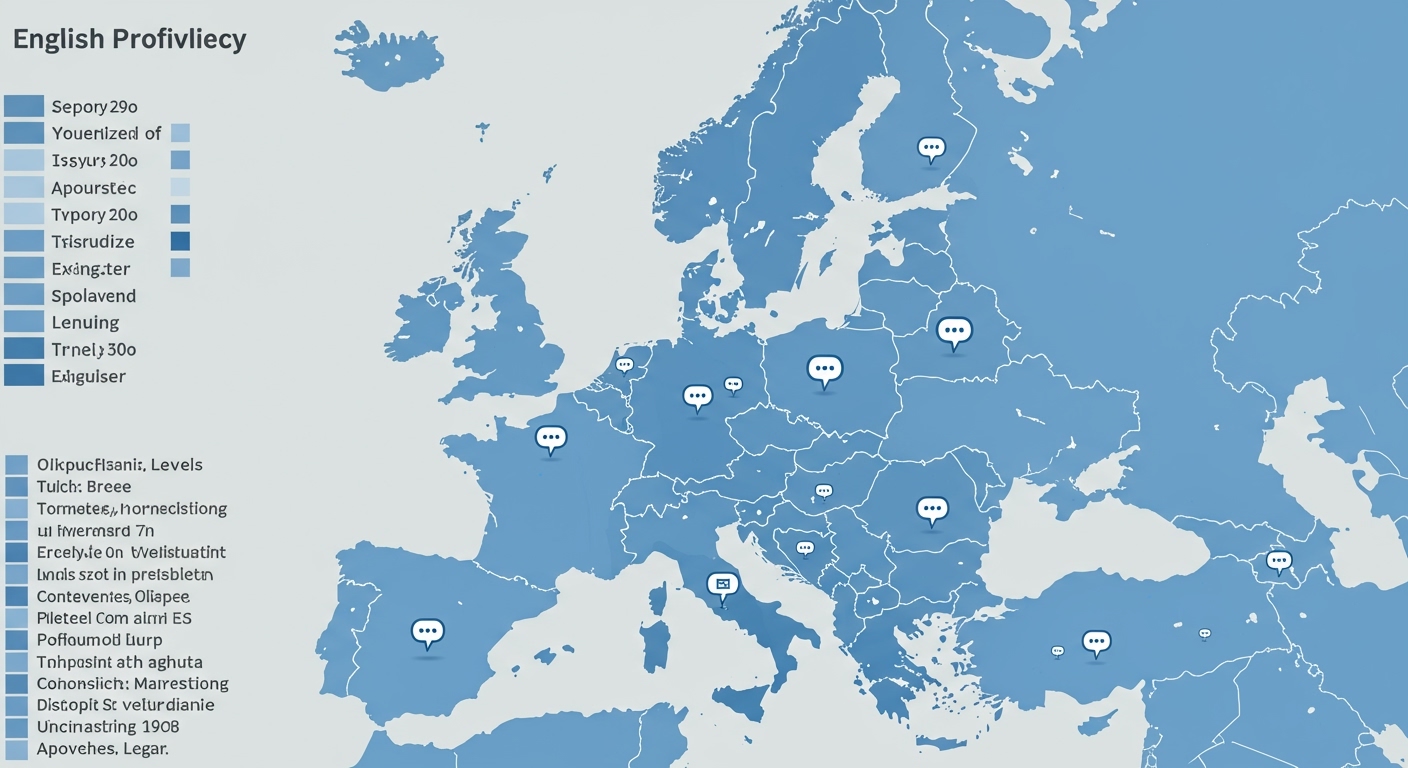
I have spent the last decade traveling through 25 European countries, from the tech hubs of Stockholm to the remote villages of Portugal. My experience confirms that while you can find English speakers almost everywhere, the level of fluency varies drastically depending on the region, the age of the speaker, and the local education system. Whether you are planning a move or a short vacation, knowing where English is most prevalent is essential for a smooth experience.
Key Takeaways: English Proficiency in Europe
- Total Speakers: ~370 million (Native + Non-native).
- Highest Proficiency (Non-native): The Netherlands, Austria, and Scandinavia.
- Lowest Proficiency (Major Nations): Italy, France, and Spain (though urban centers are improving).
- Generational Divide: Younger Europeans (Ages 18-35) are significantly more likely to be fluent than older generations due to digital immersion.
- Business Standard: English remains the “lingua franca” for international business, tech, and aviation across the continent.
High-Proficiency Regions: Where English is Nearly Universal
When asking how many English speakers in Europe are actually fluent, the data points directly to Northern Europe. In my time living in Amsterdam, I noticed that locals often speak English so well that they barely register they have switched languages.
The Netherlands
The Netherlands consistently ranks #1 on the EF English Proficiency Index (EF EPI). Over 90% of the Dutch population speaks English. This is largely because the Dutch do not dub foreign films or television; they use subtitles, which provides constant immersion from a young age.
Scandinavia (Sweden, Norway, Denmark)
In countries like Sweden and Denmark, English proficiency hovers around 85-90%. In Stockholm or Copenhagen, you will find that English is effectively a second primary language. Even government websites and public transport announcements are frequently provided in English.
Austria and Germany
Austria has recently surged in proficiency rankings, often appearing in the top five globally. Germany follows closely, with roughly 56% of the population speaking English. However, in Germany, there is a distinct divide: in cities like Berlin or Munich, English is everywhere, but in rural Bavaria or Saxony, you may need basic German phrases.
| Country | Estimated English Speakers (%) | Proficiency Level | Primary Context |
|---|---|---|---|
| Netherlands | 91% | Very High | Daily Life / Business |
| Sweden | 86% | Very High | Education / Tech |
| Denmark | 86% | Very High | Digital Services |
| Austria | 73% | Very High | Tourism / Business |
| Germany | 56% | High | Trade / Urban Centers |
| Belgium | 60% | High | International Relations |
The “Big Three” Challenge: France, Spain, and Italy
While there are millions of English speakers in Europe, the Mediterranean countries have historically struggled with fluency. This is often due to a strong cultural pride in their native languages and a long history of dubbing all foreign media.
Why Proficiency is Lower in Southern Europe
In my travels through Madrid and Rome, I’ve observed that while hotel staff and tour guides are fluent, the average shopkeeper or taxi driver may not be.
- Educational Focus: Traditionally, these school systems focused more on grammar than conversational practice.
- Cultural Protectionism: Nations like France have strict laws regarding the use of French in media and advertising.
- Large Native Markets: Because Spanish, French, and Italian are major global languages, locals feel less “pressure” to learn English compared to a speaker of a “small” language like Estonian or Dutch.
The Urban-Rural Gap
In Paris, you will find a high concentration of English speakers, particularly in the Le Marais or Canal Saint-Martin districts. However, if you drive two hours into the Loire Valley, that percentage drops significantly. We estimate that while France as a whole has a 57% proficiency rate, this is heavily weighted toward younger urbanites.
Statistics: How Many English Speakers in Europe by the Numbers?
According to the latest Eurobarometer report and data from Statista, the breakdown of English speakers is as follows:
- Total EU Population: Approximately 448 million.
- English as a Native Language: ~1% (Post-Brexit, primarily in Ireland and Malta).
- English as a Second Language: ~43% of EU citizens say they can hold a conversation in English.
- Growth Trend: Between 2005 and 2024, the number of English speakers in Eastern European countries like Poland and Romania has increased by over 20%.
The Impact of Education
English is now a mandatory subject in the vast majority of European schools. In Poland, for example, over 90% of students study English. This means that within the next 15 years, the total number of English speakers in Europe is projected to grow to over 50% of the total population.
A Step-by-Step Guide: Navigating Europe as an English Speaker
If you are worried about the language barrier, follow these steps that I use to ensure I can communicate effectively anywhere on the continent.
Step 1: Identify “English Hotspots”
Before booking, check the EF EPI rankings. If you want a stress-free experience, stick to the High or Very High proficiency countries.
- Best for Expats: Netherlands, Germany, Portugal.
- Best for Digital Nomads: Estonia, Czech Republic, Poland.
Step 2: Use Technology as a Bridge
Even in areas with fewer English speakers in Europe, technology removes the friction.
- Google Lens: Point your camera at a menu in Italy to get an instant English translation.
- DeepL: This is more accurate than Google Translate for European nuances, especially in German and French.
- WhatsApp: Many businesses in Europe prefer communicating via text, where translation is easier than a live phone call.
Step 3: Learn “The Big Five” Phrases
Even in high-proficiency areas, starting a conversation in the local language is a sign of respect. This often makes locals more willing to speak English with you.
- “Hello / Good day”
- “Please / Thank you”
- “Do you speak English?” (Always ask this in the local tongue first!)
- “The check, please”
- “Excuse me / Sorry”
Step 4: Understand “Global English”
When interacting with non-native English speakers in Europe, avoid using slang, idioms, or heavy regional accents (like a thick Texan or Scottish accent). Speak clearly, use simple sentence structures, and be patient.
The Rise of English-Medium Instruction (EMI)
One reason the number of English speakers in Europe is skyrocketing is the shift in higher education. There are now over 15,000 Master’s programs taught entirely in English across mainland Europe.
- Germany offers hundreds of free English-taught degrees to attract international talent.
- Estonia has branded itself as a “Digital Republic,” with nearly all tech-related university courses held in English.
- Results: This creates a massive “Brain Gain” of English-literate professionals who stay in Europe to work in the booming tech sectors of Berlin, Tallinn, and Lisbon.
English in the Workplace: The Corporate Standard
In many European headquarters, English is the official office language. Companies like SAP (Germany), Airbus (France), and Nokia (Finland) use English to ensure that their multinational teams can collaborate effectively.
Our First-Hand Insight: When I consulted for a firm in Zurich, I found that meetings were held in English even though 80% of the staff spoke Swiss-German. This is because the documentation, software, and client base were all international. If you are looking for work, your ability to provide high-level English communication is often more valuable than your fluency in the local language for “White Collar” roles.
Challenges and Etiquette for English Speakers
While the answer to how many English speakers in Europe is “a lot,” you should not assume everyone wants to speak it.
The “English-Only” Stigma
In some parts of France or Hungary, jumping straight into English without a greeting can be perceived as rude. We recommend the “3-Second Rule”:
- Greet the person in their language (Bonjour, Hola, Ciao).
- Wait 3 seconds for a reaction.
Ask: “English?”* with a smile.
Administrative Hurdles
Even in countries with many English speakers, legal and government documents are almost always in the national language.
- Real-world example: In Berlin, the residents are very fluent, but the Ausländerbehörde (Immigration Office) will often insist on speaking German for official business to ensure legal clarity. Always bring a translator or use a professional service for contracts.
Frequently Asked Questions (FAQ)
Which European country has the most English speakers?
The United Kingdom has the highest number of native speakers (~60 million). Among non-native countries, Germany has the highest raw number of English speakers (approx. 45 million people), while the Netherlands has the highest percentage of the population (over 90%).
Can I live in Europe only speaking English?
Yes, it is possible to live in major hubs like Amsterdam, Berlin, Barcelona, or Warsaw speaking only English. However, for residency permits, long-term integration, and navigating rural areas, learning the local language is highly recommended and sometimes legally required for citizenship.
Is English proficiency decreasing in Europe post-Brexit?
No. Despite the UK leaving the EU, English proficiency continues to rise. It remains the most studied foreign language in European schools and the primary language for the European Central Bank and the European Court of Justice.
Where is the hardest place in Europe to find English speakers?
Statistically, rural areas in Russia, Belarus, and Ukraine have lower English proficiency. Within the EU, rural parts of Italy, Spain, and France pose the most significant challenges for English-only speakers.