Understanding How Many English Speakers in Germany
Germany is a global powerhouse where approximately 56% to 60% of the population speaks English to some degree. According to the EF English Proficiency Index (EF EPI), Germany consistently ranks in the “High Proficiency” category, often placing within the top 10 or 15 countries worldwide. While you can easily navigate major cities like Berlin, Munich, and Hamburg using only English, the level of fluency drops significantly in rural areas and among the older generation in the former East Germany.
Key Takeaways for English Speakers
- National Average: Over 45 million people in Germany speak English as a second language.
- Top Cities: Berlin is the most English-friendly city, followed by Munich, Frankfurt, and Hamburg.
- Generational Gap: People under 40 are almost universally proficient in English due to the mandatory school curriculum.
- Bureaucracy: This is the “final boss” for English speakers; official documents and government offices (Amt) almost exclusively use high-level German.
How Many English Speakers in Germany? The Statistical Breakdown
When asking how many english speakers in germany are currently active, we have to look at various data points from the Eurobarometer and EF Education First.
In my experience living and working across several German states (Bundesländer), the “statistical” 56% feels much higher in urban hubs. However, “speaking English” ranges from basic tourist interactions to full professional fluency.
| Category | Estimated Percentage | Context |
|---|
- General Proficiency | 56% – 60% | Can hold a basic conversation. |
- High Proficiency (C1/C2) | 15% – 20% | Can work in a complex professional environment. |
- Youth (Ages 15-30) | 85%+ | English is a core subject in nearly all German schools. |
- Seniors (Ages 65+ ) | 15% – 25% | Proficiency is lower, especially in the former GDR (East Germany). |
Germany ranks 10th globally (as of the latest EF EPI report), placing it just behind the Scandinavian countries and the Netherlands. This makes it one of the most accessible non-native English-speaking countries in the world.
Regional Variations: Where English is Most Common
The answer to how many english speakers in germany changes drastically depending on your GPS coordinates. If you are in the heart of Mitte, Berlin, the answer is “almost everyone.” If you are in a small village in Thuringia, the answer might be “almost no one.”
The Big Three: Berlin, Munich, Hamburg
In these metropolises, English is ubiquitous. Berlin, in particular, functions as an international bubble. I’ve spent entire weeks in Berlin without uttering a single word of German, from ordering coffee to attending tech meetups.
The Financial Hub: Frankfurt
Because Frankfurt is the home of the European Central Bank and countless international firms, the “Business English” proficiency here is arguably the highest in the country. If you are a professional in finance or logistics, you will find that English is the primary language of the office.
The Former East vs. West
There is a lingering historical divide. In the former West Germany, English was the primary second language taught in schools. In the former GDR (East Germany), Russian was often prioritized. While this gap is closing among the youth, you will notice that older residents in cities like Leipzig or Dresden may be less comfortable with English than their counterparts in Cologne or Dusseldorf.
Navigating German Bureaucracy: The “English-Only” Challenge
While the question of how many english speakers in germany looks great on paper, the German bureaucracy is a different beast. Even in Berlin, the Ausländerbehörde (Immigration Office) is legally required to conduct official business in German.
Our Practical Advice for Expats:
- Bring a “Beistand”: Under German law (§ 13 SGB X), you have the right to bring an interpreter or a German-speaking friend to any appointment.
- Use Translation Tools: We recommend DeepL over Google Translate for official German documents; it handles the complex syntax and “Legalese” much better.
- Don’t Expect English Forms: Almost all official forms (Anträge) are in German. Using a service like Appere or Settled.de can help you navigate these in English.
Working in Germany: Can You Get a Job with Only English?
Yes, but it depends on your industry. The demand for skilled labor is so high that many German companies have shifted to English as their official corporate language to attract international talent.
English-Friendly Industries
- Software Development & Tech: 90% of startups in Silicon Allee (Berlin) operate in English.
- Academic Research: High-level science and research roles at institutes like Max Planck are almost exclusively English-based.
- Digital Marketing & Creative: International agencies in Hamburg and Munich often hire English-native speakers.
German-Essential Industries
- Healthcare: Doctors and nurses must pass a B2/C1 Medical German exam to practice.
- Legal & Public Service: These require near-native German fluency.
- The Mittelstand: Small-to-medium manufacturing companies in rural areas usually require B2 German for daily operations.
A Step-By-Step Guide to Survival as an English Speaker in Germany
If you are planning to visit or move, follow this roadmap to leverage the high number of English speakers in Germany while respecting the local culture.
Step 1: Target the Right Neighborhoods
Look for “Expat-heavy” areas where service staff are guaranteed to speak English.
- Berlin: Neukölln, Kreuzberg, Prenzlauer Berg.
- Munich: Maxvorstadt, Schwabing.
- Hamburg: Altona, Eimsbüttel.
Step 2: Master the “Transition Phrase”
Germans generally speak excellent English, but they appreciate it if you don’t assume they do. Always start with:
“Entschuldigung, sprechen Sie Englisch?”* (Excuse me, do you speak English?)
This small gesture of respect usually results in much friendlier assistance.
Step 3: Set Up Your Tech Stack
- DeepL: For translating mail and letters.
- Google Lens: For “live-translating” menus and grocery labels.
- DB Navigator: The train app is fully available in English and is essential for travel.
Step 4: Focus on “Niche” German
Even if you live in an English bubble, learn the German “Power Verbs” related to your life:
Anmeldung* (Resident registration)
Kündigung* (Cancellation – very important in German contract culture!)
Versicherung* (Insurance)
Social Life and “Denglisch”
You will frequently encounter Denglisch—a blend of German (Deutsch) and English. Germans have adopted English words like “Handy” (mobile phone), “Public Viewing” (watching sports on a big screen), and “Homeoffice”.
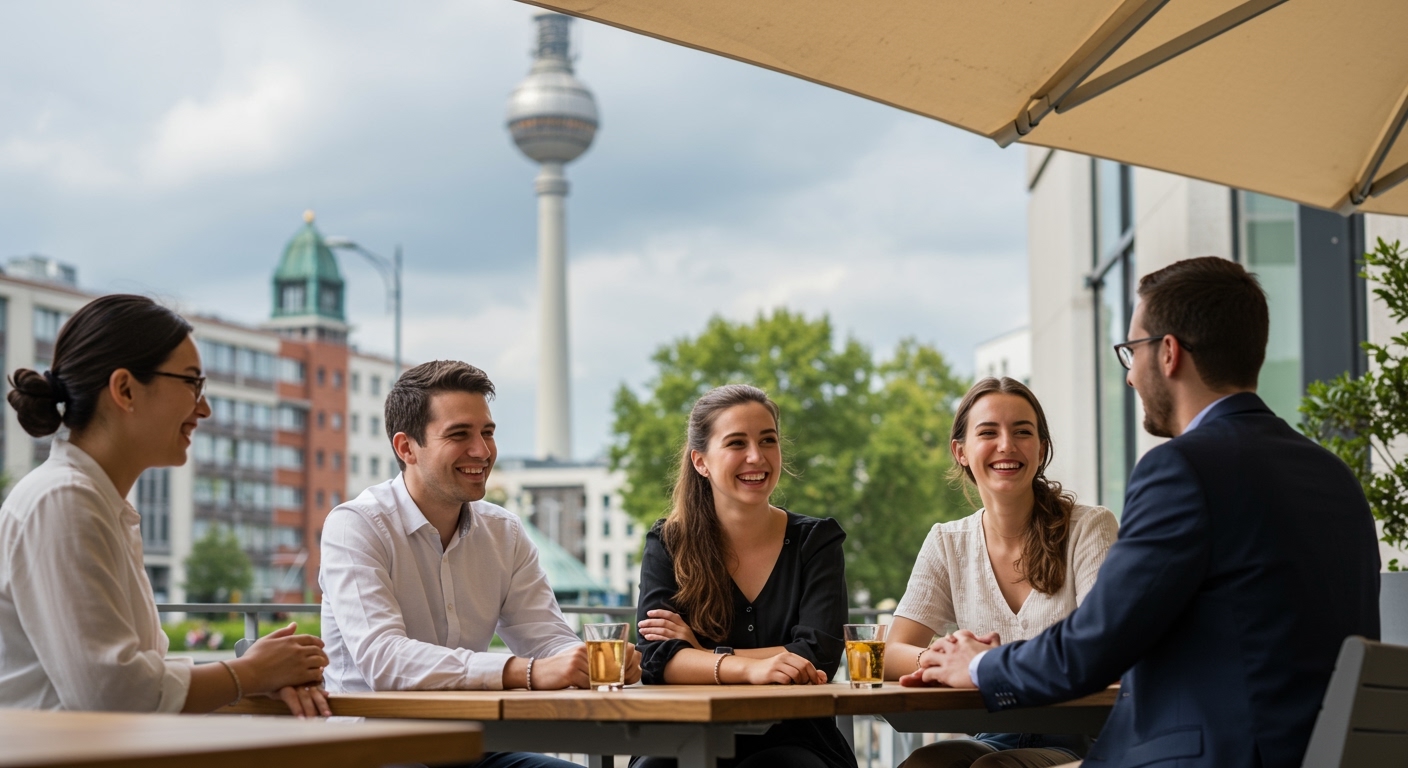
In social settings, if a group of five Germans and one English speaker are at a table, the group will often switch to English to be inclusive. This is common in the “Internationaler Freundeskreis” found in university towns like Heidelberg or Freiburg.
FAQ: English Speakers in Germany
Can I live in Germany without speaking German?
Yes, particularly in Berlin or Frankfurt. You can manage your social life, shopping, and work in English. However, you will eventually struggle with legal contracts, taxes, and deep integration into the local community.
Do doctors in Germany speak English?
Most doctors (Ärzte) are highly educated and speak very good English. In major cities, you can use the app Doctolib to filter for “English-speaking” practitioners specifically.
Is English taught in all German schools?
Yes. English is the first foreign language for the vast majority of students, starting as early as primary school. This is why how many english speakers in germany remains a high figure among the younger demographics.
Should I learn German if I already speak English?
Absolutely. While you can “survive” with English, speaking German (even at a B1 level) opens doors to better housing, deeper friendships, and a much wider range of career opportunities.
**
**
**
**