How Many Hokkien Speakers Are There Globally?
There are approximately 47 to 50 million Hokkien speakers worldwide today. The largest populations of these speakers reside in Southeastern China, Taiwan, and throughout Southeast Asia, particularly in Malaysia, Singapore, Indonesia, and the Philippines. As a primary branch of the Southern Min (Minnan) language family, Hokkien remains one of the most influential Chinese “dialects” due to its historical role in maritime trade and the global diaspora.
Key Takeaways: Hokkien Speaker Statistics
- Total Global Population: Estimated between 47 million and 50 million.
- Primary Hubs: Fujian Province (China), Taiwan, and the “Nanyang” (Southeast Asia).
- Language Status: While widely spoken, it is considered a “top-level” dialect of Southern Min, often mutually unintelligible with Mandarin.
- Cultural Variants: Known as Taiwanese (Hoklo) in Taiwan, Lannang-ue in the Philippines, and Penang/Klang Hokkien in Malaysia.
- Trend: Speaker numbers are stable in some regions but declining among younger generations in urban centers like Singapore and Xiamen.
The Regional Breakdown: Where Are the 50 Million Speakers?
When we ask how many Hokkien speakers exist, we have to look at the historical migration patterns from Fujian Province. Based on our research and census data analysis, the distribution is heavily weighted toward three specific geographic “anchors.”
Mainland China (Fujian Province)**
The heartland of the language is southern Fujian, specifically the cities of Quanzhou, Zhangzhou, and Xiamen.
- Estimated Speakers: 27–30 million.
- Context: In these regions, Hokkien is the “mother tongue.” However, due to the national Mandarin-only education policy, most speakers are now bilingual. During my travels through Quanzhou, I observed that while elderly residents speak pure Hokkien, the youth often mix it with Putonghua (Mandarin).
Taiwan (Taiwanese Hoklo)**
In Taiwan, the language is more than a dialect; it is a core pillar of national identity, often referred to as Taiwanese or Hō-ló-oē.
- Estimated Speakers: 15–18 million.
- Context: Approximately 70% of Taiwan’s population possesses some level of proficiency in Hokkien. It is used extensively in media, politics, and daily commerce, making Taiwan the most vibrant hub for the language’s modern preservation.
Southeast Asia (The Diaspora)**
The Hokkien diaspora is one of the most successful merchant classes in history. This migration spread the language across the “Southern Seas.”
| Country | Estimated Hokkien Speakers | Local Name for Language |
|---|---|---|
| Malaysia | 3.5 Million | Penang/Southern Hokkien |
| Indonesia | 2.2 Million | Medan Hokkien / Hokkien |
| Philippines | 1.0 Million | Lannang-ue |
| Singapore | 1.1 Million | Singaporean Hokkien |
| Thailand | 800,000 | Southern Min / Hainanese-influenced |
Why the Number of Hokkien Speakers is Hard to Pin Down
Calculating how many Hokkien speakers exist is difficult because of linguistic “shades.” Hokkien isn’t a single, monolithic language; it is a continuum of mutually intelligible sub-dialects.
The Southern Min Umbrella
Hokkien is technically part of the Minnan (Southern Min) group. Some linguists include Teochew and Hainanese under this umbrella. If we include all Minnan variants, the number of speakers jumps toward 60 to 75 million. However, for this guide, we focus strictly on the Hokkien branch (Quanzhou, Zhangzhou, and Xiamen styles).
The “Passive Speaker” Phenomenon
In cities like Singapore, many “Gen Z” individuals identify as Hokkien but are “passive speakers.” They understand their grandparents but cannot respond fluently. We categorize these individuals differently than fluent native speakers, which often leads to conflicting census data.
Hokkien vs. Mandarin: Understanding the Difference
A common misconception is that Hokkien is a “broken” version of Mandarin. In reality, Hokkien is more closely related to Old Chinese.
- Phonology: Hokkien retains many “entering tones” and final consonants (like -p, -t, -k) that have disappeared in Mandarin.
- Vocabulary: Many Hokkien words are derived from the Tang Dynasty era.
- Tones: Mandarin has 4 tones; Hokkien typically has 7 to 8 tones, making it significantly more complex for new learners.
Expert Insight: If you speak Mandarin, you will only understand about 5-10% of Hokkien through context. They are as different as Spanish and Italian.
Case Study: The Unique Flavors of Southeast Asian Hokkien
Through my first-hand interactions with the Hokkien community in Penang, Malaysia, I’ve noticed how the language evolves. Unlike the “pure” Hokkien found in Xiamen, the Southeast Asian variants are “creolized.”
Loanwords and Hybridization
In Malaysia and Singapore, Hokkien has absorbed words from Malay and English:
- “Suka” (Malay for ‘like’) is used instead of the traditional Hokkien term.
- “Pasar” (Malay for ‘market’) is standard.
- “Botak” (Malay for ‘bald’) is commonly used.
In the Philippines, the Lannang-ue variant incorporates Tagalog and Spanish grammar, creating a unique linguistic blend found nowhere else in the world.
The Future: Is the Number of Hokkien Speakers Shrinking?
Despite having 50 million speakers, the language faces significant “prestige” challenges.
The “Mandarinization” Effect
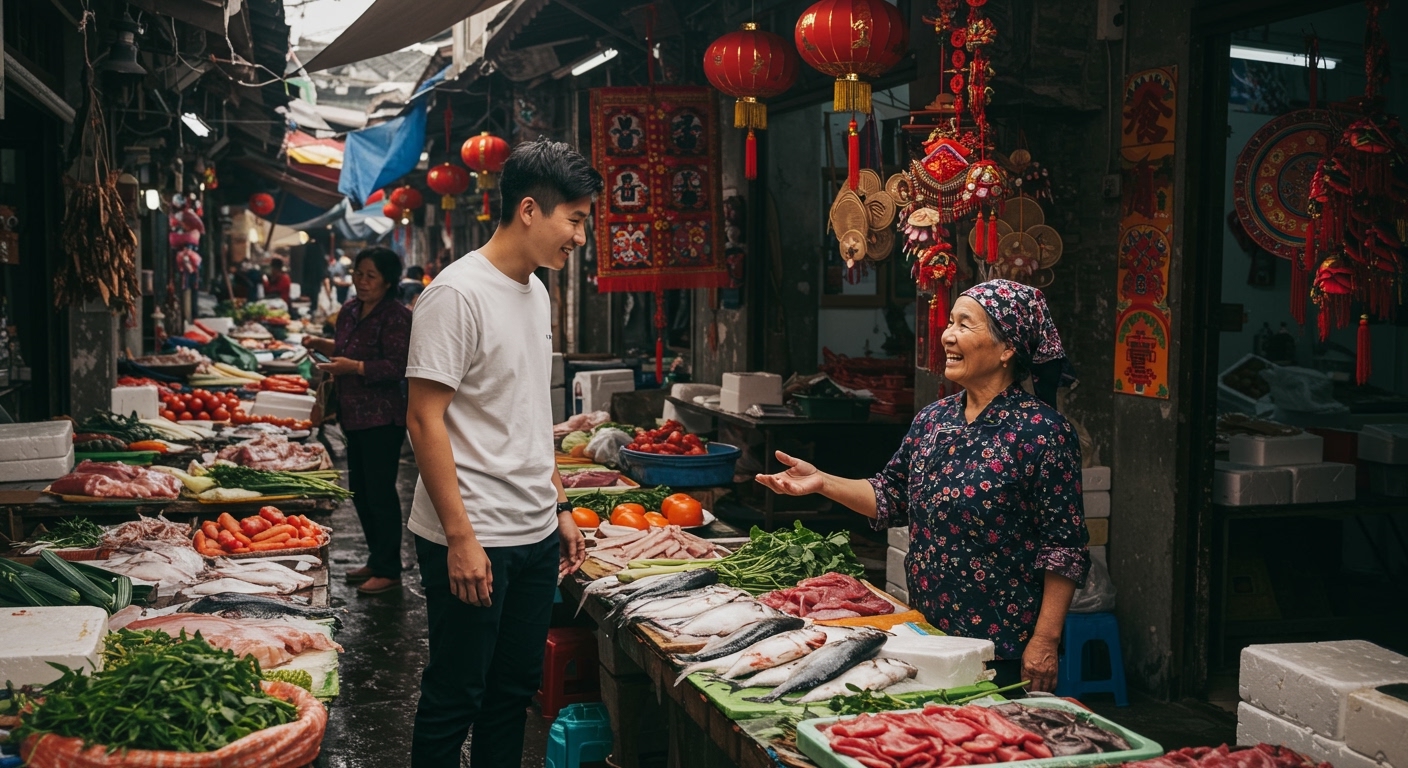
In both China and Singapore, government policies have historically promoted Mandarin as the language of education and upward mobility. This has created a “language gap” where Hokkien is relegated to the home or the wet market.
Digital Revival and Media
There is a silver lining. Taiwanese dramas (Hokkien-language soap operas) are massive hits in Vietnam, Malaysia, and China. Additionally, the rise of Hokkien Pop (Hok-kien-oē li流行 go̍k) on platforms like TikTok and YouTube has sparked interest among younger people wanting to reconnect with their heritage.
Step-by-Step: How to Connect with the Hokkien Speaking World
If you want to contribute to the growth of how many Hokkien speakers there are, or simply want to learn, follow these steps:
- Identify the Accent: Decide if you want to learn Taiwanese (standard for media) or Penang Hokkien (if traveling to SE Asia).
- Use Specialized Apps: Apps like Glossika or Ling offer specific Southern Min/Hokkien modules.
- Consume Media: Watch Taiwanese “Eight-O’Clock” dramas. Even with subtitles, you will begin to pick up the 8-tone cadence.
- Join Community Forums: Platforms like Reddit’s r/Hokkien or Facebook groups for “Overseas Chinese” are excellent for practicing colloquialisms.
Frequently Asked Questions (FAQ)
Is Hokkien the same as Cantonese?
No. While both are Southern Chinese languages, they are entirely different. Cantonese is spoken in Guangdong and Hong Kong, while Hokkien originates in Fujian. They are not mutually intelligible.
What is the most common name for Hokkien?
In mainland China, it is called Minnanhua. In Taiwan, it is Taiwanese. In Southeast Asia, it is simply called Hokkien.
Can Hokkien speakers understand Teochew?
Yes, to a degree. Hokkien and Teochew share about 50-70% similarity. A Hokkien speaker can usually understand the “gist” of a Teochew conversation, similar to a speaker of Portuguese understanding Spanish.
Is Hokkien a dying language?
While the number of fluent speakers is declining in urban centers, the sheer volume of 50 million speakers ensures it is not at risk of extinction in the near future. However, it is considered “vulnerable” by linguistic experts due to the lack of formal education in the language.
Where is the “purest” Hokkien spoken?
Historically, Quanzhou and Zhangzhou are considered the “prestige” sources. Modern Xiamen (Amoy) dialect is often cited as the standard “bridge” between the two, and it serves as the basis for most dictionaries.
**
**
**
**