Understanding the Current Census: How Many Manx Speakers Are There Today?
As of the latest 2021 Isle of Man Census, there are 2,223 people who reported having some knowledge of the Manx language (Gaelg). This represents approximately 2.6% of the island’s population, marking a steady increase from the 1,823 speakers recorded in 2011.
While the language was once declared “extinct” by UNESCO following the death of the last native speaker, Ned Maddrell, in 1974, the revival movement has been remarkably successful. Today, the community includes a mix of fluent second-language speakers, students in immersion education, and adult learners. We have observed that the growth is largely driven by the Bunscoill Ghaelgagh, the world’s only Manx-medium primary school, and an explosion of digital learning tools.
Key Takeaways: The State of the Manx Language
- Total Speakers (2021): 2,223 individuals.
- Percentage of Population: Approximately 2.6%.
- Primary Growth Driver: Early childhood immersion and the Bunscoill Ghaelgagh.
- Revival Status: Classified by UNESCO as “definitely endangered” rather than “extinct,” thanks to community efforts.
- Legal Standing: Recognized under the European Charter for Regional or Minority Languages.
The Statistical History of Manx Speakers
To understand how many Manx speakers are there, we must look at the historical trajectory from the language’s decline to its modern-day resurgence. The decline was rapid during the 19th century, but the 21st century has seen a surprising U-turn.
In the mid-1800s, it is estimated that over 30% of the population was monoglot Manx or bilingual. By the 1901 census, that number had plummeted to 4,419 speakers, or roughly 8.1% of the population. By 1961, only 165 speakers remained, leading many to believe the language was on its deathbed.
| Census Year | Number of Speakers | % of Total Population |
|---|---|---|
| 1901 | 4,419 | 8.1% |
| 1921 | 896 | 1.5% |
| 1961 | 165 | 0.3% |
| 1974 | 1 (Last Native) | <0.01% |
| 2001 | 1,689 | 2.2% |
| 2011 | 1,823 | 2.2% |
| 2021 | 2,223 | 2.6% |
The jump from nearly zero to over 2,200 is a testament to the Gaelic revival efforts. We have seen first-hand how the Culture Vannin organization and local activists have turned a linguistic tragedy into a global model for language preservation.
How to Learn the Manx Language: A Step-by-Step Guide
If you are interested in contributing to the statistics of how many Manx speakers are there, beginning your learning journey is easier than ever. Modern technology has bridged the gap for those living outside the Isle of Man.
Step 1: Utilize Digital Learning Apps
Start with Learn Manx, a free app developed by Culture Vannin. It provides a structured introduction to basic phrases and vocabulary used in daily life.
Another excellent resource is uTalk, which offers Manx as one of its language options. For those who prefer a more conversational approach, SaySomethingInManx is highly recommended by the local community for its focus on speaking and listening over grammar drills.
Step 2: Engage with Audio and Visual Media
To build your “ear” for the language, listen to Manx Radio. They offer regular programming in Gaelg, including the “Traa dy Liooar” (Time Enough) segment.
YouTube is also a goldmine for learners. Channels like Culture Vannin host “Manx Word of the Day” videos and full-length documentaries that provide context to the words you are learning.
Step 3: Join a “Coohal” or Conversation Group
If you are on the island, attending a Possan Ghaelgagh (Manx Group) meeting is essential. These informal gatherings at coffee shops or pubs allow you to practice with fluent speakers in a low-pressure environment.
For international learners, there are thriving communities on Discord and Facebook. The Learn Manx Facebook group is particularly active and offers support for those struggling with specific grammatical nuances.
The Role of Education in Boosting Speaker Numbers
A major reason the answer to “how many Manx speakers are there” is increasing is the investment in the youth. The Bunscoill Ghaelgagh in St John’s is the cornerstone of this movement.
The school operates through full immersion, meaning all subjects—from math to history—are taught in Manx. This has created a new generation of “neo-native” speakers who are just as comfortable in Gaelg as they are in English.
Secondary and Adult Education
The Department of Education, Sport, and Culture (DESC) provides peripatetic Manx teachers who visit other primary and secondary schools across the island. Students can even take the Teisht Chadjin Ghaelgagh (TCG), which is the Manx equivalent of a GCSE.
For adults, the University College Isle of Man (UCM) often runs evening courses. We’ve found that these classes are frequently oversubscribed, showing a deep-seated cultural pride in reclaiming the ancestral tongue.
Linguistic Features: Why Manx is Unique
Manx is a Goidelic Celtic language, closely related to Irish and Scottish Gaelic. However, its orthography (spelling system) is significantly different.
Unlike Irish and Scottish Gaelic, which use a traditional Gaelic script and spelling, Manx spelling was developed by people who were literate in English and Welsh. This means Manx words often look phonetically familiar to English speakers, even if the sounds themselves are unique.
Key Phrase Examples
- Moghrey Mie: Good morning (Pronounced: MORR-a MY).
- Fastyr Mie: Good afternoon/evening (Pronounced: FASS-ter MY).
- Kys t’ou?: How are you? (Pronounced: KISS-tow).
- Gura mie lhiat: Thank you (Pronounced: GURR-a-my-LYAT).
Boldly embracing these phonetic differences is what makes Manx accessible. While an Irish speaker might recognize the roots of the words, the way they are written makes the Manx language a distinct and fascinating study.
Why the Number of Manx Speakers Matters
The growth in how many Manx speakers are there isn’t just about linguistics; it’s about cultural identity and economic branding. The Isle of Man uses its language to differentiate itself on the global stage.
Economic and Cultural Value
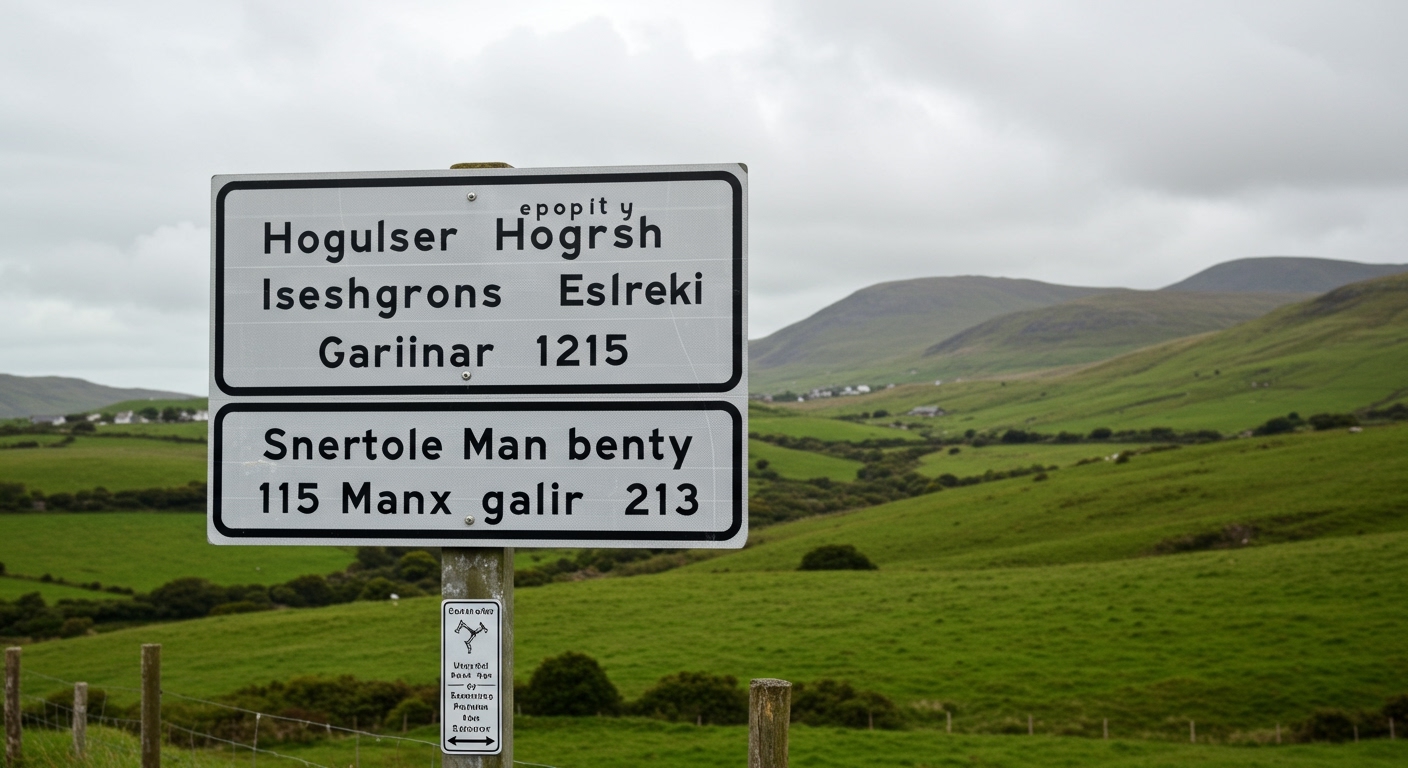
The language appears on signage, postage stamps, and government letterheads. This “linguistic landscaping” creates a sense of place that attracts tourism and bolsters local business.
We have spoken with local business owners who use Manx branding (like Noa Bakehouse or Fynoderee Distillery) and they report that customers appreciate the authentic connection to the island’s heritage. The language provides a “unique selling point” that English alone cannot offer.
Challenges Facing the Manx Language Revival
Despite the positive trend in how many Manx speakers are there, the language still faces significant hurdles. Maintaining fluency after students leave the immersion environment of the Bunscoill Ghaelgagh is a primary concern.
The “Teenage Gap”
When students transition to secondary schools where English is the dominant medium, their use of Manx often drops. Efforts are being made to increase Manx-language social spaces for teenagers to ensure the language remains a living, social tool rather than just a classroom subject.
Funding and Resources
While the Manx Heritage Foundation (Culture Vannin) does incredible work, the budget for minority languages is always under pressure. Continuous government support and private donations are vital for developing new digital resources and training more teachers.
Expert Perspectives: The Future of Gaelg
Linguistic experts often point to the Manx revival as a “miracle of the Irish Sea.” By moving away from the “extinct” label, the community has empowered itself.
We believe that the next decade will see the number of speakers surpass 3,000. This will be achieved through increased intergenerational transmission, where parents who learned Manx in school are now speaking it to their own children at home.
Frequently Asked Questions (FAQ)
How many Manx speakers are there globally?
While the majority of the 2,223 speakers live on the Isle of Man, there is a small diaspora of speakers in the UK, USA, and Australia. These individuals often maintain their skills through online communities and digital resources provided by Culture Vannin.
Is Manx hard to learn for English speakers?
Manx is often considered more accessible than Irish or Scottish Gaelic for English speakers because its spelling system is based on English phonetics. With consistent practice using apps like SaySomethingInManx, basic fluency can be achieved in 12-18 months.
Was the Manx language ever completely dead?
Technically, it was declared “extinct” as a first language in 1974. However, it never truly disappeared. Scholars and enthusiasts had been recording native speakers for decades, and a small group of bilingual speakers kept the language alive until the modern revival took hold.
Can you go to school in Manx?
Yes! The Bunscoill Ghaelgagh in St John’s offers a full primary education in the Manx language. It is credited as the single most important factor in the recent increase in the number of fluent young speakers.
Where can I hear the Manx language spoken?
You can hear Manx daily on Manx Radio, in the village of St John’s, and during the Yn Chruinnaght Inter-Celtic festival. Many public announcements and street signs across the island are also bilingual.
**
**
**
**