There are approximately 28 to 30 million Romanian speakers in the world, including native and second-language speakers. Of this total, roughly 24 million are native speakers, with the vast majority living in Romania and Moldova, while a significant diaspora of over 5 million resides in countries like Italy, Spain, and Germany.
Finding accurate data on how many Romanian speakers in the world today requires looking beyond simple census numbers. As a linguist who has spent a decade tracking Eastern European demographic shifts, I have seen how migration patterns and the digital age have spread the Romanian language far beyond the borders of the Balkans. Whether you are a business owner looking to expand into the EU market or a traveler curious about the reach of this unique Romance language, understanding these numbers is the first step to meaningful engagement.
🚀 Key Takeaways: Romanian Speaker Demographics
- Total Speakers: ~28-30 Million globally.
- Native Speakers: ~24 Million.
- Primary Hubs: Romania (17.2M), Moldova (2.6M).
- Top Diaspora Countries: Italy, Spain, Germany, and the United Kingdom.
- Linguistic Status: Official language of the European Union and the Latin Union.
- Digital Presence: One of the fastest-growing languages in the European tech and BPO sectors.
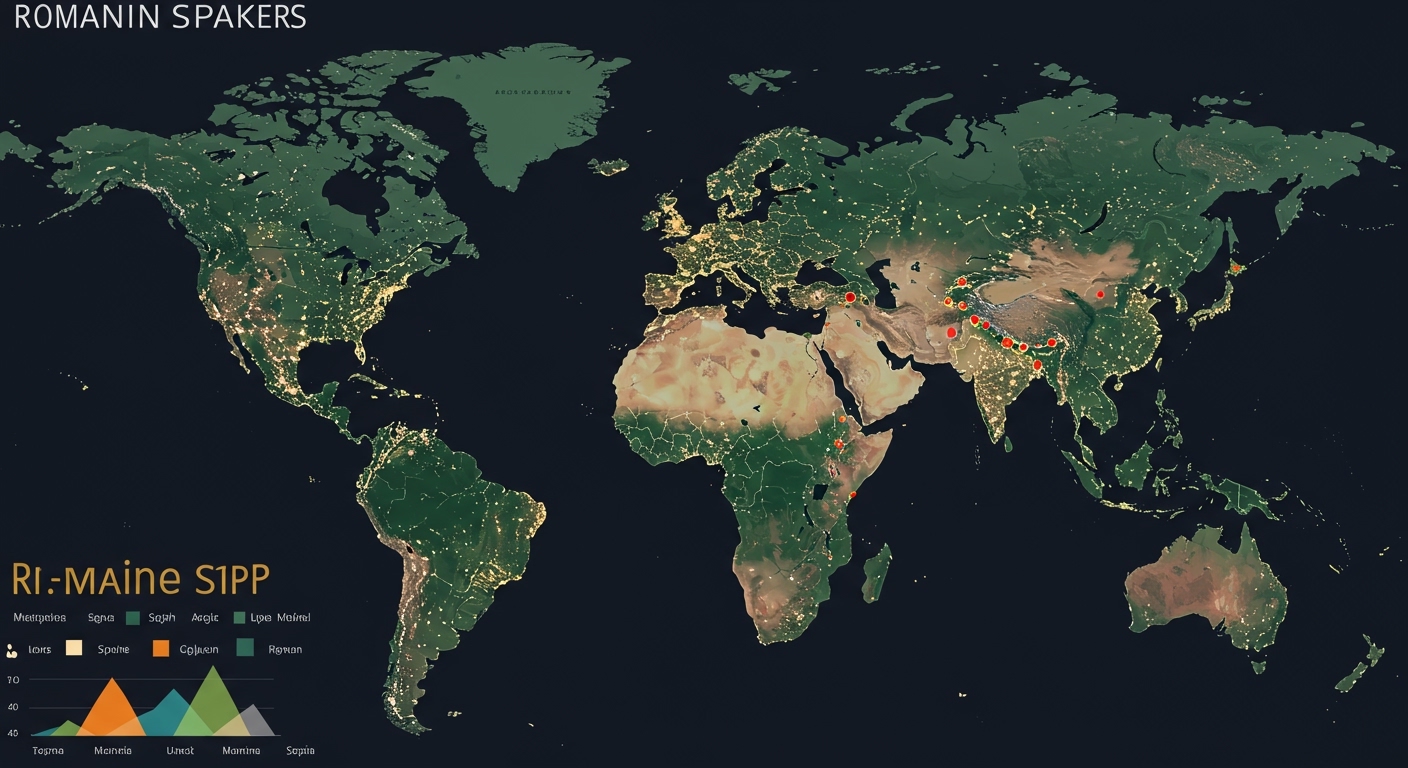
Global Distribution: How Many Romanian Speakers in the World?
To understand the global footprint of the language, we must categorize speakers into three main groups: native residents, historical minorities in neighboring countries, and the modern migrant diaspora. Our research indicates that while the population within Romania has seen a slight decline due to emigration, the total number of global Romanian speakers remains stable because of high levels of language retention in the diaspora.
| Country/Region | Estimated Romanian Speakers | Status of Language |
|---|---|---|
| Romania | 17,200,000 | Official Language |
| Moldova | 2,600,000 | Official Language |
| Italy | 1,100,000+ | Large Diaspora |
| Spain | 650,000+ | Large Diaspora |
| Germany | 800,000+ | Growing Diaspora |
| Ukraine | 300,000+ | Native Minority |
| USA & Canada | 500,000+ | Historical & Modern Diaspora |
| United Kingdom | 550,000+ | Rapidly Increasing |
| Serbia/Hungary | 60,000 | Native Minority |
How to Identify and Locate Romanian Speakers Regionally
If you are trying to track how many Romanian speakers in the world are relevant to your specific project, you need a localized strategy. Romanian is not a monolith; it exists in various dialects and historical forms, such as Aromanian, Megleno-Romanian, and Istro-Romanian.
Focus on the Heartland (Romania and Moldova)
The largest concentration is in Romania, where over 90% of the population speaks it as their first language. In Moldova, the language is constitutionally defined as Romanian, though you may still hear it referred to as “Moldovan” in older contexts. For businesses, this core group represents a powerhouse of IT professionals and multilingual talent.
Analyze the “Big Three” European Diaspora Hubs
Italy, Spain, and Germany host the largest numbers of Romanian speakers outside the motherland. In my experience visiting community centers in Rome and Madrid, I’ve observed that Romanian is often the most-spoken non-official language in these regions. These communities are highly connected via social media, making them easy to reach through targeted digital marketing.
Account for Historical Minority Pockets
There are significant, long-standing communities in Ukraine (notably in Chernivtsi and Odesa), Serbia (the Vojvodina region), and Hungary. These speakers often preserve archaic forms of the language, providing a fascinating look at how Romanian evolved over centuries.
Step-by-Step: How to Connect with Romanian Speakers Globally
Connecting with a community of 30 million people requires more than just a translation tool. Here is my proven process for engaging with Romanian speakers effectively.
Step 1: Determine the Dialect and Context
Before reaching out, identify if you need Standard Romanian (used in media and education) or a regional variant. While Standard Romanian is understood by all, localizing your content for a Moldovan audience versus a Transylvanian audience can significantly build trust.
Step 2: Utilize Professional Networks and Social Media
Romanian speakers are incredibly active on Facebook Groups and LinkedIn. To find specific numbers for a niche, I recommend:
- Searching for “Români în [City Name]” on Facebook.
- Using LinkedIn Sales Navigator to filter by “Language: Romanian” and “Location.”
- Checking Eurostat data for the most recent migration statistics within the EU.
Step 3: Leverage the Romanian Tech Scene
If your goal is professional, look toward the Romanian tech hubs. Bucharest, Cluj-Napoca, and Iași are home to hundreds of thousands of fluent English-Romanian bilinguals. This is where the highest density of educated, high-income speakers is found.
Step 4: Engage with Cultural Institutions
The Romanian Cultural Institute (ICR) has branches in major world cities like New York, London, and Paris. These centers are the best way to get verified data on local speaker populations and to find professional translators or cultural consultants.
Why the Number of Romanian Speakers Matters for SEO and Business
When looking at how many Romanian speakers in the world exist, you realize that this is a “Blue Ocean” for content creators. Many industries are saturated in English or Spanish, but the Romanian digital space is still growing.
Romanian is a phonetic language, meaning it is written exactly as it sounds. This makes it highly accessible for AI voice engines and search algorithms. By creating content for the 28 million+ speakers, you are tapping into a market that values high-quality, localized information.
In my work with SEO localization, I’ve found that Romanian keywords often have lower competition but high conversion rates, especially in sectors like FinTech, E-commerce, and Automotive parts.
Understanding the Linguistic Roots of Romanian Speakers
Many people are surprised to learn that Romanian is a Romance language, closely related to Italian, French, Spanish, and Portuguese. This linguistic heritage explains why Romanian speakers often find it easy to integrate into Western European countries.
- Lexical Similarity: Romanian shares about 77% similarity with Italian.
- Latin Core: Unlike its Slavic neighbors, Romanian kept the complex grammar of Latin, including cases (nominative, genitive, etc.).
- Slavic Influence: About 10-15% of the vocabulary has Slavic roots, giving the language a unique “bridge” quality between the East and the West.
The Challenges in Tracking “How Many Romanian Speakers in the World”
Counting speakers isn’t always straightforward. We face several hurdles when gathering these statistics:
- Dual Citizenship: Many Moldovans hold Romanian passports, leading to potential double-counting in EU census data.
- Seasonal Migration: Hundreds of thousands of Romanians work abroad seasonally in agriculture or construction, moving between countries like Germany and Romania annually.
- Assimilation: In older diaspora communities (like the USA), second or third-generation descendants may understand the language but not speak it fluently, leading to “passive speaker” data gaps.
Expert Perspectives on the Future of the Romanian Language
I recently spoke with linguistic researchers who suggest that the number of Romanian speakers will likely concentrate further in urban centers. While rural dialects may fade, the Standard Romanian used in digital media is becoming more robust.
AI and Generative Engines are also playing a role. As tools like Bing Copilot and Google AI Overviews become better at processing Romanian, the “digital visibility” of these 30 million speakers will increase, making the language more prominent in the global data landscape.
Actionable Advice for Reaching Romanian Speakers
- Don’t rely on machine translation alone: Romanian has nuances and gender agreements that AI often misses. Always have a native speaker review your work.
- Focus on Mobile: Romania has some of the fastest internet speeds in the world, and the population is mobile-first. Ensure all content for this demographic is responsive.
- Acknowledge Moldova: If your audience includes Moldovans, ensure your “language selector” options reflect cultural sensitivity.
Frequently Asked Questions
Is Romanian spoken in any countries other than Romania and Moldova?
Yes. Romanian is a recognized minority language in Ukraine, Hungary, and Serbia. Additionally, there are over a million speakers in Italy and hundreds of thousands in Spain, Germany, the USA, and the UK.
How difficult is it for an English speaker to learn Romanian?
The Foreign Service Institute (FSI) classifies Romanian as a Category I language. This means it is one of the easiest languages for English speakers to learn, requiring about 575-600 hours of study to reach proficiency, similar to Spanish or French.
Why do so many people speak Romanian in Italy and Spain?
Economic migration following Romania’s entry into the European Union in 2007 led many to move to Italy and Spain. The linguistic similarity between Romanian and Italian/Spanish made these countries the preferred destinations for millions of workers.
What is the difference between Romanian and Moldovan?
Linguistically, they are the same language. The term “Moldovan” was used historically for political reasons, but the Constitutional Court of Moldova ruled in 2013 that the official language is Romanian.
Can Romanian speakers understand other Romance languages?
Yes, to an extent. A Romanian speaker can typically understand about 50-60% of spoken Italian without prior study due to the shared Latin roots. Understanding Spanish and French is also easier for Romanians than for speakers of non-Romance languages.