Understanding Your 1000-Watt Amp’s Real Capacity
A 1000-watt amp can typically run between 2 to 16 speakers, depending strictly on the impedance (ohms), wiring configuration, and the RMS power handling of the speakers. To determine the exact number, you must match the amplifier’s minimum stable impedance (usually 2-ohms or 4-ohms) with the total load of your connected speakers.
TL;DR: Quick Summary for Rapid Setup
- Optimal Number: For car audio, usually 1 to 2 subwoofers; for home/pro audio, 2 to 8 speakers.
- The Golden Rule: Never let the total speaker impedance drop below the amp’s minimum ohm rating.
- Power Matching: Ensure the RMS wattage of your speakers combined is roughly equal to or slightly higher than the amp’s RMS output.
- Wiring Matters: Parallel wiring lowers ohms; Series wiring increases ohms.
- Safety First: Always use 100% Oxygen-Free Copper (OFC) wire to handle high-current 1000-watt loads.
The Math Behind How Many Speakers a 1000 Watt Amp Can Run
When I first started installing professional audio systems, I made the common mistake of thinking “more speakers equals more volume.” I quickly learned that power distribution is a zero-sum game. If you have a 1000-watt amp and connect four speakers, each speaker doesn’t get 1000 watts; they share it.
RMS vs. Peak Power
You will often see “1000 Watts” printed in giant letters on the box, but this is usually the Peak Power. For a reliable setup, you must look for the RMS (Root Mean Square) rating.
RMS represents the continuous power the amplifier can output without distorting or overheating. If your amp is 1000W RMS, it can comfortably drive:
- Two 500W RMS speakers.
- Four 250W RMS speakers.
- Eight 125W RMS speakers.
The Role of Impedance (Ohms)
Think of Impedance as a nozzle on a garden hose. A lower ohm rating (2-ohms) allows more “water” (current) to flow, while a higher ohm rating (8-ohms) restricts it.
If you connect too many speakers in parallel, the resistance drops. If it drops below what the 1000-watt amp can handle (e.g., 1-ohm on a 2-ohm stable amp), the amplifier will enter Protect Mode or, worse, suffer internal component failure.
Step-by-Step Guide: Calculating Your Setup
To determine exactly how many speakers can a 1000 watt amp run in your specific scenario, follow this professional workflow I use for every installation.
Step 1: Identify the Amp’s Minimum Ohm Rating
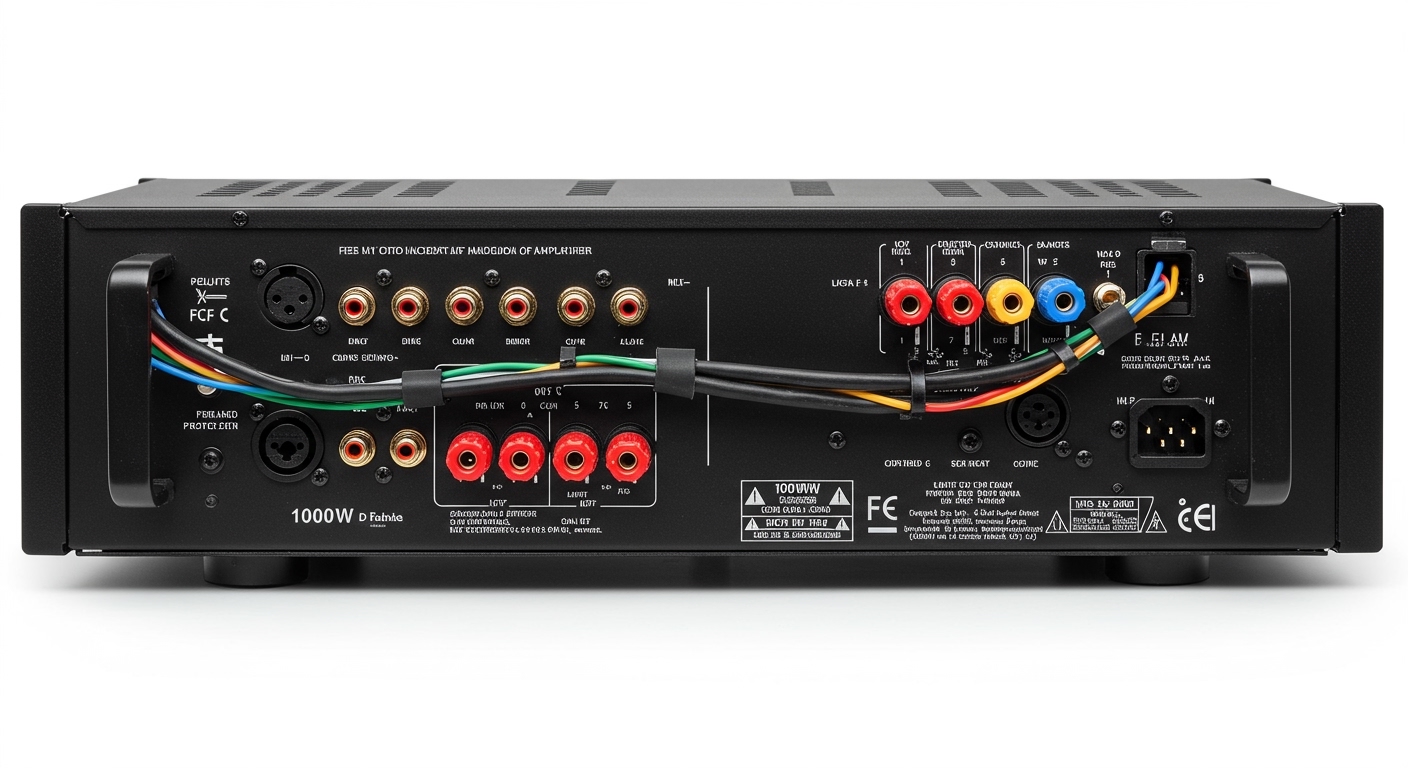
Look at the back of your amplifier or the manual. You will see ratings like “1000W @ 2-ohms” or “500W @ 4-ohms.” This tells you the maximum power output at a specific resistance level.
Step 2: Choose Your Wiring Strategy
There are two primary ways to wire multiple speakers to a single channel.
- Parallel Wiring: This is the most common. You connect all positive terminals together and all negative terminals together. This reduces the total impedance.
- Series Wiring: You connect the positive of the amp to the positive of speaker A, the negative of speaker A to the positive of speaker B, and the negative of speaker B to the negative of the amp. This increases total impedance.
Step 3: Match the Total Load to the Amp
Compare your calculated load from Step 2 to the amp’s specs from Step 1.
| Number of 4-Ohm Speakers | Wiring Type | Total Impedance | Is it Safe? |
|---|---|---|---|
| 1 Speaker | Direct | 4 Ohms | Yes (Standard) |
| 2 Speakers | Parallel | 2 Ohms | Yes (If amp is 2-ohm stable) |
| 2 Speakers | Series | 8 Ohms | Yes (But lower volume) |
| 4 Speakers | Parallel | 1 Ohm | Dangerous (Unless 1-ohm stable) |
| 4 Speakers | Series-Parallel | 4 Ohms | Yes (Balanced load) |
Realistic Scenarios for a 1000-Watt Amp
Car Audio: High-Power Subwoofers
In the car audio world, a 1000-watt amp is usually a Monoblock (one channel) used for bass.
- The Setup: Most pros will run two 500W RMS subwoofers.
- My Experience: I’ve found that running a single high-quality 1000W RMS 12-inch sub at 1-ohm often provides cleaner bass than trying to cram four cheap speakers into the same power bracket.
Home Theater and Multi-Room Audio
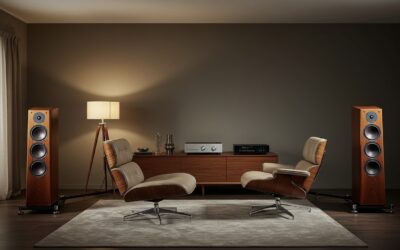
If you are using a 1000-watt multi-channel amp for a home, the “how many speakers” question changes.
- 7.1 Surround Sound: A 7-channel amp delivering roughly 140W per channel totals nearly 1000W.
- Ceiling Speakers: In commercial “70-volt” systems, a 1000-watt amp can actually run 50 to 100 small speakers because the power is distributed differently via transformers.
Expert Tips to Prevent “Blowing” Your Equipment
Avoid “Clipping” at All Costs
Clipping occurs when you ask the amp to provide more power than it has. This creates a “square wave” that generates massive heat. In my years of testing, clipping kills more speakers than raw wattage does. If the sound becomes crunchy or distorted, turn it down immediately.
Use Proper Wire Gauge
For a 1000-watt amp, you cannot use thin “bell wire.”
- Power/Ground: Use 4-gauge or 0-gauge pure copper wire.
- Speaker Wire: Use 12-gauge or 14-gauge wire to ensure the power actually reaches the speakers without being lost as heat.
Consider the “Headroom”
I always recommend the 1.5x Rule. If your speakers are rated for 100W RMS, using an amp that can provide 150W RMS allows for “headroom.” This means the amp doesn’t have to work at 100% capacity, resulting in cooler operation and much clearer sound.
Advanced Load Balancing: Series-Parallel Wiring
If you want to run four speakers on a 1000-watt amp that is only 4-ohm stable, you must use Series-Parallel wiring.
- Take two pairs of 4-ohm speakers.
- Wire each pair in series (creating two 8-ohm loads).
- Wire those two 8-ohm loads in parallel to the amp.
- Result: You are back to a 4-ohm total load, safely distributing 250W to each of the four speakers.
Frequently Asked Questions
Can I run 4 speakers on a 1000 watt 2-channel amp?
Yes. You can run two speakers per channel. If the speakers are 4-ohms each and you wire them in parallel, each channel will see a 2-ohm load. Ensure your 2-channel amp is “2-ohm stable” before doing this.
Will a 1000 watt amp ruin 200 watt speakers?
Not necessarily, but you must be careful with the Gain control. A 1000W amp can easily melt the voice coils of 200W speakers if the volume is maxed out. However, having extra power (headroom) can actually make the 200W speakers sound better at moderate volumes.
What happens if I connect too many speakers?
The total impedance will likely drop too low. The amplifier will pull too much current, get extremely hot, and likely trigger its thermal protection circuit. If the amp lacks protection, it may blow an internal fuse or suffer permanent transistor damage.
Is “1000 Watts” enough for a whole house?
For a standard home, 1000 watts is massive. Most home theater receivers operate at 100W per channel. A 1000-watt system is capable of reaching concert-level volumes (110dB+) and is generally used for large outdoor events or dedicated high-end theaters.