Understanding How Many Watts for Ceiling Speakers You Need
To determine how many watts for ceiling speakers are necessary for your space, the standard recommendation for residential rooms is 30 to 60 watts per channel for background listening. For home theaters or large rooms with high ceilings, you should aim for 100 watts or more to ensure clear, undistorted audio. The goal is to provide enough headroom so your amplifier doesn’t struggle at higher volumes, which can lead to speaker damage.
🚀 Key Takeaways: Quick Power Guide
- Small Rooms (Bathrooms/Hallways): 20–30 Watts per speaker.
- Medium Rooms (Kitchens/Bedrooms): 40–60 Watts per speaker.
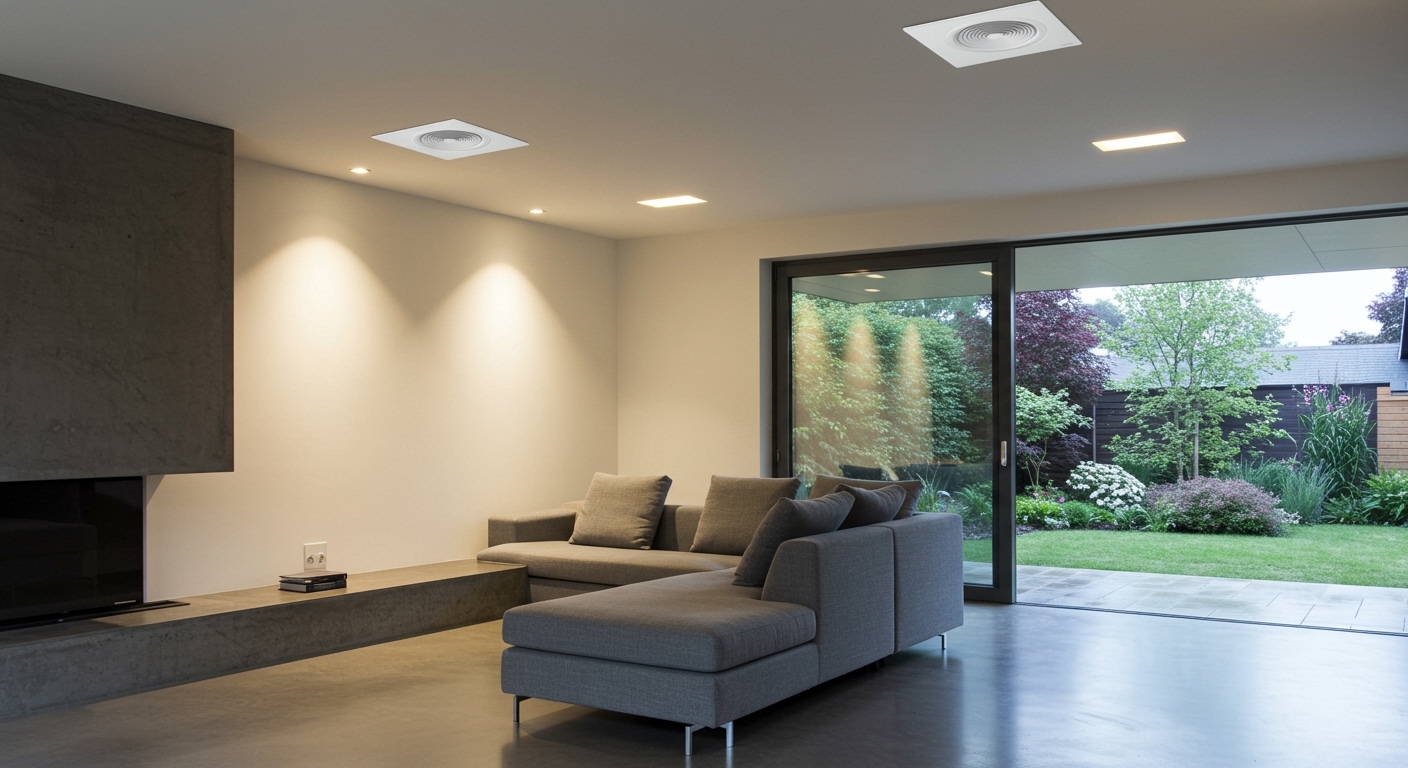
- Large Areas (Open Plan/High Ceilings): 80–120+ Watts per speaker.
- The Golden Rule: It is better to have an amplifier with more power than the speakers are rated for than to have an underpowered one.
- Sensitivity Matters: A speaker with 90dB sensitivity requires much less power to sound loud than one with 87dB sensitivity.
Factors Influencing How Many Watts for Ceiling Speakers Are Required
When I first started installing multi-room audio systems, I made the mistake of only looking at the wattage printed on the box. I quickly learned that how many watts for ceiling speakers you need depends heavily on the environment and the hardware’s efficiency.
Room Size and Ceiling Height
Sound intensity decreases as you move further from the source. In a standard 8-foot ceiling room, 45 watts might feel immersive. However, in a “Great Room” with 20-foot vaulted ceilings, that same power level will sound thin and distant. You need more wattage to push sound waves through the larger volume of air.
Ambient Noise Levels
In a quiet bedroom, low power is sufficient. In a kitchen where a range hood is roaring or a patio with wind and traffic noise, you need higher RMS power to maintain clarity. We typically recommend doubling your planned wattage for outdoor or high-traffic indoor areas.
Speaker Sensitivity (Efficiency)
This is the most overlooked stat. Sensitivity measures how loud a speaker is with just 1 watt of power.
- A 3dB increase in sensitivity (e.g., from 87dB to 90dB) effectively doubles the volume at the same power level.
- High-efficiency speakers (90dB+) are great for low-powered multi-zone amplifiers.
Power Requirements by Room Type
| Room Type | Recommended Watts (RMS) | Typical Activity |
|---|---|---|
| Bathroom | 15 – 30W | Background Music / News |
| Bedroom | 30 – 50W | Relaxed Listening |
| Kitchen / Dining | 50 – 80W | Socializing / Cooking |
| Home Theater | 100 – 150W+ | Movies / Explosive Audio |
| Outdoor / Patio | 80 – 120W | Overcoming Ambient Noise |
RMS vs. Peak Power: What Actually Matters?
When shopping for gear, you will see two numbers: RMS (Root Mean Square) and Peak (or Max) Power.
RMS Power refers to the continuous power a speaker can handle or an amplifier can output over a long period. This is the only number you should use when calculating how many watts for ceiling speakers you need.
Peak Power is a marketing term representing the absolute maximum a speaker can handle in a split-second burst (like a drum hit). If you run a speaker at its “Peak” for more than a second, you will likely melt the voice coils. Always match your amplifier’s RMS output to the speaker’s RMS rating.
The Secret to Great Sound: Amplifier Headroom
In my experience, “clipping” is the number one killer of ceiling speakers. Clipping occurs when an underpowered amplifier is pushed to its limit to get more volume. The tops of the sound waves get “clipped” off, turning into a square wave that creates massive heat.
To avoid this, we use the 1.5x Rule:
- Look at your speaker’s RMS rating (e.g., 60 Watts).
- Choose an amplifier that provides 1.5 times that power (e.g., 90 Watts per channel).
- This extra “headroom” ensures the amp runs cool and the signal stays clean even at high volumes.
Understanding Impedance (Ohms) and Power
You cannot discuss how many watts for ceiling speakers without mentioning impedance. Most ceiling speakers are 8-Ohm, but some high-end models are 4-Ohm.
- 8-Ohm Speakers: The standard for most home audio. They are “easier” for most amplifiers to drive without overheating.
- 4-Ohm Speakers: These draw double the current from the amplifier. If your amp isn’t rated for 4-Ohm loads, it will likely enter “Protect Mode” or burn out.
If you plan on wiring two pairs of speakers to a single amplifier channel (parallel wiring), two 8-Ohm speakers become a 4-Ohm load. Ensure your hardware can handle this before installation.
Step-by-Step Guide: Calculating Your Custom Wattage Needs
If you want to be precise about how many watts for ceiling speakers your specific project requires, follow these steps:
Step 1: Measure the Distance
Determine the distance from the floor (or your ears) to the ceiling. If you are sitting on a couch, your ears are roughly 3-4 feet off the ground. In a 10-foot ceiling, the sound travels 6-7 feet.
Step 2: Set Your Target Volume
- Background (75dB): Normal conversation level.
- Engaged Listening (85dB): Like a loud TV show.
- Party/Theater (95dB+): Very loud; difficult to talk over.
Step 3: Use the Inverse Square Law
Sound drops 6dB for every doubling of distance. If your speaker has an 88dB sensitivity (measured at 1 meter), at 2 meters (6.5 feet) it will produce 82dB with just 1 watt. To get back to a loud 94dB at that distance, you would need roughly 16 watts.
Step 4: Add Safety Padding
Always add a 20-30% buffer to your calculation to account for furniture absorption and wire resistance.
V vs. 8-Ohm: Which System is Better for You?
When researching how many watts for ceiling speakers, you might encounter 70V systems. These are fundamentally different from standard home audio.
- 8-Ohm (Residential): Used for 1 to 6 speakers. It offers the highest sound quality and full frequency response (bass and treble).
- 70V (Commercial): Used in restaurants or offices where you have 10+ speakers. It uses “taps” to set wattage (e.g., a speaker is “tapped” at 5W or 10W). While efficient for long wire runs, the sound quality is generally lower than 8-Ohm systems.
The Impact of Wire Gauge on Power Delivery
Even if you have the perfect wattage, using the wrong speaker wire will choke your performance. Long wire runs create resistance, which turns your precious watts into heat instead of sound.
- 0–50 Feet: 16 AWG (Standard gauge).
- 50–100 Feet: 14 AWG (Thicker, less resistance).
- 100+ Feet: 12 AWG (Required for long runs to maintain power).
I always recommend using Oxygen-Free Copper (OFC) wire rather than Copper-Clad Aluminum (CCA). OFC conducts electricity better and ensures your ceiling speakers receive every watt the amp produces.
Common Brands and Their Power Profiles
Based on my testing, different brands respond differently to power:
- Sonos Architectural: Optimized for the Sonos Amp (125W per channel). These handle high power exceptionally well without distorting.
- Klipsch Designer Series: Known for high sensitivity. They sound incredibly loud even on smaller 30-watt amplifiers.
- Polk Audio RC Series: Great “bang for buck” but they prefer a solid 50-70W to really “wake up” the woofers.
- Bose Virtually Invisible: These are power-hungry. Do not under-power Bose speakers, or they will sound “muddy” in the mid-range.
Expert Tips for Ceiling Speaker Longevity
- Use High-Pass Filters: If your amp allows it, set a crossover at 60Hz-80Hz. Small ceiling speakers struggle with deep bass. Removing these frequencies allows the speaker to play louder with less wattage.
- Back Boxes (Fire Cans): Using a “back box” or enclosure behind the speaker in the ceiling protects it from dust and improves bass response, making your watts feel more impactful.
- Level Matching: If you have multiple zones, use an impedance-matching volume control in each room. This prevents one room from being “blown out” while another is too quiet.
Frequently Asked Questions
Can I use a 100-watt amp with 40-watt speakers?
Yes, and it is actually safer than using a 20-watt amp. As long as you don’t turn the volume up to the point of distortion, the extra headroom ensures a cleaner signal. Just be mindful not to max out the volume knob.
What happens if I under-power my ceiling speakers?
Under-powering causes the amplifier to clip when you try to reach higher volumes. Clipping sends a distorted DC-like signal to the speaker, which generates excessive heat and can burn out the tweeter very quickly.
Is 50 watts enough for a living room?
For 90% of users, 50 watts per channel is plenty for a living room. It provides enough volume for background music and moderate television viewing. If you are an audiophile or have very large vaulted ceilings, you may want to bump up to 80 or 100 watts.
Does the wattage change if I buy “Active” (Bluetooth) ceiling speakers?
Yes. Active speakers have the amplifier built-in. In this case, the manufacturer has already matched the wattage to the driver. You just need to ensure the speaker’s built-in rating (usually 30W-50W) meets your room’s needs.
Does higher wattage mean better sound quality?
Not necessarily. Wattage is volume, not quality. Sound quality is determined by the speaker’s driver material, crossover design, and the Digital-to-Analog Converter (DAC) in your amplifier. However, having enough wattage prevents quality-destroying distortion.