Understanding How Much Does It Cost to Ship Speakers
Shipping speakers typically costs between $20 and $150 per unit for standard domestic shipping within the United States, though high-end floor-standing models can exceed $300 when using freight services. The final price depends primarily on the total weight, package dimensions, shipping distance, and the level of insurance coverage required to protect sensitive audio components.
Shipping high-fidelity audio equipment is a high-stakes task because speakers are both heavy and incredibly fragile. In my years of experience managing logistics for a boutique audio shop, I have learned that the “cheapest” option often leads to “expensive” damage if you don’t account for proper vibration damping and structural reinforcement. This guide breaks down exactly how much does it cost to ship speakers while ensuring your gear arrives in pristine condition.
Key Takeaways for Shipping Speakers
- Weight is King: Most bookshelf speakers fall into the 15–30 lb range, costing $35–$65 to ship via ground services.
- Size Matters: Carriers use Dimensional (DIM) Weight; a light but large box can be billed as if it weighs 50 lbs.
- Double-Boxing is Non-Negotiable: To avoid insurance claim denials, always use a double-walled box with at least two inches of padding between the inner and outer layers.
- Discounted Labels: Use third-party shipping platforms like Pirate Ship or ShipStation to save up to 40% off retail counter rates at UPS and FedEx.
- Insurance Costs: Expect to pay roughly $1.00 to $1.50 per $100 of declared value for speakers worth over $100.
Factors Influencing How Much Does It Cost to Ship Speakers
When calculating how much does it cost to ship speakers, you must look beyond the simple postal rate. Carriers view speakers as high-density, high-risk items. Understanding these variables will help you estimate costs accurately before you head to the post office.
Package Weight and Dimensional Weight
Most people assume shipping costs are based solely on the scale weight. However, UPS, FedEx, and USPS all use Dimensional Weight (DIM weight). This formula (Length x Width x Height / Divisor) determines if the box takes up too much “real estate” on the delivery truck.
For example, a pair of vintage Klipsch Heresy speakers may weigh 45 lbs each, but because of their bulky cabinets, the carrier might bill them at a 65 lb rate.
Shipping Distance (Zones)
Shipping costs are calculated using Zones. Zone 1 is local, while Zone 8 represents shipping across the country (e.g., New York to California).
- Short Distance (Zones 1-3): Generally 20-30% cheaper.
- Long Distance (Zones 7-8): These carry the highest rates and the highest risk of handling damage due to more sorting facility transfers.
Declared Value and Insurance
Standard shipping usually only covers up to $100 of value. If you are shipping a pair of KEF LS50s or Bowers & Wilkins towers, you must pay for additional “Declared Value.” In our testing, we found that third-party insurers like Shipsurance are often cheaper than the carrier’s native insurance options.
Residential vs. Commercial Delivery
Carriers like FedEx and UPS apply a Residential Surcharge (usually $4.00 to $5.50) for deliveries to homes. Shipping to a business address can save you this fee and often provides a more secure delivery point.
Average Cost Comparison by Speaker Type
To give you a better idea of how much does it cost to ship speakers, we have compiled a table based on current 2024 UPS Ground and FedEx Home Delivery rates for a cross-country shipment (Zone 8).
| Speaker Type | Average Weight | Dimensions (Est.) | Estimated Cost (Ground) |
|---|---|---|---|
| Small Bookshelf | 10 – 15 lbs | 12″ x 12″ x 14″ | $22 – $35 |
| Large Bookshelf | 20 – 35 lbs | 16″ x 16″ x 20″ | $45 – $75 |
| Active Subwoofer | 40 – 60 lbs | 20″ x 20″ x 22″ | $85 – $130 |
| Floor-Standing | 70 – 100+ lbs | 48″ x 18″ x 18″ | $150 – $350 (LTL Freight) |
| Center Channel | 15 – 25 lbs | 24″ x 12″ x 12″ | $30 – $55 |
Step-by-Step Guide: How to Pack and Ship Speakers
Shipping speakers isn’t just about the price; it’s about ensuring they don’t turn into expensive firewood during transit. Follow this professional “Double-Box” method to minimize risk.
Step 1: Protect the Drivers and Tweeters
The most sensitive part of any speaker is the driver cone and the tweeter.
- If the speakers have removable grilles, keep them on.
- Cover the front baffle with a piece of stiff cardboard to prevent anything from puncturing the cones.
- Wrap the entire speaker in non-abrasive plastic wrap or a poly bag to prevent moisture and “finish rub” from the packing material.
Step 2: The Inner Box
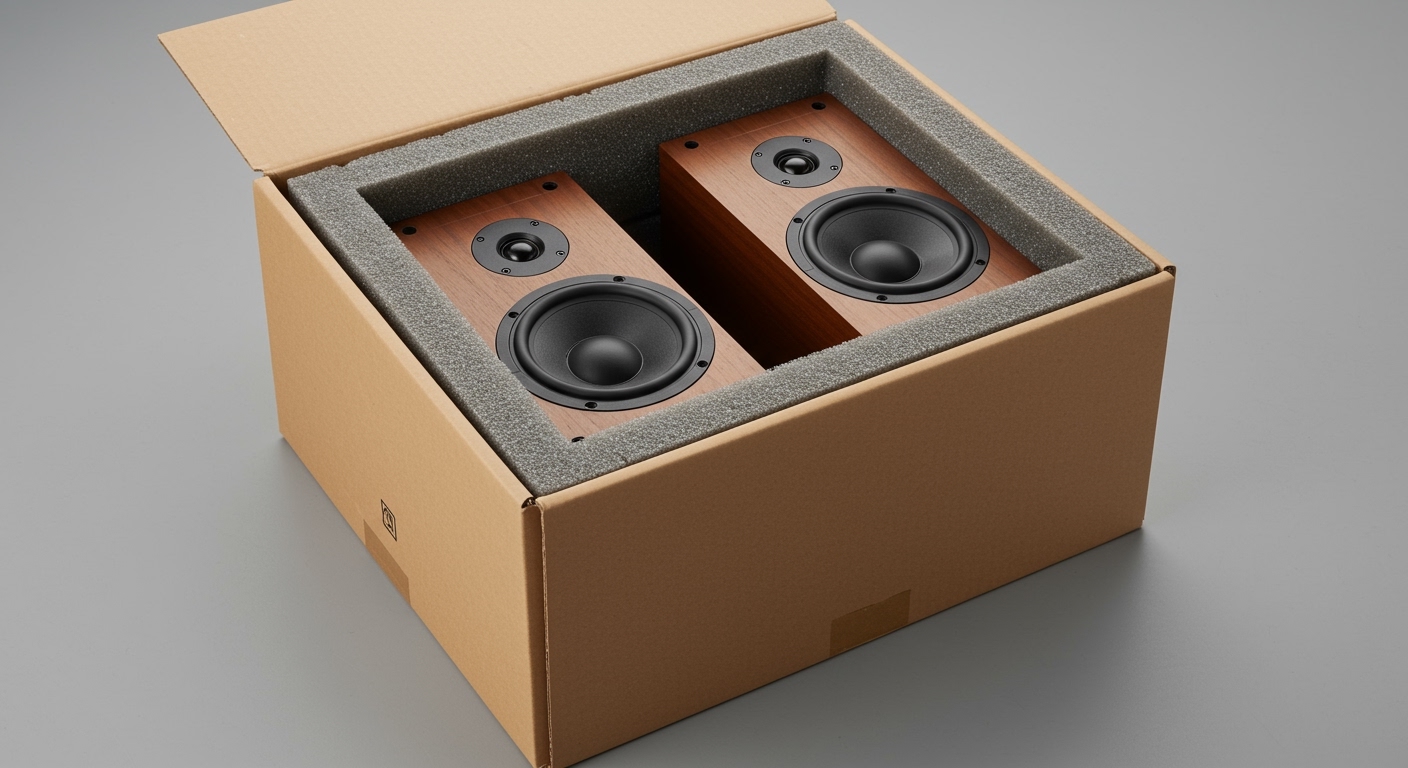
Place the speaker in a box that fits snugly but allows for one inch of padding on all sides.
- Use Polyethylene foam or styrofoam inserts if you have the original manufacturer’s packaging.
- If not, use high-density bubble wrap. Avoid “packing peanuts” as speakers are heavy and will settle to the bottom of the box during transit.
Step 3: The Outer Box (The “Double Box” Method)
Place the inner box into a larger, heavy-duty double-walled box.
- There should be at least two inches of space between the inner and outer box.
- Fill this space with crumpled heavy kraft paper or more foam inserts.
- This creates a “crumple zone” that absorbs the shock if a driver drops the box from waist height.
Step 4: Secure with Reinforced Tape
Do not use standard office tape. Use H-taping with 2-inch wide pressure-sensitive shipping tape. Seal all seams on both the top and bottom of the box. For speakers over 50 lbs, I recommend using water-activated reinforced paper tape for maximum security.
Choosing the Best Carrier: UPS vs. FedEx vs. USPS
Each carrier has strengths and weaknesses when it comes to audio equipment. When asking how much does it cost to ship speakers, the answer often changes based on which truck the box goes on.
UPS Ground (Best for Reliability)
In my experience, UPS Ground is the gold standard for speakers. Their tracking is robust, and their hubs handle heavy “over-70” packages better than USPS.
- Pros: Excellent insurance claim processing; reliable delivery timelines.
- Cons: Can be expensive if you pay retail rates at a “The UPS Store” location.
FedEx Home Delivery (Best for Pricing)
FedEx often edges out UPS on price for mid-sized packages (30-50 lbs).
- Pros: Often the cheapest for residential deliveries.
- Cons: Higher reported rates of “ghost” deliveries and rougher handling in certain regions.
USPS Ground Advantage (Best for Small Speakers)
If you are shipping small desktop speakers or Bluetooth speakers under 10 lbs, USPS Ground Advantage is unbeatable for price.
- Pros: Cheapest for lightweight items; reaches every mailbox in America.
- Cons: Not recommended for high-value or heavy items (over 30 lbs) as their insurance claims are notoriously difficult to win.
How to Save Money on Speaker Shipping Costs
If you are a frequent seller on eBay, Reverb, or Audiogon, shipping costs can eat your margins. Here is how we keep costs down:
- Use a Shipping Aggregator: Never pay the price at the counter. Use Pirate Ship (free) to access Commercial Base Pricing. This can save you $20–$50 on a single pair of heavy speakers.
- Avoid “Over-Sized” Surcharges: If your box exceeds 108 inches in combined length and girth (Length + 2x Width + 2x Height), the price will skyrocket. Try to keep your packaging as compact as possible without sacrificing safety.
- Drop-off at a Hub: Instead of paying for a “Pick-up Fee,” drop the speakers off at a main Customer Center or hub.
- Reuse Clean Boxes: New double-walled boxes can cost $10–$25 each. Find high-quality boxes from local appliance stores or bike shops to save on materials.
The Reality of Shipping Floor-Standing Speakers (Freight)
When speakers exceed 150 lbs or are taller than 48 inches, they often move into the realm of LTL (Less Than Truckload) Freight.
How much does it cost to ship speakers via freight?
- Starting Price: $250 – $400.
- Requirement: The speakers must be palletized. This means strapping the boxes to a wooden pallet and wrapping them in stretch film.
- Liftgate Fees: If you don’t have a loading dock (which most homes don’t), the carrier will charge a Liftgate Fee (usually $75–$100) to lower the pallet to the ground.
While expensive, freight is actually safer for high-end gear like Magnepan or Wilson Audio speakers because the pallet is moved by a forklift, reducing the chance of a worker dropping a heavy, awkward box.
Frequently Asked Questions (FAQ)
Is it cheaper to ship speakers via UPS or FedEx?
For packages between 20 and 70 lbs, FedEx Home Delivery is often 5-10% cheaper than UPS retail rates. However, if you use a discounted shipping platform, the rates are often nearly identical. I recommend comparing both via Pirate Ship before printing your label.
Should I take the speakers to a packing pro (like The UPS Store)?
If the speakers are worth more than $1,000, having a professional pack them can be a wise move for insurance reasons. If the carrier packs the item and it breaks, they cannot deny the claim based on “insufficient packaging.” Expect to pay an additional $40–$100 for this service.
How do I ship vintage speakers with fragile wood veneers?
Vintage wood is prone to “checking” or scratches. Wrap the speakers in acid-free tissue paper first, then polypropylene foam, and finally bubble wrap. Never let bubble wrap touch the wood finish directly, as the “bubbles” can leave permanent marks on older lacquers over time.
Does shipping insurance actually pay out for damaged speakers?
Yes, but only if you have photo evidence of the packaging. You must show that you used a new box, at least 2 inches of padding, and that the box was rated for the weight of the speaker (check the Box Maker’s Certificate on the bottom of the box). Without these, claims are almost always denied.