

Why Learning How to Check Car Speakers is Essential
Hearing a distorted crackle or dead silence from your car’s audio system is a frustrating experience for any driver. To how to check car speakers effectively, you must determine if the failure is in the speaker driver, the wiring, or the head unit (stereo). By using simple tools like a 9V battery or a multimeter, you can diagnose the health of your audio system at home without paying expensive shop labor rates.
🚀 Key Takeaways: Expert Summary
Quick Diagnostic: Use the Balance and Fader settings on your car stereo to isolate which specific speaker is malfunctioning.
The Pop Test: A 9V battery is the fastest way to how to test car speakers before installing to confirm the voice coil is intact.
Precision Testing: Use a Digital Multimeter (DMM) to check for impedance (Ohms); a reading of “Infinite” or “0” indicates a blown speaker.
Visual Cues: Check for foam rot, moisture damage, or loose wiring terminals which are common culprits in older vehicles.
Essential Tools for Car Speaker Testing
Before you begin, gather these basic tools. Most of these are available in a standard household toolbox or can be purchased cheaply at any hardware store.
| Tool | Purpose | Importance |
|---|---|---|
| Digital Multimeter | Measures resistance (Ohms) and continuity. | Critical |
| 9V Battery | Performs a “Pop Test” to check cone movement. | High |
| Screwdriver Set | For removing door panels or speaker grilles. | High |
| Jumper Wires | Allows you to connect the speaker to a battery easily. | Optional |
| Flashlight | To inspect the speaker cone and wiring in dark areas. | Medium |
Method 1: How to Check if Car Speakers are Working (In-Car Test)
The easiest way to start is by using the built-in software of your car’s head unit. This helps you identify how to check if car speakers work without taking anything apart.
Isolate the Sound via Balance and Fader
Access your car stereo’s Audio Settings. Move the Balance all the way to the left, then all the way to the right. Do the same with the Fader (Front/Rear).
If one corner is silent while others play, you have localized the problem.
If all speakers on one side are out, the issue might be the amplifier or a wiring harness.
Perform a “Listen Test” for Distortion
Play a high-quality track with a wide frequency range. Listen for:
Rasping/Cracking: Usually indicates a torn surround or spider.
Muffled Sound: Suggests the tweeter has failed, leaving only the woofer active.
Intermittent Cut-outs: Often caused by a loose crimped connector behind the door panel.
Method 2: How to Test Car Speakers with a Battery (The “Pop” Test)
If you have a speaker out of the car, or if you have access to the wiring, the battery test is a classic “go/no-go” diagnostic. This is the gold standard for how to test car speakers before installing.
Step 1: Identify the Speaker Terminals
Look at the back of the speaker. You will see two metal tabs. The larger one is typically the Positive (+) terminal, and the smaller one is the Negative (-) terminal.
Step 2: Connect the Battery
Take a standard 9V battery. Touch one terminal of the battery to one terminal of the speaker using a jumper wire or by holding the speaker against the battery. Briefly touch the second terminal.
The Result: You should hear a distinct “pop” or “click” sound.
Visual Confirmation: The speaker cone should move either outward or inward.
Step 3: Check for Polarity
If the cone moves outward, the battery positive is connected to the speaker positive.
If the cone moves inward, the polarity is reversed.
Expert Tip: Always ensure your speakers are “in phase” (moving the same direction) to avoid bass cancellation.
Method 3: How to Test Car Speakers at Home Using a Multimeter
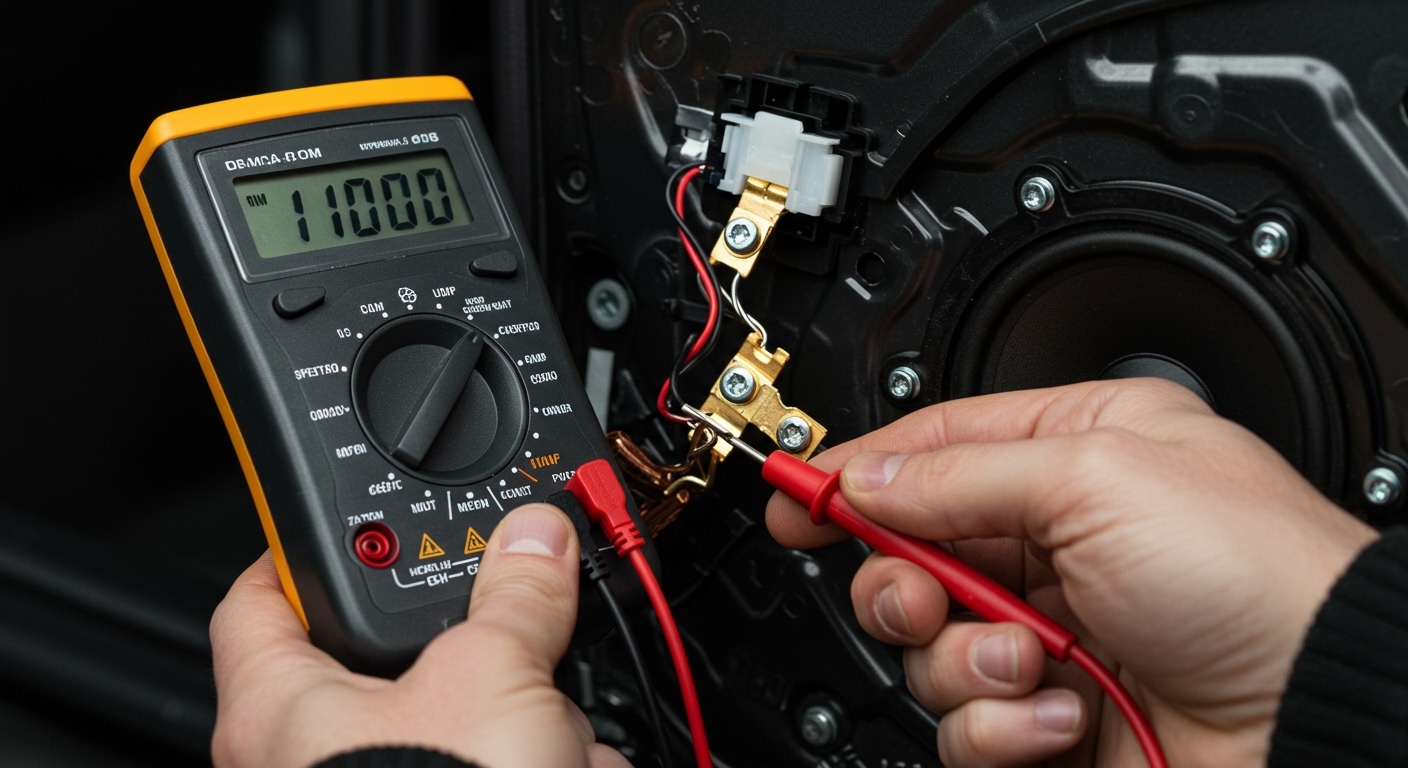
For a professional-grade diagnosis, you need to measure DC Resistance. This is the most accurate way to how to check car speakers are working internally.
Set the Multimeter to Ohms (Ω)
Turn your Digital Multimeter dial to the lowest resistance setting (usually 200 Ohms).
Probe the Terminals
Place the red probe on the positive terminal and the black probe on the negative terminal. Ensure the speaker is disconnected from the car’s wiring to avoid false readings from the head unit.
Interpret the Data
4-Ohm Speakers: Should read between 3.2 and 3.8 Ohms.
2-Ohm Speakers: Should read between 1.6 and 1.9 Ohms.
Reading of “OL” (Open Loop): The voice coil is broken (blown). The speaker is dead.
Reading of 0.00: There is a short circuit in the voice coil. The speaker is dead.
Method 4: Visual and Physical Inspection
Sometimes, how to test if car speakers work is as simple as using your eyes and hands. Car environments are harsh, with extreme temperature swings and moisture.
Check for Foam Rot
The surround (the flexible ring connecting the cone to the frame) is often made of foam. Over 10-15 years, this foam disintegrates. If you see gaps or crumbling material, the speaker will sound distorted even if the electronics are fine.
The “Push Test”
Gently and evenly press down on the speaker cone with your fingers.
It should move smoothly and silently.
If you hear a scratching sound, the voice coil is rubbing against the magnet (often due to overheating or a warped frame). This speaker needs replacement.
Common Mistakes When Testing Car Stereo Speakers
Based on years of car audio installations, I see DIYers make these three mistakes repeatedly:
- Testing with the Volume Maxed: Never test a suspected “bad” speaker at high volume. If the voice coil is loose, you could damage the amplifier by creating a short.
- Leaving the Battery Connected: In the 9V battery test, only tap the connection. Holding it for more than a second can overheat the thin wire of the voice coil.
- Ignoring the Wiring: Frequently, people buy new speakers only to find the problem was a corroded wire in the rubber boot between the door and the car frame. Always test the wire for continuity before condemning the speaker.
FAQs: Expert Troubleshooting
How do I know if my car speaker is blown or just has a loose wire?
If the speaker works intermittently when you hit a bump, it is likely a loose wire or a bad connection. If it produces a constant “fuzz” or “crackle” regardless of the road conditions, the cone or voice coil is likely damaged (blown).
Can I test car speakers without removing the door panel?
Yes, you can how to test car stereo speakers by accessing the wiring harness behind the head unit. However, you will need a wiring diagram for your specific vehicle to identify which colored wires correspond to which speaker.
What does it mean if my multimeter reads “1” or “OL”?
This stands for Open Loop. It means there is no electrical path through the speaker. The internal wire (voice coil) has snapped, usually from being overpowered. The speaker cannot be repaired and must be replaced.
Is a 9V battery safe for all speakers?
For most mid-range and woofer speakers, a 9V battery is safe for a quick tap. However, for small tweeters, it is safer to use a 1.5V AA battery, as 9V can occasionally provide too much current for the delicate components of a high-frequency driver.
Conclusion: Take Action on Your Audio Quality
Learning how to check car speakers is a foundational skill for any vehicle owner. Whether you use the quick 9V battery pop test or a precise multimeter reading, identifying the source of audio failure saves you time and money.
If your speakers pass the resistance test but still sound poor, check your source material or look for rattles in the door panel itself. If they fail the test, it’s the perfect excuse to upgrade to high-fidelity aftermarket components.
Ready to upgrade? Start by measuring your speaker dimensions and checking the mounting depth to ensure your new set fits perfectly!
