

Optimizing Your Sound with Cluster 144 and A and B Audio
Configuring a Cluster 144 setup allows you to maximize the potential of a and b audio outputs on your receiver for a seamless multi-room or multi-speaker experience. By correctly wiring your a and b speakers, you can achieve high-fidelity sound in two different locations or create a rich, layered soundstage in a single large room without damaging your amplifier.
Expert Summary: Key Takeaways for Cluster 144
Impedance Awareness: Always check the Ohm rating; running a and b speakers simultaneously often drops impedance, which can overheat a a and b speakers receiver.
Polarity Matters: Ensure positive (+) and negative (-) terminals match perfectly to avoid “thin” sound caused by phase cancellation.
Wire Quality: Use at least 14-gauge oxygen-free copper (OFC) wire for runs over 50 feet to maintain signal integrity in a Cluster 144 configuration.
Receiver Logic: Understand if your receiver uses Series or Parallel internal wiring when both A and B sets are active.
Understanding the Foundation of A and B Audio
The concept of a and b audio refers to the ability of a stereo receiver or integrated amplifier to power two separate pairs of loudspeakers. In a Cluster 144 configuration, we treat these outputs as distinct zones or layered clusters to enhance the acoustic environment.
Most modern a and b speakers receiver units feature a front-panel switch or a remote setting that allows you to select “A,” “B,” or “A+B.” While “A” and “B” operate independently, the “A+B” setting is where most users run into technical hurdles regarding power distribution and impedance.
Technical Specifications for Cluster 144 Setup
| Component | Recommended Specification | Why It Matters |
|---|---|---|
| Receiver Type | High-current a and b speakers receiver | Prevents clipping when driving 4 speakers simultaneously. |
| Speaker Impedance | 8 Ohms per speaker (minimum) | Most receivers struggle with 4-Ohm loads in A+B mode. |
| Speaker Wire | 14 AWG or 12 AWG | Reduces resistance over long distances. |
| Connectors | Banana Plugs or Spade Lugs | Ensures a secure, oxidation-resistant connection. |
Step 1: Inventory and Compatibility Check
Identify the impedance of your a and b speakers. Look at the back of your speakers for a label indicating the “Nominal Impedance” (usually 4, 6, or 8 Ohms). This is the most critical step in a Cluster 144 guide.
If you plan to run both sets of a and b audio simultaneously, your receiver must be capable of handling the combined load. Most consumer receivers are rated for 6-16 Ohms. When you run two 8-Ohm pairs in parallel (the standard for most A+B switches), the receiver “sees” a 4-Ohm load.
Expert Tip: The 4-Ohm Danger Zone
If you connect two pairs of 4-Ohm speakers and select A+B, the impedance drops to 2 Ohms. Most a and b speakers receiver units will trigger “Protect Mode” or, worse, blow a fuse or transistor. Stick to 8-Ohm speakers for the safest Cluster 144 experience.
Step 2: Preparing the Wiring for Cluster 144
Measure and cut your speaker wires to length. While it is a myth that wires must be the exact same length for “time alignment,” keeping them relatively similar helps maintain consistent resistance across all a and b audio channels.
- Strip the insulation: Remove about 1/2 inch of the plastic jacket from the ends of the wires.
- Twist the strands: Ensure no stray copper strands are sticking out, as these can cause short circuits.
- Attach connectors: I highly recommend using banana plugs. They provide a much more stable connection for a and b speakers than bare wire, especially if you move your equipment frequently.
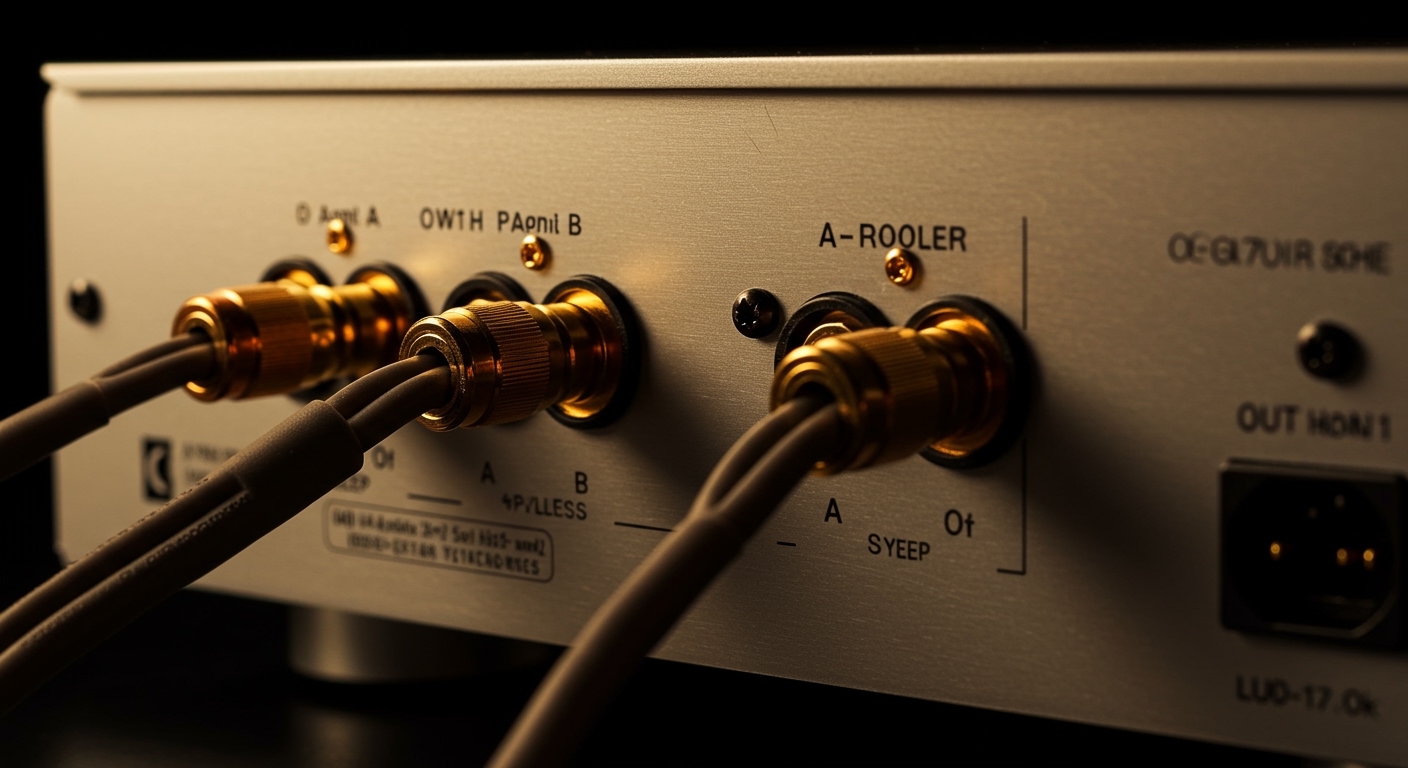
Step 3: Connecting to the A and B Speakers Receiver
Power down the receiver completely. Never connect or disconnect speakers while the amplifier is turned on, as a momentary short can destroy the output stage.
Sub-step: Connecting the “A” Pair
Locate the “Speaker A” terminals on the back of the receiver.
Connect the Red (+) wire from the right speaker to the Red (+) terminal on the receiver.
Connect the Black (-) wire from the right speaker to the Black (-) terminal.
Repeat for the left speaker.
Sub-step: Connecting the “B” Pair
Locate the “Speaker B” terminals.
Follow the same color-coding process. In a Cluster 144 strategy, the “B” pair is often placed in a secondary zone (like a patio or kitchen) or used as “fill” speakers in a large hall.
Step 4: Configuring the Cluster 144 Audio Logic
Select the desired output mode on your receiver interface. Most a and b audio systems allow you to toggle through the outputs.
Mode A: Use this for critical listening in your primary seat.
Mode B: Use this for background music in the secondary zone.
Mode A+B: Use this for “Party Mode.”
Calibrating Volume Levels
Note that in a Cluster 144 setup, the receiver shares its power supply between all active speakers. If your “A” speakers are much more efficient (higher sensitivity) than your “B” speakers, one pair will sound significantly louder than the other. You may need an external speaker selector box with individual volume controls if the imbalance is distracting.
Step 5: Testing and Troubleshooting
Start with the volume at zero and slowly increase it. Listen for any distortion, popping, or humming.
- Check Phase: If the bass sounds weak or the vocals seem to come from “everywhere” instead of the center, your a and b speakers might be out of phase. Double-check that all (+) and (-) wires match.
- Monitor Heat: After 15 minutes of play in A+B mode, feel the top of your a and b speakers receiver. It should be warm, but not painfully hot. If it is scorching, your speakers’ impedance is too low for the receiver.
- Signal Loss: If one zone is quieter, check for “kinks” in the wire or poor terminations at the binding posts.
Tools and Materials Needed for Cluster 144
| Tool | Purpose | Recommendation |
|---|---|---|
| Wire Strippers | Removing insulation without damaging copper. | Precision adjustable strippers. |
| Banana Plugs | Creating a secure, professional connection. | Closed-screw type for maximum grip. |
| Multimeter | Testing speaker impedance and wire continuity. | Digital model with an Ohms setting. |
| Label Maker | Identifying wires for future maintenance. | Label both ends (e.g., “Living Room A – Right”). |
Expert Advice for Advanced A and B Audio Setups
In my 15 years of audio engineering, I have seen many a and b audio receivers fail because users ignored the “Total Load” principle. If you are serious about a Cluster 144 configuration, consider these professional insights:
Ventilation is Non-Negotiable: When driving a and b speakers together, the internal heat sinks work twice as hard. Do not stack other components (like a Blu-ray player) directly on top of the receiver.
Use an Impedance-Matching Selector: If you want to connect more than two pairs of speakers, do not just twist wires together. Use a dedicated selector box that maintains a constant 8-Ohm load to the receiver.
The “B” Channel for Subwoofers: Some hobbyists use the “B” terminals to send a high-level signal to a powered subwoofer. This is a great way to add bass to vintage receivers that lack a dedicated “Sub Out.”
Common Mistakes to Avoid
Mixing 4-Ohm and 8-Ohm Speakers: This creates an uneven power draw. The 4-Ohm speakers will hog the current, potentially starving the 8-Ohm pair and straining the a and b speakers receiver.
Using Thin “Bell Wire”: Cheap, thin wire (20 AWG or higher) acts like a resistor, turning your precious amplifier power into heat instead of sound.
- Ignoring Local Building Codes: If running a and b audio wires through walls or ceilings, you must use CL2 or CL3 rated wire to comply with fire safety regulations.
FAQs about A and B Audio and Cluster 144
Can I play different music on Speaker A and Speaker B?
No, a standard a and b speakers receiver uses a single amplifier stage. Both sets of speakers will play the same source. To play different music in different rooms, you would need a “Multi-Zone” or “Dual-Source” receiver, which is a more advanced version of the Cluster 144 concept.
Does using A+B reduce the sound quality?
Slightly. Because the power supply is shared, the “headroom” (the ability to handle sudden loud peaks) is reduced. For critical listening, it is best to use only the “A” set of a and b speakers.
What happens if I short the wires on my a and b audio setup?
Most modern receivers have a protection circuit that will shut the unit down instantly. However, older vintage gear may blow a fuse or sustain permanent damage to the output transistors. Always double-check your connections before powering on.
Can I connect 4 speakers to a receiver that only has “A” terminals?
It is possible by wiring them in Series, but it is not recommended for a Cluster 144 setup as it significantly changes the impedance and can lead to very low volume levels. It is always better to use a receiver specifically designed with a and b audio terminals.
Conclusion
Setting up a Cluster 144 configuration is the most effective way to expand your home audio footprint. By understanding the relationship between your a and b audio outputs and the impedance of your a and b speakers, you ensure a system that is both high-performing and durable.
Remember to prioritize high-quality 14-gauge wiring, secure your connections with banana plugs, and always respect the power limits of your a and b speakers receiver. With these steps, you will enjoy a rich, multi-dimensional listening experience throughout your space.
Ready to upgrade your sound? Start by auditing your current speaker impedance and ensure your receiver is placed in a well-ventilated area before activating your new a and b audio zones!
