Quick Guide: How to Connect Bose Companion 3 Speakers to Computer
To how to connect bose companion 3 speakers to computer, plug the 3.5mm audio cable from the Control Pod or Acoustimass module into the green Audio Out/Headphone jack on your PC or Mac. Ensure the Acoustimass module is powered on and the volume is dialed up on the Control Pod. For modern wireless models, you can how to connect bose speakers to computer bluetooth by putting the speaker in Pairing Mode and selecting it from your computer’s Bluetooth settings.
Expert Summary: Key Takeaways
Physical Connection: Most Bose computer speakers use a standard 3.5mm auxiliary cable for a lag-free, high-fidelity connection.
The Control Pod: For Companion 3 and Companion 20 models, the Control Pod is the “brain” of the system—ensure it is firmly seated in the Acoustimass module.
Audio Settings: Always set your computer’s system volume to 75-80% and use the Bose control pod to adjust the final output for the best Signal-to-Noise Ratio.
Mac Compatibility: When learning how to connect bose speakers to mac computer, remember to change the Output Device in System Settings > Sound.
Essential Tools for Bose Speaker Setup
Before you begin the process of how to hook up bose computer speakers, ensure you have the following components ready. Having the right hardware prevents interruptions and ensures a clean signal path.
| Component | Purpose | Requirement |
|---|---|---|
| Acoustimass Module | The subwoofer and power hub for the Companion 3. | Required |
| Satellite Speakers | Provide the mid and high-range frequencies. | 2 Speakers |
| Bose Control Pod | Wired remote for volume, muting, and headphone access. | Required |
| 3.5mm Audio Cable | Transmits the analog signal from PC to Bose speakers. | Male-to-Male |
| Power Cord | Connects the module to a wall outlet. | Standard AC |
| Bluetooth Dongle | For older PCs without built-in wireless capabilities. | Optional |
Step-by-Step Guide: How to Connect Bose Companion 3 Speakers to Computer
The Bose Companion 3 is a 2.1 system, meaning it uses two satellite speakers and a dedicated Acoustimass module (subwoofer). Following these steps ensures you don’t damage the sensitive pins on the proprietary connectors.
Step 1: Position the Acoustimass Module and Satellites
Place the Acoustimass module on the floor under your desk or against a wall for optimal bass response. Position the satellite speakers on either side of your monitor, angled slightly toward your ears to create a wide soundstage.
Step 2: Connect Satellites to the Module
Plug the satellite speaker cables into the “Outputs to Speakers” jacks on the back of the Acoustimass module. These connectors are color-coded and keyed; do not force them. Ensure they “click” into place to prevent static or channel dropouts.
Step 3: Attach the Control Pod
Insert the Control Pod cable into the circular multi-pin port labeled “Control Pod” on the module. This is a critical step in how to set up bose computer speakers, as the system will not power on without this connection.
Step 4: Link the Module to Your Computer
Connect the 3.5mm audio cable from the “Audio Input” jack on the Acoustimass module to the headphone/line-out jack on your computer. If you are using a desktop, this is usually the lime-green port on the back of the motherboard.
Step 5: Power On and Test
Plug the power cord into a surge protector and then into the module. Tap the top of the Control Pod (the touch-sensitive mute area) to turn the system on. The LED indicator should turn from amber to green.
How to Hook Up Bose Speakers to Computer (Companion 2 & 20)
While the Companion 3 uses a subwoofer, the Bose Companion 2 and Companion 20 are 2.0 systems. Learning how to connect bose companion 20 speakers to computer is slightly simpler because all electronics are housed within the speakers themselves.
For Bose Companion 2 (Series I, II, or III)
- Connect the Right speaker to the Left speaker using the attached cable.
- Plug the AC power adapter into the “DC Power” port on the back of the Right speaker.
- Insert the 3.5mm audio cable into the “Computer” input on the speaker and the other end into your PC.
- Rotate the volume knob clockwise to power the unit on.
For Bose Companion 20
- Connect the Left speaker to the Right speaker’s “To Left Speaker” port.
- Plug the Control Pod into the designated port on the Right speaker.
- Connect the audio cable from the computer to the “Audio In” jack on the back of the Right speaker.
- Tap the center of the Control Pod to activate the speakers.
Wireless Method: How to Connect Bose Speakers to Computer Bluetooth
If you own a modern Bose SoundLink or a newer Bose Smart Speaker, you might prefer a wireless desk setup. Here is how to connect bose speakers to computer bluetooth for both Windows and Mac users.
On Windows 10/11
- Activate Pairing Mode on your Bose speaker (usually by holding the Bluetooth button until the light flashes blue).
- Navigate to Settings > Bluetooth & Devices on your PC.
- Click “Add Device” and select “Bluetooth.”
- Select your Bose speaker from the list of discovered devices.
On macOS
- Open the Apple Menu and go to System Settings.
- Click on Bluetooth in the sidebar.
- Put your Bose speaker into pairing mode.
- Click “Connect” next to the speaker name when it appears in the “Nearby Devices” list.
Pro Tips for the Best Bose Audio Experience
As an expert who has configured hundreds of Bose computer speaker setups, I recommend these advanced optimizations to get the most out of your investment.
Avoid the Front Panel Jack: On desktop PCs, the front-panel headphone jack often has unshielded wires that pick up electrical noise from the CPU. How to install bose speakers to computer properly involves using the rear motherboard ports for a cleaner signal.
Adjust the Bass Dial: The Bose Companion 3 has a physical bass compensation knob on the back of the Acoustimass module. Set this to the 12 o’clock position first, then adjust based on your room’s acoustics.
Disable “Audio Enhancements”: Windows often applies “Loudness Equalization” or “Virtual Surround” by default. Go to Sound Settings > Properties and disable these to hear the natural Bose signature sound.
Cables Matter: If you hear a persistent hum, you likely have a “ground loop.” Switching to a shielded 3.5mm cable or using a ground loop isolator can fix this immediately.
Troubleshooting: Why Are My Bose Speakers Not Working?
If you followed the steps for how to set up bose speakers on computer but still have silence, check these common failure points:
The Control Pod is Muted
The Bose Companion 3 and Companion 20 use a touch-sensitive top surface. A common mistake is accidentally muting the device. Ensure the LED is Green (Active) and not Amber (Muted/Standby).
Incorrect Default Playback Device
Sometimes Windows doesn’t automatically switch the output.
Right-click the speaker icon in your taskbar.
Select “Sound Settings.”
- Choose “Speakers (High Definition Audio)” or your specific Bose model as the default output.
Loose Proprietary Connections
The multi-pin connectors on the Acoustimass module are notorious for loosening over time. If one speaker is quieter than the other, unplug and re-seat the satellite cables and the Control Pod cable firmly.
Frequently Asked Questions
(FAQs)
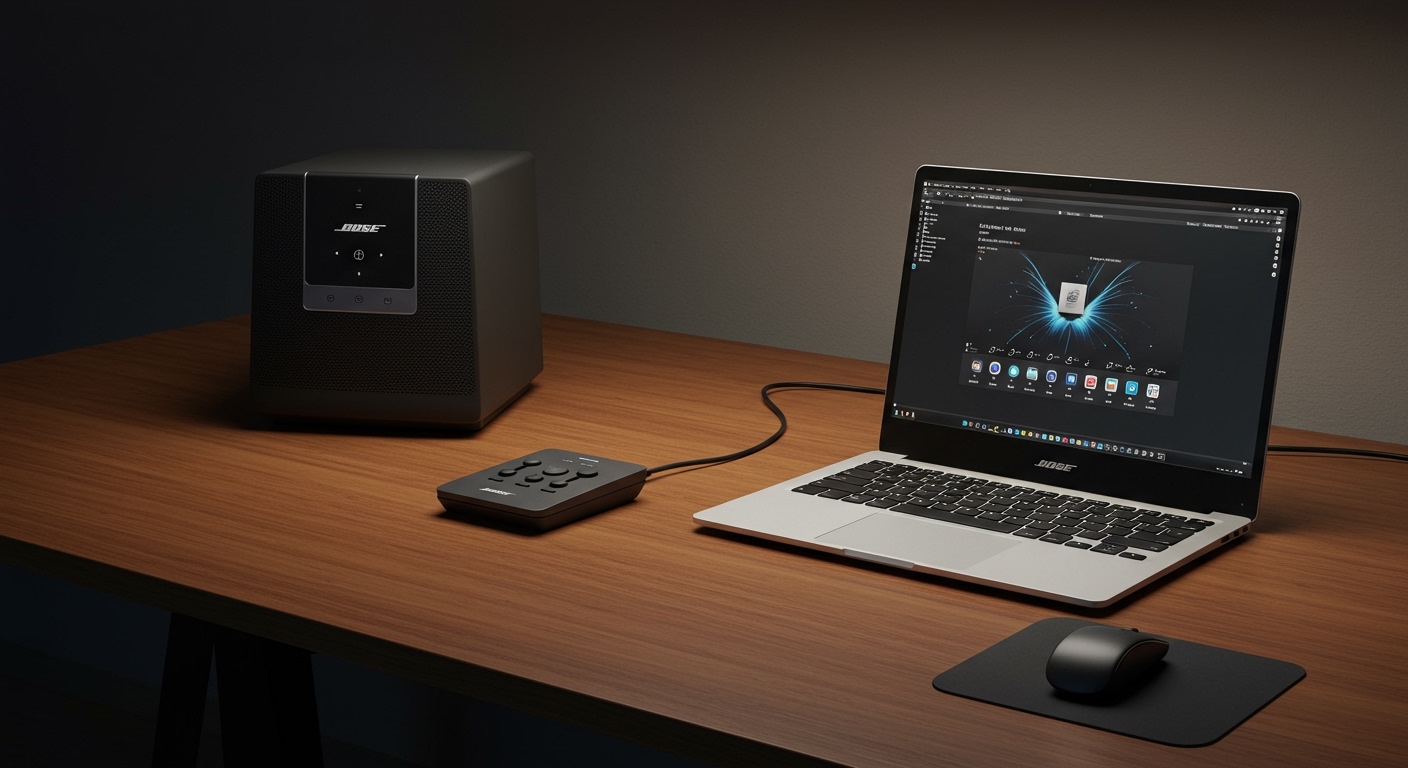
Can I connect Bose Companion 3 speakers to a laptop?
Yes. To how to hook up bose speakers to my computer (laptop), simply use the 3.5mm headphone jack. If your laptop only has a USB-C port, you will need a USB-C to 3.5mm female adapter (often called a “dongle”) to complete the connection.
Why do my Bose speakers make a buzzing sound when connected to my PC?
This is usually caused by EMI (Electromagnetic Interference) or a ground loop. Ensure your computer and Bose speakers are plugged into the same power strip. Also, move the speakers away from large power bricks or wireless routers.
Do I need to install drivers for Bose Companion speakers?
No. Bose Companion 2, 3, and 20 speakers are analog devices. They do not require software or drivers. They rely on the audio drivers already installed on your computer’s motherboard or sound card.
How do I connect Bose speakers to a Mac with no headphone jack?
For newer MacBooks, you must use a USB-C to 3.5mm adapter. Once plugged in, go to System Settings > Sound > Output and select the “USB 2.0 Device” or “External Headphones” option to route the audio to your Bose speakers.
Can I use the Bose Music App to set up Companion speakers?
No. The Bose Music App is designed for smart speakers and soundbars. The Companion series is a legacy “plug-and-play” line that requires physical wired connections and does not have Wi-Fi or App integration.
Conclusion: Enjoying Your Bose Setup
Mastering how to connect bose companion 3 speakers to computer is a straightforward process that rewards you with legendary audio performance. By focusing on secure physical connections, proper placement of the Acoustimass module, and correct OS-level sound settings, you ensure a crisp, distortion-free listening experience.
Whether you are learning how to install bose speakers to computer for gaming, professional video editing, or just enjoying high-fidelity music, the key is the Control Pod and the 3.5mm interface. If you ever run into issues with static or power, always check your cable seating first. Now that your Bose speaker setup is complete, go ahead and test your favorite high-bitrate track to hear the difference!
Ready to upgrade your desk? Explore our other guides on optimizing PC audio or choosing the best DACs for high-end speakers.