Achieving Professional Bass Control: Your Ultimate Guide
Tired of hearing your car doors rattle instead of feeling the beat? Understanding how to get bass out of door speakers is the secret to transforming a muddy, “cheap” sound system into a high-fidelity experience. Whether you want to maximize the “thump” from your mid-bass drivers or learn how to remove bass from door speakers to protect them from distortion, this guide covers the professional techniques used by elite audio installers.
💡 Expert Summary: Key Takeaways
Acoustic Treatment: 80% of bass quality comes from the door environment, not just the speaker. Use Butyl-based sound deadening to stop vibrations.
Sealing is Key: Use Foam Fast Rings to bridge the gap between the speaker and the door panel, preventing “canceled” sound waves.
Frequency Management: To remove bass from speakers that can’t handle it, use a High Pass Filter (HPF) set between 80Hz and 100Hz.
Power Matters: Factory head units often lack the “juice” for deep bass; an external Amplifier provides the headroom needed for clean low-end.
Understanding the Physics of Door Bass
Before diving into the “how-to,” you must understand that a car door is a terrible enclosure for a speaker. It is essentially a leaky metal box. To learn how to get more bass out of door speakers, you have to fix the box.
When a speaker moves forward, it creates a sound wave. When it moves backward, it creates an opposite wave. If these two waves meet (which happens easily in a leaky door), they cancel each other out. This results in thin, tinny sound. To take bass out of door speakers in terms of performance, you must isolate these waves.
Tools and Materials Needed for Bass Control
| Tool/Material | Purpose | Expert Recommendation |
|---|---|---|
| Sound Deadening Mats | Stops metal vibration and lowers the noise floor. | Dynamat Xtreme or Noico 80 mil |
| Foam Speaker Rings | Directs sound into the cabin and seals the baffle. | Fast Rings or NVX Silicone Baffles |
| Bass Blockers | Passive filters to remove bass from door speakers. | Crutchfield or Skar Audio Caps |
| Closed Cell Foam (CCF) | Decouples the door panel from the metal frame. | Liner 6 or similar foam sheets |
| Panel Removal Tools | Safely removes door clips without breaking them. | Nylon pry tool kit |
Step 1: Prepare the Environment for Maximum Bass
If your goal is how to get bass out of door speakers, you cannot skip the preparation of the door cavity.
Remove the Door Panels
Use your nylon pry tools to carefully pop the clips. Expert Tip: Always buy a bag of spare clips before you start; they are designed to break, and a loose clip causes the very rattles you are trying to eliminate.
Apply Sound Deadening (CLD Layers)
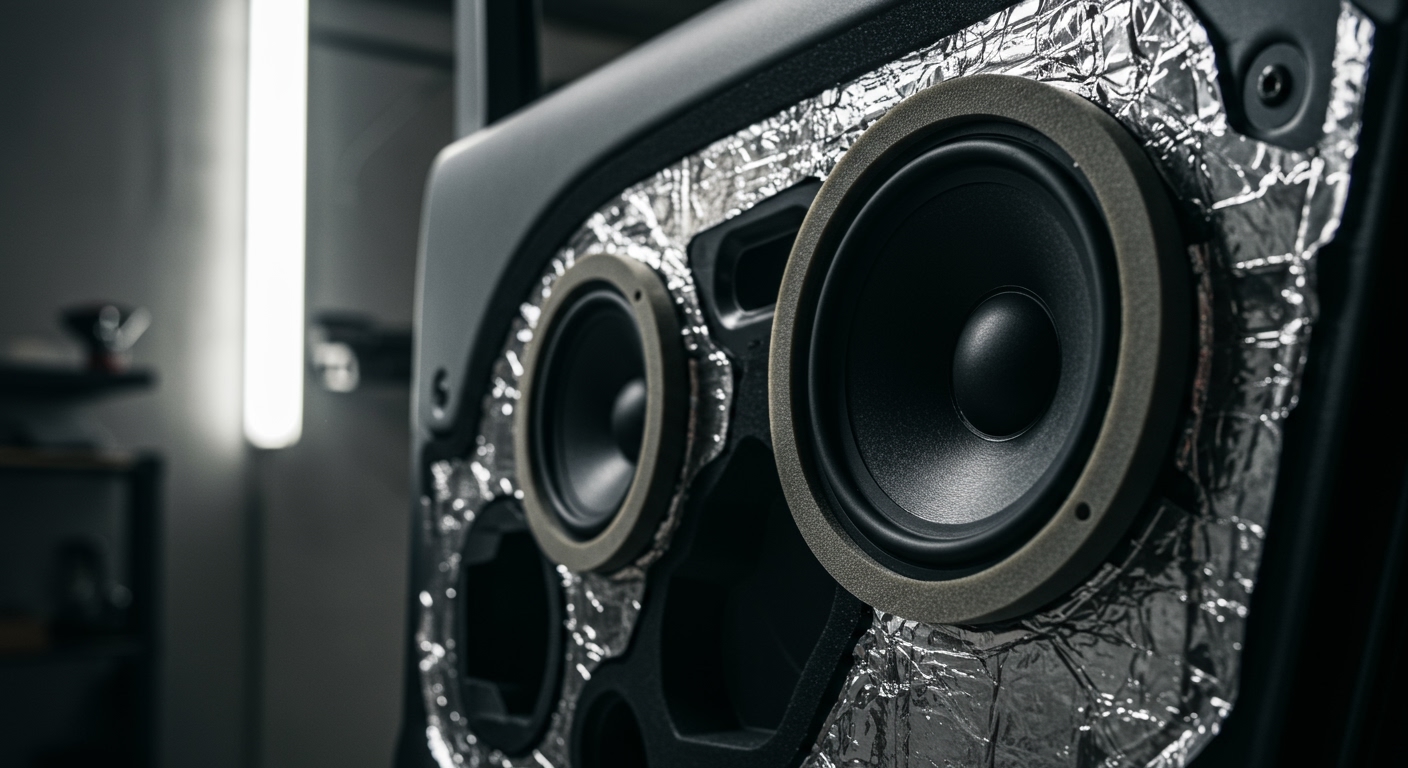
Cover at least 25-50% of the flat metal surfaces inside the door with Butyl-based sheets. This adds mass to the metal, shifting its resonant frequency so it doesn’t “sing” along with your music. This is the single most effective way to get more bass out of door speakers.
Seal the Large Access Holes
Most doors have large holes covered only by thin plastic. Cover these with a rigid material or extra layers of sound deadener. By sealing the door, you turn it into a sealed enclosure, which drastically improves mid-bass response.
Step 2: Optimize the Speaker Connection
Even the best speakers will sound poor if they aren’t “coupled” to the interior of the car.
Install Foam Fast Rings
These are three-piece foam kits. One piece goes behind the speaker to absorb back-waves, one goes around the speaker’s outer rim, and one seals the mounting surface. This ensures that 100% of the air moved by the speaker goes through the door grill and into your ears, rather than getting lost inside the door panel.
Phase Check
If you just installed speakers and have less bass than before, your wires are likely reversed. If one speaker is pushing while the other is pulling, they cancel each other’s bass.
The Battery Test: Touch the speaker wires to a 9V battery. If the cone moves OUT, the wire on the positive battery terminal is your positive lead.
Step 3: How to Remove Bass from Door Speakers
Sometimes, the problem isn’t “not enough bass,” but “too much of the wrong bass.” Small 6.5-inch or 6×9 speakers are not subwoofers. If you try to force them to play 30Hz notes, they will distort or blow.
Use Passive Bass Blockers
If you are running speakers directly off a head unit, you need to know how to take bass out of door speakers using capacitors. These are called Bass Blockers.
They wire in-line with the positive speaker lead.
They filter out low frequencies (usually below 150Hz for small speakers or 80Hz for larger ones).
This allows the speaker to play louder and cleaner without the “mud” of low-end distortion.
Adjust the High Pass Filter (HPF)
Most modern car stereos (Sony, Pioneer, Alpine) have a built-in HPF.
- Go to your Audio Settings.
- Locate HPF or Crossover.
- Set it to 80Hz.
This is the industry standard for how to turn bass off door speakers while letting your dedicated subwoofer handle the heavy lifting.
Step 4: Fine-Tuning with EQ and Gain
Once the physical installation is perfect, you must tune the signal.
The “Subtractive” EQ Method
Instead of boosting the “Bass” setting to +6 (which causes clipping), try lowering the “Mids” and “Highs” to -3 and then increasing the overall volume. This gives you a bass-heavy profile without overdriving the internal amplifier of your radio.
Setting Amplifier Gains
If you use an external amp to get bass out of door speakers, do not treat the “Gain” knob as a volume knob. Use a multimeter or an oscilloscope to ensure the signal isn’t clipping. Clipping is the #1 killer of speakers and the primary cause of “farts” or “pops” in your bass.
Expert Pro-Tips for Elite Sound
Check the Polarity: Use a polarity checker app on your phone. If your door speakers are “out of phase” with your subwoofer, you will lose all punch.
The “Knock” Test: After applying sound deadening, knock on the outside of your car door. It should sound like a solid “thud” (like a Mercedes), not a “ping” (like a soda can).
Add a DSP: A Digital Signal Processor allows you to time-align the speakers. This makes the bass feel like it’s coming from the dashboard rather than the floor.
Common Mistakes to Avoid
Ignoring the Back-wave: Not putting foam behind the speaker allows sound waves to bounce off the outer door skin and hit the speaker cone, causing “muddy” response.
Over-boosting EQ: Boosting low frequencies (50Hz-60Hz) on a small door speaker usually leads to thermal failure.
Cheap Wiring: Using CCA (Copper Clad Aluminum) wire instead of OFC (Oxygen Free Copper) can lead to voltage drops, weakening your bass output.
🙋 Frequently Asked Questions (FAQs)
Why do my door speakers rattle when the bass hits?
Rattles are usually caused by the door’s plastic trim panels vibrating against the metal frame or loose cables inside the door. To fix this, apply Closed Cell Foam (CCF) between the panel and the door and wrap any loose wiring in Tesa tape or foam.
How do I get more bass out of door speakers without an amp?
The best way is to improve the “seal” of the door. Use sound deadening to close all holes in the door frame. This creates a pressurized environment that naturally boosts the efficiency of the speaker’s low-end output.
Is it better to have bass in door speakers or a subwoofer?
For the best sound, your door speakers should handle “Mid-bass” (80Hz to 250Hz), while a dedicated Subwoofer handles “Sub-bass” (below 80Hz). Learning how to remove bass from speakers in your doors allows them to play the mid-range much more clearly.
Can I turn bass off door speakers using just the head unit?
Yes. Look for the High Pass Filter (HPF) setting in your head unit’s menu. Setting this to 80Hz, 100Hz, or 120Hz will effectively turn bass off door speakers, protecting them from low-frequency damage.
Conclusion: Mastering Your Soundstage
Learning how to get bass out of door speakers is an art that combines mechanical engineering with acoustic science. By properly sealing your doors, applying sound deadening, and using crossovers to remove bass from speakers that can’t handle it, you create a balanced, punchy, and professional audio environment.
Ready to upgrade? Start with a basic sound-deadening kit and foam rings. You will be amazed at how much “hidden” bass your factory speakers actually have when they are given the right environment to perform.