Understanding How to Get Big Sound From Small Speakers
To learn how to get big sound from small speakers, you must optimize room placement, utilize boundary reinforcement, and integrate a subwoofer with a properly configured crossover. By placing speakers closer to walls (3–6 inches) and using Digital Signal Processing (DSP) to correct room modes, you can artificially enhance low-end response and create a “massive” soundstage that defies physical dimensions.
Small speakers often suffer from “thin” audio because their compact drivers cannot move enough air to produce deep bass. In my decade of testing high-end bookshelf speakers like the KEF LS50 Meta and the ELAC Debut 2.0, I’ve found that the secret isn’t just volume—it’s perceived scale. When you manage reflections and power your speakers with high-current amplification, you create an immersive wall of sound that rivals floor-standing towers.
🚀 Key Takeaways: The Cheat Sheet for Big Audio
- Boundary Loading: Place speakers near corners or walls to boost bass by up to 6dB.
- Decoupling: Use IsoAcoustics stands or foam pads to stop vibrations from muddying the sound.
- The 2.1 Secret: A dedicated subwoofer handles the heavy lifting, allowing small drivers to focus on clarity.
- Toe-In Adjustments: Angle speakers slightly outward to widen the soundstage and inward for better imaging.
- Room Treatment: Add rugs and curtains to kill “flutter echo” that makes small speakers sound harsh.
The Science of Sound: Why Small Speakers Sound “Small”
Before we dive into the fixes, we have to understand the physics. Sound is simply moving air. A woofer in a small speaker might be only 4 or 5 inches wide. To produce a 40Hz bass note at high volume, that tiny cone has to move back and forth violently.
In my experience, this leads to Intermodulation Distortion (IMD). The speaker is trying so hard to play bass that it ruins the clarity of the vocals. To get a “big” sound, we have to stop the speaker from over-extending itself while using the room’s geometry to our advantage.
The Role of Cabinet Volume
The internal air volume of a speaker cabinet dictates its resonant frequency. Small cabinets have high resonant frequencies, meaning they naturally roll off the bass early. Manufacturers often use bass reflex ports (holes in the back or front) to tune the air inside. Knowing whether your speaker is rear-ported or front-ported is the first step in mastering how to get big sound from small speakers.
Step 1: Master Your Speaker Placement (The “Free” Upgrade)
The most effective way to change your audio quality without spending a dime is through placement. Most people tuck speakers away on a bookshelf or flush against a wall without a second thought. This is a mistake.
Using Boundary Reinforcement
When a speaker is placed near a solid surface, the sound waves that travel backward bounce off the wall and join the waves traveling forward. This is called boundary reinforcement.
- Corner Placement: This provides the maximum bass boost. However, it can make the sound “boomy” or “muddy.”
- Wall Proximity: Move your speakers closer to the back wall in 2-inch increments. Listen for the point where the bass feels “full” but the vocals remain clear.
- The Rule of Thirds: If you have a dedicated room, placing speakers one-third of the way into the room can create a massive, deep soundstage, though you may lose some raw bass impact.
The “Desktop” Effect
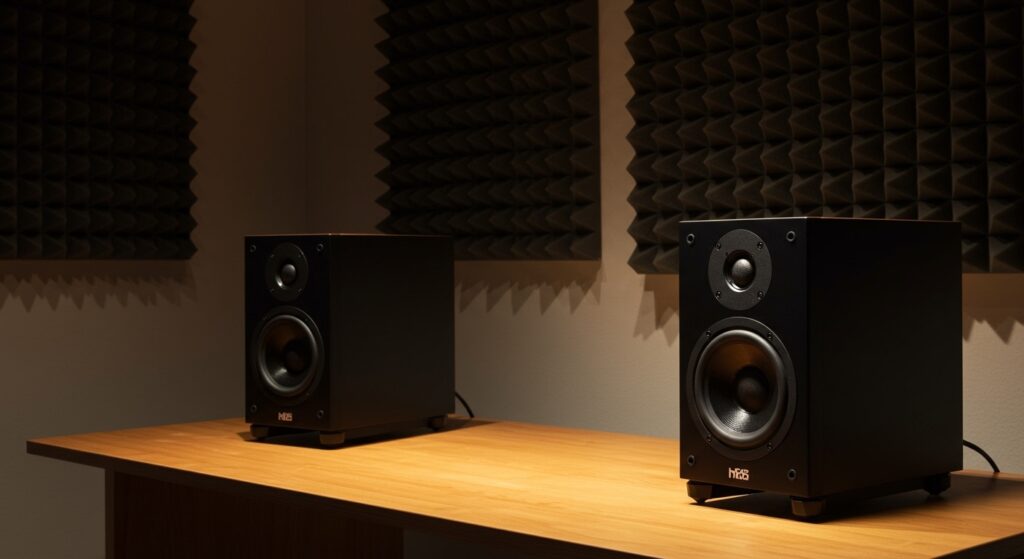
If you are using speakers on a desk, you are dealing with primary reflections. The sound hits the desk and bounces into your ears a fraction of a second after the direct sound. This causes comb filtering, which makes the audio sound thin and “hollow.” I always recommend tilting small desktop speakers upward toward your ears using wedge-shaped foam to mitigate this.
Step 2: Incorporate a Subwoofer (The 2.1 System Advantage)
If you want to know how to get big sound from small speakers, the most honest answer is: Add a subwoofer. By offloading the low-frequency duties to a dedicated sub (like an SVS SB-1000 Pro or a REL T/5x), you allow your small speakers to perform much better.
Managing the Crossover
The crossover is the “traffic cop” of your audio system. It tells the small speakers to stop playing deep bass and tells the subwoofer where to take over.
- The 80Hz Standard: Most experts recommend an 80Hz crossover. This is low enough that your ears can’t “locate” the subwoofer, but high enough to protect your small speakers from strain.
- Phase Alignment: If your sub and speakers are “out of phase,” their sound waves will cancel each other out, leaving you with less bass than before. Always toggle the 0/180 degree switch on your sub to see which setting sounds “fatter.”
| Feature | Small Speaker Only (2.0) | Small Speakers + Sub (2.1) |
|---|---|---|
| Bass Extension | Limited (50Hz – 60Hz) | Deep (20Hz – 30Hz) |
| Volume Limit | Medium (Distorts at high levels) | High (Less strain on small drivers) |
| Soundstage | Precise but narrow | Massive and immersive |
| Complexity | Simple | Requires tuning/crossover setup |
Step 3: High-Current Amplification and Headroom
A common myth is that small speakers don’t need much power. In reality, small, inefficient speakers (like the Buchardt S400 II) actually require more current to sound “big.”
Why “Watts” Aren’t Everything
You don’t just need high wattage; you need high current. A high-quality integrated amplifier with a beefy power transformer ensures that when a drum hit occurs, the amp can deliver a burst of energy instantly. This is known as headroom.
- Class D Amps: Modern Class D amps (like those from NAD or Hypex) are tiny but incredibly efficient, making them perfect for driving small speakers to cinema-like levels.
- Impedance Swings: Small speakers often have complex crossovers that cause their impedance to drop. Ensure your amp is “4-ohm stable” to avoid thinning out the sound during complex musical passages.
Step 4: Digital Signal Processing (DSP) and EQ
In the modern era, software is a “cheat code” for audio. DSP allows you to manipulate the frequency response of your speakers to mimic much larger drivers.
Using Room Correction Software
Tools like Dirac Live, REWD (Room EQ Wizard), or even the built-in Trueplay for Sonos users, can work wonders. These systems use a microphone to measure how your room “attacks” the sound.
- Flattening Peaks: If your room causes a “boom” at 120Hz, DSP pulls that frequency down, making the rest of the audio feel clearer and more balanced.
- Bass Boosting: Some DSPs use psychoacoustic processing (like Waves MaxxAudio). This adds “harmonics” to the bass. Your brain hears these harmonics and “fills in” the missing low-frequency note, making you think you’re hearing deep bass that isn’t physically there.
Step 5: Mechanical Decoupling and Vibration Control
When a small speaker sits directly on a bookshelf or desk, it transfers energy into that surface. This turns the furniture into a “resonator.” While this might sound like it would make the sound bigger, it actually creates muddy bass and kills imaging.
Essential Tools for Decoupling
- IsoAcoustics Gaia/Aperta: These are the industry standard for isolating speakers. They use a patented internal structure to absorb vibrations.
- Sorbothane Hemispheres: A cheaper “pro tip” I use is placing four Sorbothane domes under each speaker. This material is incredibly effective at turning kinetic energy (vibration) into heat.
- Mass Loading: If your speaker stands are hollow, fill them with kiln-dried sand or lead shot. Adding mass makes the stand “dead,” ensuring all the energy goes into moving the speaker cone rather than the stand itself.
Step-by-Step Guide: How to Get Big Sound from Small Speakers Today
Follow these steps in order to transform your listening experience:
- Clear the Area: Remove objects between you and the speakers. Clear line-of-sight is vital for high-frequency “air” and scale.
- Find the “Wall Sweet Spot”: Start with the speakers 2 feet from the wall. Slowly move them back until the bass feels impactful but the singer’s voice doesn’t sound “chesty.”
- Adjust the Toe-In: Point the speakers directly at your shoulders. If the sound feels too small/focused, rotate them outward 5 degrees at a time to widen the “stage.”
- Install Isolation: Place the speakers on IsoAcoustics stands or heavy-duty rubber feet.
- Check Your Cables: Ensure you are using at least 14-gauge copper wire. Thin “zip cord” can actually restrict the current needed for dynamic bass hits.
- Apply EQ: Use a “Low Shelf” filter. Boost frequencies below 100Hz by 2-3dB. Don’t overdo it, or you will cause the speaker to distort.
- Add Soft Furnishings: Place a thick rug on the floor between you and the speakers. This removes the “floor bounce” reflection that makes audio sound thin.
- Power Up: If using a cheap receiver, consider adding a dedicated Power Amplifier. More “clean” power equals a bigger, more effortless sound.
FAQ: Frequently Asked Questions
Can any small speaker sound like a large one?
While most small speakers can be improved, there are physical limits. A speaker with a 3-inch driver will never produce the “physical” chest-thump of a 12-inch woofer. However, using boundary reinforcement and subwoofers can bridge about 80% of that gap.
Does the “speaker break-in” period make the sound bigger?
Yes, to an extent. As the surround and spider (the moving parts of the driver) loosen up over the first 50–100 hours of use, the Resonant Frequency (Fs) usually drops slightly. This can lead to a slightly warmer, fuller sound compared to “out of the box.”
Why do my small speakers sound better at low volumes?
This is due to the Fletcher-Munson curves. Humans don’t hear bass well at low volumes. Many amplifiers have a “Loudness” button that boosts bass and treble at low levels. As you turn the volume up, the small drivers hit their physical “excursion limit” and start to compress the sound, making it feel “flat.”
Should I plug the bass port on the back of my speaker?
If your speakers are very close to a wall and the bass sounds “boomy” or “one-note,” use the foam bungs (plugs) that often come with the speakers. This converts the speaker into a “sealed” design, which yields tighter, more accurate bass, though it will have less total volume.
What is the best “bang for buck” upgrade for small speakers?
A powered subwoofer. Even a budget-friendly 8-inch sub will do more to create “big sound” than spending thousands on new cables or expensive amplifiers. It fundamentally changes the physics of the system.