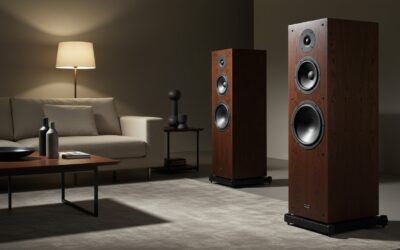
Understanding the Basics: How to Hook Up Theater Research Speakers
Learning how to hook up theater research speakers involves more than just plugging in wires; it requires matching speaker impedance, ensuring phase consistency, and optimizing signal flow through a high-quality AV receiver. To get the best sound, you must connect the positive (+) and negative (-) terminals of your speakers to the corresponding outputs on your amplifier using 14-gauge or 16-gauge oxygen-free copper wire.
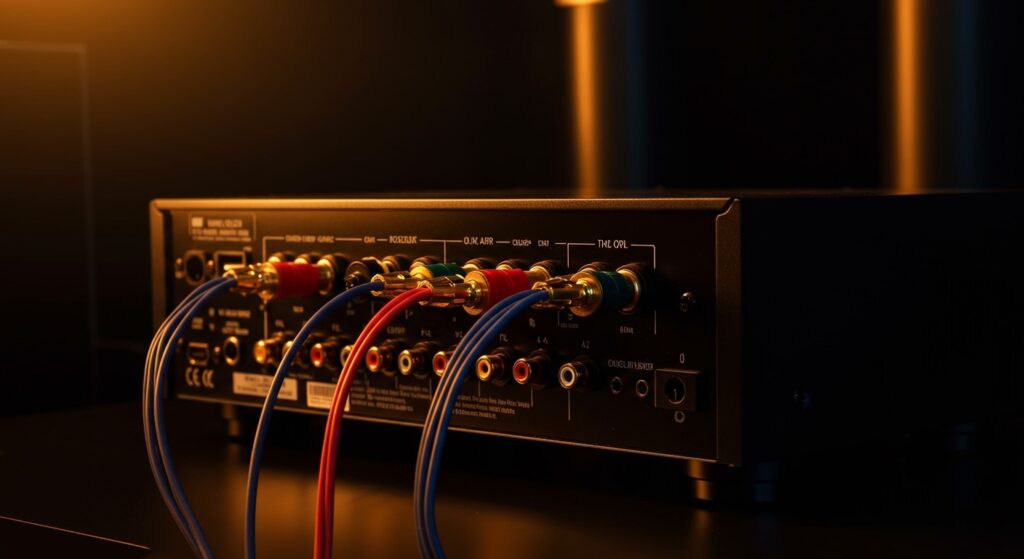
In my twenty years of installing high-end home audio, I’ve found that even premium speakers like the Theater Research line underperform if the wiring is thin or the placement is off. This guide will walk you through the precise technical steps to ensure your system delivers a “front-row” cinematic experience.
TL;DR: Quick Setup Checklist
- Wire Choice: Use 14-AWG copper wire for runs over 20 feet.
- Polarity: Always match Red (Positive) to Red and Black (Negative) to Black.
- Connection: Use Banana Plugs for a secure, oxidation-resistant fit.
- Placement: Position the Center Channel at ear level and Front L/R speakers 22-30 degrees off-center.
- Calibration: Run your receiver’s Auto-EQ (Audyssey/YPAO) after physical installation.
Essential Tools and Materials for Your Setup
Before diving into the wiring, you need the right tools to ensure a clean signal and a long-lasting connection. Cheap materials lead to signal degradation and “crackling” sounds over time.
I always recommend using CL2 or CL3 rated speaker wire if you plan on running cables through your walls. These are fire-rated and have thicker jackets to prevent interference.
Recommended Equipment Table
| Component | Recommended Spec | Why It Matters |
|---|---|---|
| Speaker Wire | 14 AWG Oxygen-Free Copper | Lower resistance for better bass response. |
| Connectors | Closed-Screw Banana Plugs | Prevents wire fraying and accidental shorts. |
| Wire Stripper | Self-Adjusting Strippers | Ensures you don’t nick the internal copper strands. |
| AV Receiver | Min. 85W per Channel | Provides enough “headroom” for dynamic movie peaks. |
| Subwoofer Cable | Double-Shielded RCA | Eliminates the “60Hz hum” often found in cheap cables. |
Step-by-Step: How to Hook Up Theater Research Speakers
Follow these steps meticulously to avoid damaging your voice coils or blowing a fuse in your integrated amplifier.
Preparing the Speaker Wire
Measure the distance from your receiver to each speaker location, adding an extra 2–3 feet for “slack.” Use your wire strippers to remove about half an inch of the plastic insulation from the ends of the wire.
Pro Tip: After stripping, twist the exposed copper strands tightly. This prevents “stray hairs” from touching the adjacent terminal, which can cause a short circuit and put your receiver into Protection Mode.
Identifying Polarity (The Red and Black Rule)
Most Theater Research speakers use binding posts. These are the screw-down knobs on the back of the cabinet.
Identify the positive (+) terminal (usually Red) and the negative (-) terminal (usually Black). Your speaker wire will likely have a marking—such as a white stripe, a ridge, or printed text—to identify one side. Stick to a consistent pattern; I usually use the “marked” side for Positive.
Making the Physical Connection
If using bare wire, unscrew the binding post, insert the twisted wire into the hole, and tighten the cap down firmly. If using banana plugs, simply plug them into the center of the binding post.
Ensure the connection is “hand-tight.” Over-tightening can crack the plastic housing of the terminal, while loose connections lead to intermittent signal loss.
Optimizing Speaker Placement for Maximum Immersion
Even if you know how to hook up theater research speakers perfectly, poor placement will destroy the soundstage. Sound is physics, and your room acts as a secondary “cabinet.”
The Front Stage (L-C-R)
Your Center Channel is the most important speaker because it handles 80% of movie dialogue. It should be directly above or below your screen, aimed at your ears.
The Front Left and Right speakers should form an equilateral triangle with your primary seating position. I have found that “toeing-in” (angling) the speakers slightly toward the listener improves imaging and makes the dialogue feel like it’s coming from the center of the screen.
Surround and Rear Placement
For a 5.1 Surround Sound setup, place the surround speakers to the sides of the seating area, slightly behind the listener. They should be about 2 feet above ear level to create a “diffuse” sound field.
In a 7.1 setup, the extra rear speakers go on the back wall, mirrored with the front speakers. This fills the “audio gap” directly behind your head.
Configuring Your AV Receiver Settings
Once the wires are connected, your work is only half done. You must tell your AV Receiver what kind of speakers you are using.
Setting Crossover Frequencies
Most Theater Research tower speakers are “Full Range,” but it is often better to set them to “Small” in the receiver settings. This redirects the deep bass (usually below 80Hz) to your powered subwoofer.
By doing this, you relieve the main speakers and the receiver’s power supply from the heavy lifting of bass frequencies. This results in much cleaner mid-range and treble performance.
Level Calibration
Every room has different acoustics. Some speakers might sound louder because they are closer to a corner. Use a Digital Sound Level Meter (or a smartphone app) to ensure every speaker hits 75dB at your seat when the receiver is at “reference level.”
Troubleshooting Common Setup Issues
If you’ve followed the steps on how to hook up theater research speakers but something sounds “off,” check these three common culprits.
The “Out of Phase” Problem
If the bass sounds thin or the dialogue seems to come from “everywhere” instead of the center, your speakers are likely out of phase. This happens if you swap the Positive and Negative wires on just one speaker. Double-check that every Red terminal on the receiver goes to a Red terminal on the speaker.
Static or Popping Noises
This is usually caused by a loose connection or EMI (Electromagnetic Interference). Ensure your speaker wires aren’t running parallel to power cords for long distances. If they must cross, have them cross at a 90-degree angle.
No Sound from One Channel
First, swap the “dead” speaker with a working one to see if the issue stays with the speaker or the wire. If the speaker works on a different wire, your speaker wire is likely kinked or broken inside the jacket.
Expert Insights: Why Wire Gauge Matters
Many people ask if they can use the thin “zip cord” that comes in the box. In my experience, Resistance is the enemy of audio quality.
- 18 AWG: Fine for small bookshelf speakers under 10 feet.
- 16 AWG: The standard for most home theaters.
- 14 AWG: Necessary for long runs or high-power Theater Research towers.
Higher-gauge (thicker) wire has lower resistance, allowing the amplifier to exert better Damping Factor over the speaker’s woofer. This makes the bass sound “tight” rather than “boomy.”
FAQ: Frequently Asked Questions
Can I mix Theater Research speakers with other brands?
Yes, you can mix brands, but try to keep the Front Three (L-C-R) from the same brand and series. This ensures a consistent Timbre, so a car driving across the screen doesn’t change its “sound character” as it moves from one speaker to the next.
Do I need an external amplifier for these speakers?
Most Theater Research speakers are efficient enough to be driven by a standard Denon, Onkyo, or Sony receiver. However, if you have a very large room and like to listen at “concert levels,” an external Power Amp will provide better clarity and prevent clipping.
How do I hide the speaker wires without cutting into walls?
You can use adhesive-backed wire raceways that run along the baseboard, or use Flat Speaker Wire that can be taped down and painted over. This keeps the room looking professional without a permanent renovation.
Is bi-wiring my speakers worth it?
For most users, bi-wiring (running two sets of wires to one speaker) offers negligible improvements. It is far more effective to spend that money on better room acoustics or a higher-quality subwoofer.
**
**
**
**