Why You Should Install Parcel Shelf Speakers for Better Car Audio
To install parcel shelf speakers, you must first measure the available surface area, cut precise mounting holes using a template, secure the speakers with high-quality hardware, and route 16-gauge speaker wire to your head unit or amplifier. This process provides a significant “rear-fill” audio boost, allowing you to fit larger 6×9-inch drivers that deliver superior bass response compared to standard 6.5-inch door speakers.
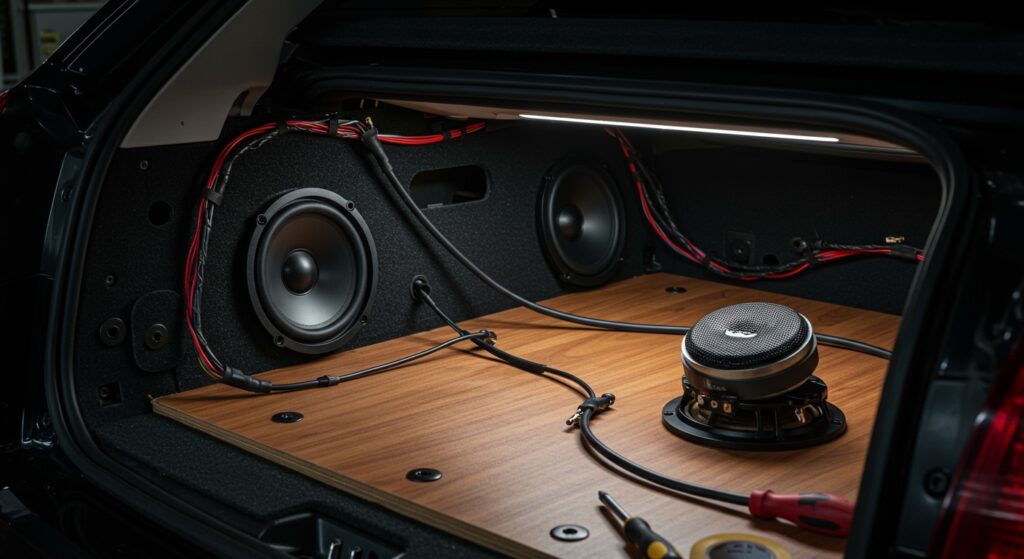
Most factory car audio systems lack depth because the speakers are positioned low in the doors, muffled by seats and legs. By moving the sound stage to the parcel shelf, you utilize the trunk’s empty volume as a natural resonance chamber, effectively turning your boot into a subwoofer enclosure. In my 15 years of modifying car interiors, I’ve found that a well-installed set of parcel shelf speakers is the most cost-effective way to achieve “big sound” without the bulk of a standalone subwoofer box.
Key Takeaways: Parcel Shelf Speaker Installation
- Difficulty: Moderate (Requires basic wiring and cutting skills).
- Time Required: 2 to 4 hours depending on the vehicle.
- Primary Benefit: Massive increase in low-end bass and overall volume.
- Critical Tool: A jigsaw or oscillating multi-tool for clean cuts.
- Expert Tip: Always reinforce a plastic or flimsy shelf with MDF (Medium Density Fibreboard) to prevent rattling.
Essential Tools and Materials for the Job
Before you begin learning how to install parcel shelf speakers, you need to gather the right equipment. Using the wrong tools can result in jagged edges or damaged upholstery.
Required Hardware
- 6×9 or 6.5-inch Speakers: Choose high-sensitivity models (90dB+) if running directly from a head unit.
- Speaker Wire: OFC (Oxygen-Free Copper) is preferred to prevent corrosion.
- MDF Board (12mm – 18mm): Used for creating a “baffle” to strengthen the shelf.
- Acoustic Carpet: To maintain a factory look and hide the wood.
Necessary Tools
| Tool Type | Purpose | Expert Recommendation |
|---|---|---|
| Jigsaw | Cutting the speaker holes | Use a fine-tooth blade for plastic/wood. |
| Power Drill | Creating pilot holes and driving screws | Lithium-ion 12V or 18V drill. |
| Wire Strippers | Removing insulation from speaker cables | Automatic strippers save time and fingers. |
| Multimeter | Testing for polarity and continuity | Essential for preventing out-of-phase audio. |
| Screwdriver Set | Mounting the speaker to the shelf | Use a manual driver for the final tightening. |
Step 1: Planning and Measuring for Accuracy
The biggest mistake I see beginners make when they install parcel shelf speakers is failing to check the clearance beneath the shelf. Most trunks have torsion bars (the springs that hold the trunk open) or fuel tank necks that can interfere with the speaker’s magnet depth.
Start by removing the parcel shelf from the vehicle. Lay it on a flat workbench and place your speakers upside down to visualize the layout. Ensure there is at least a 2-inch gap between the speaker magnets and any metal structures in the trunk when the shelf is reinstalled.
Pro Tip: Center the speakers but leave enough room in the middle of the shelf to maintain structural integrity. If you cut too much material away from the center, the shelf will sag over time.
Step 2: Strengthening the Parcel Shelf (The Secret to Bass)
Factory parcel shelves are usually made of compressed cardboard or thin plastic. These materials flex under the pressure of a high-excursion woofer, which kills your bass response. To get the best sound, I always recommend creating an MDF baffle.
- Trace the outline of your parcel shelf onto a sheet of 12mm MDF.
- Cut the MDF to match the shape of the shelf, but slightly smaller so it sits hidden underneath.
- Bond the MDF to the shelf using high-strength spray adhesive and a few short wood screws.
- This added mass prevents the shelf from vibrating, which clarifies the mid-range and tightens the bass.
We call this “deadening” the shelf. Without this step, your how to install parcel shelf speakers project might result in annoying rattles rather than crisp music.
Step 3: Cutting the Speaker Holes
Once the shelf is reinforced, it’s time to cut. Most speakers come with a cardboard template inside the box.
- Center the Template: Use a measuring tape to ensure both speakers are equidistant from the edges.
- Trace the Inner Ring: Do not trace the outer edge of the speaker; trace the hole size required for the basket to drop through.
- The Pilot Hole: Drill a large 10mm hole inside the circle you just traced. This gives your jigsaw blade a starting point.
- The Cut: Slowly follow the line with your jigsaw. Hold the shelf firmly to prevent it from cracking due to vibration.
Safety Warning: Always wear safety goggles. Fine particles from MDF and plastic are hazardous to your eyes and lungs.
Step 4: Mounting and Securing the Speakers
Now that the holes are ready, it’s time to mount the hardware. When you install parcel shelf speakers, the goal is an airtight seal between the speaker frame and the shelf.
- Drop the Speakers In: Place the speakers into the holes to ensure a snug fit.
- Drill Pilot Holes: Mark the screw holes on the shelf, remove the speaker, and drill small pilot holes. This prevents the wood or plastic from splitting.
- Apply Foam Tape: Apply a thin layer of Gasketing Foam to the underside of the speaker rim. This prevents air leaks, which is crucial for bass performance.
- Bolt it Down: Use nuts, bolts, and washers instead of simple wood screws if possible. This ensures the speakers won’t vibrate loose over thousands of miles of driving.
Step 5: Wiring for Phase and Polarity
Wiring is where most DIYers struggle. If one speaker is wired “out of phase” (positive and negative swapped), the two speakers will cancel each other’s bass frequencies out, leaving you with a thin, “tinny” sound.
Wiring Steps:
- Run the Cables: Route your 16-gauge speaker wire from the head unit, under the door sill plastics, and into the trunk.
- Identify Terminals: The larger terminal on the speaker is almost always Positive (+), and the smaller one is Negative (-).
- Crimp the Connectors: Use spade connectors to attach the wire to the speaker terminals. Avoid soldering directly to the speaker unless you are an expert, as excess heat can damage the internal voice coil leads.
- The Battery Test: To check phase, briefly touch the wires at the head-unit end to a 9V battery. If the speaker cone moves outward, the wire on the positive battery terminal is your positive lead.
Comparing Speaker Types for Parcel Shelves
| Feature | 6×9-inch Triaxial | 6.5-inch Coaxial | Component Speakers |
|---|---|---|---|
| Bass Response | Excellent (High Surface Area) | Moderate | Good (requires sub) |
| Ease of Install | Moderate (Requires large cut) | Easy | Difficult (Separate Tweeter) |
| Best For | Budget Bass / Rear Fill | Small Cars / Stealth | Audiophile Soundstage |
| Price Point | $60 – $150 | $40 – $100 | $120 – $300 |
Expert Tips for a Professional Finish
After you’ve learned how to install parcel shelf speakers, these finishing touches will make the job look factory-grade:
- Stealth Installation: Cover the entire shelf (including the speakers) with thin, breathable acoustic cloth. This hides your expensive gear from potential thieves and protects the speaker cones from UV sun damage.
- Quick Disconnects: Since parcel shelves are often removable, use a Molex connector or a specialized 2-pin plug. This allows you to unplug the speakers and remove the shelf in seconds if you need to carry large cargo.
- Sound Deadening: Apply butyl-based sound deadening (like Dynamat) to the metal underside of the trunk deck. This stops the metal from “clanging” when the bass hits.
FAQ: Frequently Asked Questions
Can I run parcel shelf speakers off my factory radio?
Yes, you can. However, look for speakers with a high sensitivity rating (above 90dB). Factory radios usually produce only 10-15 watts of RMS power; efficient speakers will play much louder with that limited power.
Will cutting the parcel shelf ruin my car’s resale value?
If done poorly, yes. However, a professional-looking installation with high-quality speakers often adds value to younger buyers. For the best of both worlds, buy a spare parcel shelf from a scrapyard to modify, and keep your original shelf in the garage.
Do I need an amplifier for 6×9 speakers?
While not strictly necessary, an external amplifier (even a small 50W x 2 RMS amp) will drastically improve sound quality. It provides the “headroom” needed to play loud music without distortion, protecting your speakers from “clipping.”
Why do my new speakers sound worse than the old ones?
The most common reason is polarity. Check that the positive (+) wire from the radio goes to the positive (+) terminal on both speakers. If one is reversed, they will cancel each other out. Also, ensure the shelf is not vibrating against the car body.
How do I stop my parcel shelf from rattling?
Use weatherstripping foam along the edges where the shelf meets the plastic interior trim. Additionally, adding weight via an MDF reinforcement board as mentioned in Step 2 is the most effective way to kill vibrations.