How to Make DJ Speakers at Home: A Professional Guide
To make DJ speakers at home, you must design a rigid enclosure based on your woofer’s Thiele/Small parameters, cut 18mm Baltic Birch plywood, install a high-frequency compression driver, and wire a crossover circuit to manage frequencies. This DIY process allows you to achieve professional-grade Sound Pressure Levels (SPL) and durability at roughly 40-60% of the cost of retail brands like QSC or JBL.
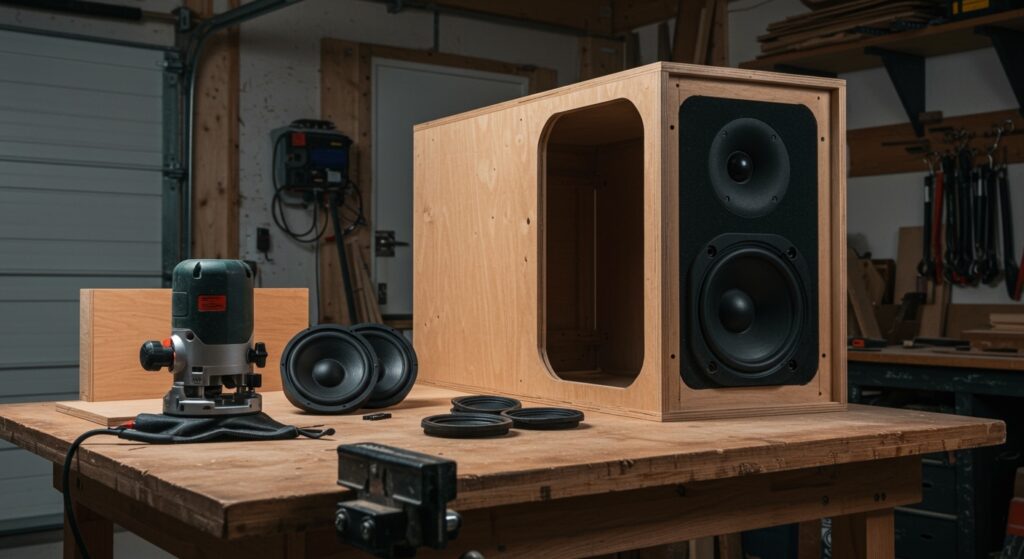
Building your own mobile DJ rig is a rite of passage for many audio engineers. While off-the-shelf speakers are convenient, they often use cheaper internal components to meet price points. When we built our first set of 12-inch tops in the workshop, the clarity outperformed “prosumer” models because we prioritized high-quality Eminence drivers and heavy-duty internal bracing.
Key Takeaways for DIY DJ Speakers
- Material Choice: Always use 13-ply Baltic Birch plywood; avoid thin MDF for mobile use.
- Driver Selection: Focus on high-sensitivity Woofers (96dB+) to maximize amplifier efficiency.
- Software is Essential: Use WinISD or VituixCAD to model your box volume before cutting wood.
- Connection Standard: Use Neutrik speakON connectors for reliable, high-current power delivery.
- Finish Matters: Apply Duratex texture coating for a professional, scratch-resistant “pro-audio” look.
Why You Should Learn How to Make DJ Speakers at Home
The primary reason to build your own gear is the Price-to-Performance ratio. For the $800 you might spend on a single active plastic speaker, you can build a high-performance passive cabinet using Italian-made B&C drivers that will last a decade.
In my experience, retail speakers often fail at the crossover or the built-in plate amp. By building a passive system (external amplifier), you make your rig more modular and easier to repair during a live gig. If an amp fails, you swap the rack unit; if a driver blows, you know exactly how to reach it.
Essential Components and Tools
Before you start the assembly, you need a specific list of hardware. Don’t compromise on the quality of your wood or your high-frequency (HF) drivers, as these define the “throw” and clarity of your sound.
| Component | Recommended Type | Purpose |
|---|---|---|
| Enclosure Material | 18mm Baltic Birch Plywood | Provides structural rigidity and reduces resonance. |
| Low-Frequency Driver | 12″ or 15″ High-Output Woofer | Handles the “kick” and mid-bass frequencies. |
| Compression Driver | 1″ or 1.4″ Exit Pro-Audio Driver | Provides the crisp “highs” needed for dance music. |
| Crossover | 2-Way Passive (1.6kHz – 2.5kHz) | Splits the signal between the woofer and the tweeter. |
| Acoustic Damping | Polyfill or Egg-crate Foam | Absorbs internal standing waves to clean up the sound. |
| Hardware | Recessed Handles & Top Hats | Makes the speakers portable and mountable on stands. |
Required Tools for the Build
- Table Saw or Circular Saw with a high-tooth count blade for clean cuts.
- Router with a circle-cutting jig for perfect driver holes.
- Power Drill and impact driver.
- Wood Glue (Titebond II or III is the industry standard).
- Clamps (You can never have too many).
Step 1: Designing Your Enclosure with WinISD
The most common mistake when learning how to make DJ speakers at home is “guessing” the box size. Every speaker driver has a Vas (Equivalent Volume) and Fs (Resonant Frequency).
Download WinISD (free software) and input your driver’s Thiele/Small parameters. The software will tell you the exact internal volume (measured in Liters or Cubic Feet) needed to reach your target bass response. For a DJ “top” speaker, you usually want a tuning frequency (Fb) between 50Hz and 65Hz.
Step 2: Cutting and Bracing the Cabinet
Once you have your dimensions, it is time to cut your Baltic Birch. I highly recommend using a “cleated” joinery method or pocket holes combined with plenty of wood glue.
Internal bracing is the secret to a professional sound. A large, unbraced wooden panel will vibrate like a drumhead, coloring your sound and wasting energy. We always install “shelf bracing” or window-pane braces every 8-10 inches inside the cabinet to ensure the box is “dead” to the touch during high-volume playback.
Step 3: Routing the Driver Holes and Ports
Use a Plunge Router with a circle jig to cut the openings for your woofer and your horn lens. If you are building a ported design, you will also need to cut holes for your PVC or wooden shelf ports.
Pro Tip: Always “recess” your drivers. Routing a shallow 1/4-inch lip allows the speaker to sit flush with the wood. This doesn’t just look better; it reduces diffraction and makes it easier to install a protective steel grille later.
Step 4: Installing the Crossover and Wiring
The Crossover is the “brain” of your speaker. It ensures that deep bass doesn’t destroy your delicate compression driver and that high frequencies don’t muddy up your woofer.
- Mount the Crossover: Secure it to the back panel, away from the vibrating woofer magnet.
- Use Heavy Gauge Wire: Use at least 14 AWG copper wire for internal connections.
- Solder Connections: While crimp connectors work, soldering ensures that vibrations won’t shake your wires loose during a 4-hour DJ set.
- Install speakON Jacks: Use a Neutrik NL4MP connector. It is the global standard for pro audio because it locks into place.
Step 5: Sanding, Finishing, and Duratex
DJ speakers take a beating. They get moved in and out of vans and bumped in dark clubs. Standard paint will chip immediately.
We use Duratex, a water-based specialized coating. You apply it with a textured roller to create a rugged, “bumpy” finish that hides wood imperfections and resists scratches. After two coats, your DIY project will look exactly like a Turbosound or Martin Audio cabinet.
Testing Your DIY DJ Speakers
Before taking your new speakers to a gig, perform a polarity test. Use a 9V battery on the speaker cable; the woofer should move forward when the positive terminal is touched. If it moves backward, your wiring is out of phase, which will cancel out all your bass.
Run the speakers at low volume for 10-12 hours to “break in” the stiff fabric surrounds of the pro-audio woofers. You’ll notice the bass becomes much warmer and deeper after this initial period.
Frequently Asked Questions
Is it cheaper to build or buy DJ speakers?
If you are comparing DIY to budget “big box” store speakers, buying is cheaper. However, if you want high-end performance, you can build a speaker that sounds like a $1,200 unit for about $500 in parts. The value is found in the component quality.
What wood is best for DJ speakers?
13-ply Baltic Birch Plywood is the gold standard. It is incredibly strong, holds screws well, and doesn’t have internal air pockets (voids) like standard construction plywood. MDF is too heavy and fragile for mobile DJ use.
Do I need a crossover for my DIY speakers?
Yes. Without a crossover, your high-frequency driver will receive low-frequency energy that will physically break the diaphragm within seconds of high-volume use. It also ensures a smooth transition between the two drivers.
Can I make active speakers at home?
Yes, you can buy Plate Amplifiers (like those from Dayton Audio or Hypex) that screw directly into the back of your cabinet. This eliminates the need for an external amp rack but makes the speaker heavier.