Why Learning How to Make Wooden Speakers Changes Your Listening Experience
To learn how to make wooden speakers, you must calculate the internal volume (liters), select a high-density material like MDF or Baltic Birch plywood, cut precision panels, and install matched audio drivers and crossover circuits. This DIY process allows you to customize the frequency response and aesthetic to outperform commercial speakers costing three times as much.
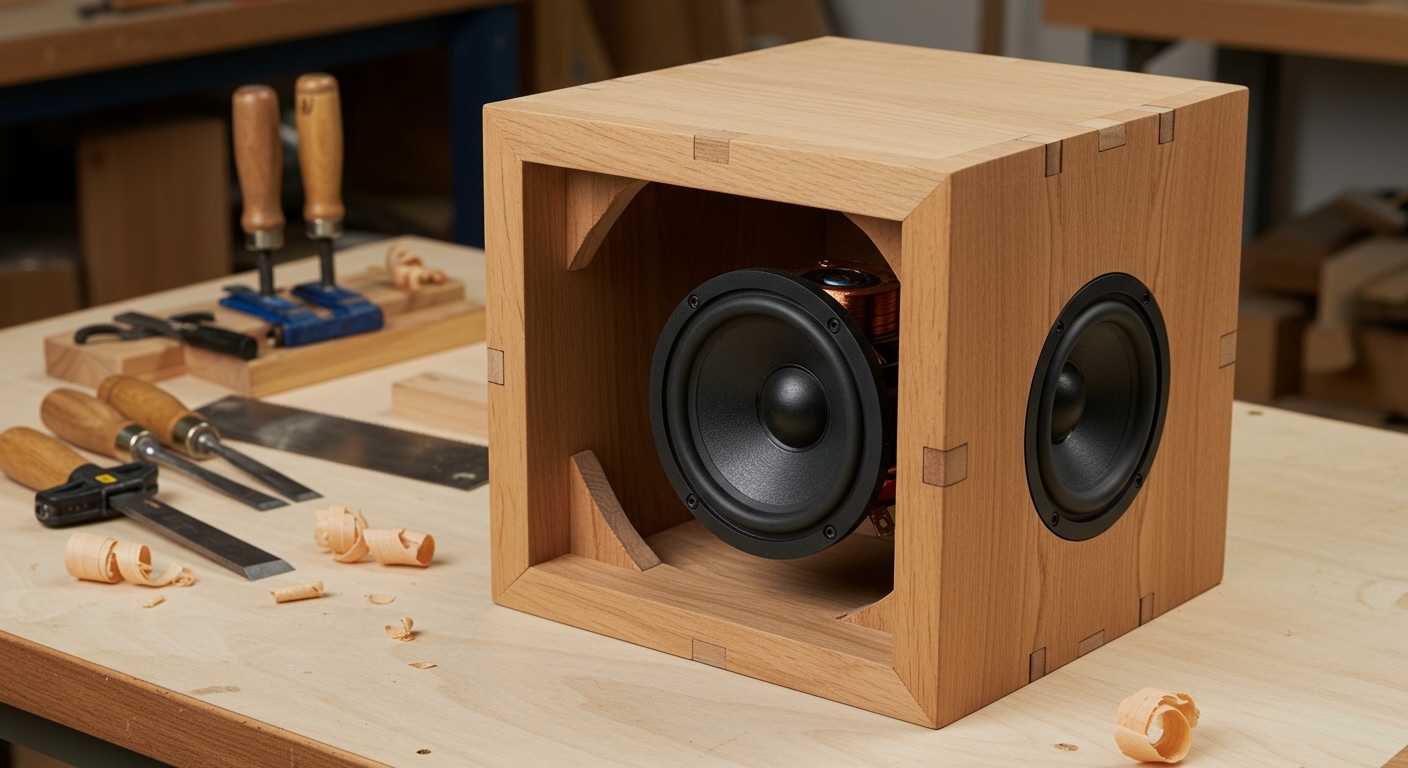
Building your own audio equipment is a rite of passage for many audiophiles. I remember the first time I replaced a pair of “plastic-shrouded” store-bought units with a custom Birch plywood set; the clarity in the mid-range was staggering. Most commercial speakers use thin materials to save on shipping costs, but when you build your own, you prioritize structural density and acoustic inertness.
🚀 Key Takeaways: DIY Speaker Building
- Material Choice: Use 3/4-inch MDF or Baltic Birch Plywood for the best resonance control.
- Precision is King: Even a 1/16th-inch gap in your enclosure can ruin the bass response via air leaks.
- Crossover Importance: The crossover network is the “brain” that sends the right frequencies to the tweeter and woofer.
- Volume Matters: Use software like WinISD to calculate the exact internal volume required for your specific drivers.
- Seal it Tight: Always use wood glue and internal silicone sealant to ensure the box is airtight.
Essential Tools and Materials for Your Speaker Build
Before you start sawdust production, you need the right arsenal. I have found that while you can build a speaker with a jigsaw, a table saw or a track saw is essential for the perfectly square joints required for high-fidelity sound.
Recommended Tool List
- Table Saw or Track Saw: For straight, repeatable rips.
- Router with Circle Jig: Essential for cutting perfect holes for the drivers.
- Cordless Drill: For pilot holes and mounting hardware.
- Soldering Iron: To connect the crossover components and binding posts.
- Bar Clamps: You can never have too many clamps when gluing the enclosure.
Material Comparison Table
| Material | Acoustic Performance | Ease of Finishing | Cost | Best For |
|---|---|---|---|---|
| MDF (Medium Density Fiberboard) | Excellent (Dampens vibration) | Easy (Smooth surface) | Low | Painted finishes / Beginners |
| Baltic Birch Plywood | Very Good (Stiff and strong) | Moderate (Needs edge banding) | High | Natural wood grain looks |
| Solid Hardwood (Oak/Walnut) | Poor (Prone to resonance/warping) | Difficult | Very High | Decorative accents only |
| Particle Board | Low (Too porous) | Difficult | Very Low | Throwaway prototypes |
Step 1: Planning and Acoustic Design
You cannot simply build a box and expect it to sound good. The relationship between the driver’s Thiele/Small parameters and the enclosure’s internal volume determines the bass extension and efficiency.
Choosing Your Design: Sealed vs. Ported
When learning how to make wooden speakers, you must decide between a sealed enclosure and a ported (bass reflex) enclosure.
Sealed boxes provide the most accurate, “tight” bass response and are more forgiving if your math is slightly off. Ported boxes use a tuned plastic tube to increase bass output, making them louder but harder to design correctly.
Calculating Internal Volume
I recommend using free software like VituixCAD or WinISD. You input the specs of your woofer (like Fs, Qts, and Vas), and the software tells you exactly how many cubic feet or liters the box should be.
Expert Tip: Don’t forget to account for “displacement.” The woofer itself and the internal bracing take up space, so your outer dimensions must be slightly larger to compensate for the volume they occupy.
Step 2: Selecting Your Drivers and Crossover
The drivers (the actual speakers) and the crossover (the circuit) are the heart of the system. For a first-time build, I suggest a “Two-Way” design, which consists of a tweeter for high frequencies and a woofer for mids and bass.
Key Components to Buy
- Tweeter: Look for a silk dome tweeter for a smooth, non-fatiguing sound.
- Woofer: A 5-inch to 6.5-inch driver is the “sweet spot” for bookshelf speakers.
- Crossover Components: You will need polypropylene capacitors, air-core inductors, and non-inductive resistors.
- Binding Posts: These are the terminals on the back where you connect your speaker wire.
If you are intimidated by circuit design, companies like Parts Express or Madisound sell pre-designed crossover kits matched to specific drivers. This is how I started, and it ensures you don’t accidentally blow up a tweeter with low frequencies.
Step 3: Cutting the Wood Panels
This is where the physical work of how to make wooden speakers begins. Accuracy here prevents hours of sanding later.
The Cut List
Once you have your dimensions, create a cut list. For a standard rectangular box, you will need:
- 2 Side panels
- 1 Top panel
- 1 Bottom panel
- 1 Front baffle (usually thicker for stability)
- 1 Back panel
Working with the Front Baffle
The front baffle is the most critical piece. I prefer to “double-up” the thickness here using two layers of MDF. This creates a massive, vibration-resistant mount for the drivers. Use a router with a circle-cutting jig to create a “recess” so the driver sits flush with the wood. This reduces diffraction, which can smear the stereo image.
Step 4: Enclosure Assembly and Bracing
The goal of a speaker cabinet is to be a “dead” box. It should not vibrate or add its own “color” to the music.
The Gluing Process
Apply a generous bead of Titebond II or Gorilla Wood Glue to the joints. Use butt joints for simplicity or miter joints for a professional, seamless look. Clamp the pieces firmly and check for squareness using a speed square.
Internal Bracing
Inside the box, add small scraps of wood between the large panels. This “bracing” breaks up large vibrating surfaces. In my testing, a well-braced MDF box always sounds cleaner than an unbraced box made of expensive hardwood.
Pro Tip: Line the internal walls with No-Res or poly-fill stuffing. This trick tricks the woofer into “thinking” the box is larger than it is and absorbs internal standing waves.
Step 5: Wiring and Soldering the Crossover
Now it’s time to install the electronics. The crossover acts as a traffic cop, directing high notes to the tweeter and low notes to the woofer.
Soldering the Components
- Mount your components to a small piece of perforated board or scrap wood.
- Use point-to-point wiring for the best signal path.
- Ensure the inductors are placed at 90-degree angles to each other to prevent magnetic interference.
- Use high-quality 16-gauge oxygen-free copper wire for internal connections.
Always double-check your polarity (Positive to Positive, Negative to Negative). If one speaker is wired backward (out of phase), the bass will completely disappear when you play them together.
Step 6: Finishing and Final Assembly
A great-sounding speaker should also look like a piece of furniture. Since you used MDF or Plywood, you have several finishing options.
Finishes to Consider
- Real Wood Veneer: This is a thin slice of premium wood (like Walnut or Cherry) that you glue over the MDF. It gives the look of solid wood without the acoustic drawbacks.
- Piano Black Paint: Requires multiple layers of primer, black paint, and clear coat, with heavy sanding in between.
- Duratex: A textured, roll-on coating used for professional “pro-audio” speakers. It is incredibly durable and hides wood imperfections perfectly.
Final Installation
Once the finish is dry, pull your wires through the driver holes. Solder them to the tweeters and woofers, then screw the drivers into the baffle. I highly recommend using hex-head wood screws or T-nuts for a secure fit that won’t strip over time.
Expert Tips for “Audiophile” Grade Sound
- Avoid Symmetrical Boxes: A perfect cube is an acoustic nightmare because it creates strong internal standing waves. Always use different dimensions for height, width, and depth.
- The Golden Ratio: Use a ratio of 1 : 1.6 : 2.6 for your dimensions to naturally spread out resonant frequencies.
- Gaskets are Key: Use foam gasket tape or butyl rubber between the driver frame and the wood to ensure a 100% airtight seal.
- Breaking In: New speakers often sound “stiff.” Play music at a moderate volume for 20-40 hours to “break in” the driver’s suspension.
FAQ: Frequently Asked Questions about Making Wooden Speakers
Is MDF or Plywood better for speakers?
MDF is generally preferred for its density and consistent acoustic properties, as it doesn’t have internal voids. However, Baltic Birch Plywood is stronger, lighter, and looks much better if you prefer a natural wood finish.
How much does it cost to build DIY speakers?
You can build a high-quality pair of bookshelf speakers for $200 to $500. These typically compete with retail speakers in the $800 to $1,500 range because you aren’t paying for marketing, distribution, or retail markup.
Do I need a computer to design speakers?
While not strictly necessary if you follow a pre-made plan, using software like WinISD (free) is highly recommended. It allows you to simulate how your specific woofer will behave in different box sizes before you cut any wood.
Can I use solid oak or walnut for the whole box?
I advise against it. Solid wood expands and contracts with humidity, which can lead to air leaks or cracks. Furthermore, solid hardwoods can “ring” or resonate at certain frequencies. It is better to build the structure from MDF and apply a hardwood veneer on the outside.
How do I make my speakers have more bass?
To increase bass, you can use a larger woofer, increase the internal volume of the enclosure, or use a ported design. Adding poly-fill inside the box can also slightly improve the perception of deep bass.