Understanding the Essentials of Passive PA Speaker Power
To power passive PA speakers, you must connect them to an external power amplifier using dedicated speaker cables, as they do not have internal amplification. The key to a safe and clear sound is matching the amplifier’s output to the speaker’s impedance (ohms) and providing 1.5 to 2 times the Continuous (RMS) power rating of the speaker to ensure adequate “headroom.”
Setting up a sound system can be intimidating, especially when you are staring at a pile of heavy power amps, thick cables, and massive speaker cabinets. I remember my first gig where I mismatched the impedance on a pair of subwoofers; the amp overheated and shut down right before the headliner started. This guide is built on those “trial by fire” moments, designed to help you avoid blown drivers and thermal shutdowns while achieving the punchiest sound possible.
TL;DR: Quick Guide to Powering Passive Speakers
- Source an External Amp: Passive speakers require a separate power amplifier or a powered mixer.
- Match the Ohms: Ensure your amp is stable at the speaker’s impedance (usually 4 or 8 ohms).
- The 2x Rule: Aim for an amp that delivers double the RMS wattage of the speaker.
- Use Speakon Cables: Use high-gauge Speakon cables for the most secure and efficient power transfer.
- Avoid Clipping: Never let your amp’s “Peak” or “Clip” lights stay solid red.
Step 1: Decode Your Speaker’s Power Ratings
Before buying an amplifier, you must understand the label on the back of your passive PA speaker. Manufacturers provide three main numbers, and choosing the wrong one to follow is the most common cause of gear failure.
RMS (Continuous) vs. Program vs. Peak
- RMS (Root Mean Square): This is the “real world” number. It represents the amount of continuous power the speaker can handle over a long period. Always use this as your baseline.
- Program Power: This is generally twice the RMS rating. It simulates real-world musical peaks. Most professionals recommend matching your amp to this number.
- Peak Power: This is the absolute maximum the speaker can handle for a fraction of a second. Never buy an amp based on this number, as you will likely melt the voice coils.
Why Headroom Matters
In my 15 years of live sound engineering, I’ve found that “under-powering” a speaker is often more dangerous than “over-powering” it. If your amp is too small, you will push it into clipping to get enough volume. A clipping amp sends a square-wave signal that generates massive heat, which destroys tweeters instantly. Providing 1.5x to 2x the RMS power gives you “headroom,” allowing the amp to breathe during loud transients without distorting.
Step 2: Match Impedance (The “Ohms” Law)
Impedance is the electrical resistance your speakers provide to the amplifier, measured in Ohms (Ω). Most PA speakers are rated at 8 ohms, though some subwoofers are 4 ohms.
Understanding Load and Efficiency
Think of impedance like a pipe:
- 8 Ohms: A thinner pipe. The amp doesn’t have to work as hard, but less “water” (power) flows.
- 4 Ohms: A wider pipe. The amp works harder, and more power flows.
- 2 Ohms: A massive pipe. Only high-end professional amplifiers (like the Crown I-Tech series) can handle this without catching fire.
Connecting Multiple Speakers
When you “daisy-chain” two 8-ohm speakers together from one amp channel, the total impedance drops to 4 ohms. You must ensure your power amplifier is rated to handle a 4-ohm load. If you connect three or four speakers to one channel and drop below 2 ohms, most budget amps will enter “Protect Mode” or blow a fuse.
| Speaker Configuration | Total Impedance Load | Amplifier Requirement |
|---|---|---|
| Single 8Ω Speaker | 8 Ohms | Standard; Low Heat |
| Two 8Ω Speakers (Parallel) | 4 Ohms | Most Common; Higher Output |
| Two 4Ω Speakers (Parallel) | 2 Ohms | Requires High-End “2-Ohm Stable” Amp |
| Four 8Ω Speakers (Parallel) | 2 Ohms | Dangerous for budget amps |
Step 3: Choose the Right Power Amplifier
Once you know your wattage and ohms, you need the right tool for the job. Not all amplifiers are created equal.
Amplifier Classes
- Class A/B: These are traditional, heavy, and reliable. They sound great but generate significant heat. Look at the QSC RMX series for a bulletproof example.
- Class D: These are the modern standard. They are incredibly lightweight (often under 10 lbs) and highly efficient. The Behringer NX series or Crown XLS DriveCore are popular for mobile DJs and bands.
Stereo vs. Bridge Mono Mode
Most amps have a switch on the back for different modes:
- Stereo Mode: Channel A powers Speaker A, and Channel B powers Speaker B. This is the standard setup.
- Parallel Mode: One input signal is sent to both output channels. Great for mono PA setups.
- Bridge Mono Mode: Combines both channels into one massive mono output. I frequently use this for passive subwoofers that need 2000+ watts of power, but be careful—this doubles the voltage and can easily blow standard speakers.
Step 4: Use the Correct Speaker Cables
You cannot use standard guitar cables (TS instrument cables) to power passive PA speakers. While they look similar, instrument cables are shielded and have very thin wire. They will melt under the high current of a power amp.
Speakon vs. 1/4″ TS
- Speakon (NL4): The industry standard. These lock into place, preventing accidental unplugging. They have better contact surface area and can handle much higher current. Always use Speakon if your gear supports it.
- 1/4″ Speaker Cable: Used on older gear. Ensure the cable is labeled “Speaker Cable” and uses at least 14-gauge or 12-gauge wire.
Wire Gauge (AWG)
The longer the cable run, the thicker the wire needs to be to prevent power loss.
- Under 25 feet: 16-gauge is acceptable.
- 25 – 50 feet: 14-gauge is recommended.
- Over 50 feet: Use 12-gauge to ensure your bass stays tight and impactful.
Step 5: The Connection Sequence (Signal Flow)
To avoid a loud “pop” that can damage your compression drivers, always follow this specific power-up and power-down sequence.
The Power-Up Routine
- Turn all volumes down: Start with your mixer and amp at zero.
- Turn on the Mixer/Processing: Let your console, EQ, and crossovers stabilize first.
- Turn on the Power Amplifier: Always turn the amp on last.
- Increase Gain: Slowly bring up your mixer masters, then the amp attenuators.
The Power-Down Routine
- Turn off the Power Amplifier first: This prevents any shutdown transients from the mixer from reaching the speakers.
- Turn off the Mixer and Outboard Gear.
Step 6: Setting Gain and Avoiding the “Red Lights”
Setting your levels is the final step in how to power passive PA speakers correctly. We use a process called “Gain Staging.”
- Set Mixer Levels: Run your mixer so the meters are hitting “0 dB” or just into the yellow.
- Open Amp Attenuators: Turn your amplifier knobs up until you reach the desired volume.
- Watch the Clip Light: If the red “Clip” or “Peak” light on the amp flickers occasionally during a kick drum hit, you are at the limit. If it stays lit, turn the volume down immediately.
I’ve seen many “bedroom DJs” keep their amp knobs at 100% and then barely move their mixer faders. This is a mistake. It raises the noise floor (that annoying “hiss”). Instead, find a balance where the mixer has a strong signal and the amp provides the necessary muscle.
Troubleshooting Common Issues
No Sound
- Check the Amp Mode: Is it in “Bridge” mode while you are plugged into “Stereo” outputs?
- Check the Cables: Speakon connectors require a “twist and click.” If they aren’t locked, they won’t make contact.
Distorted Sound at Low Volume
- Check the Input Signal: Are you sending too hot a signal from the mixer? Check the “Input Clip” light on the amp.
- Impedance Mismatch: You might be trying to run a 2-ohm load on a 4-ohm rated amp.
The Amp Keeps Shutting Off
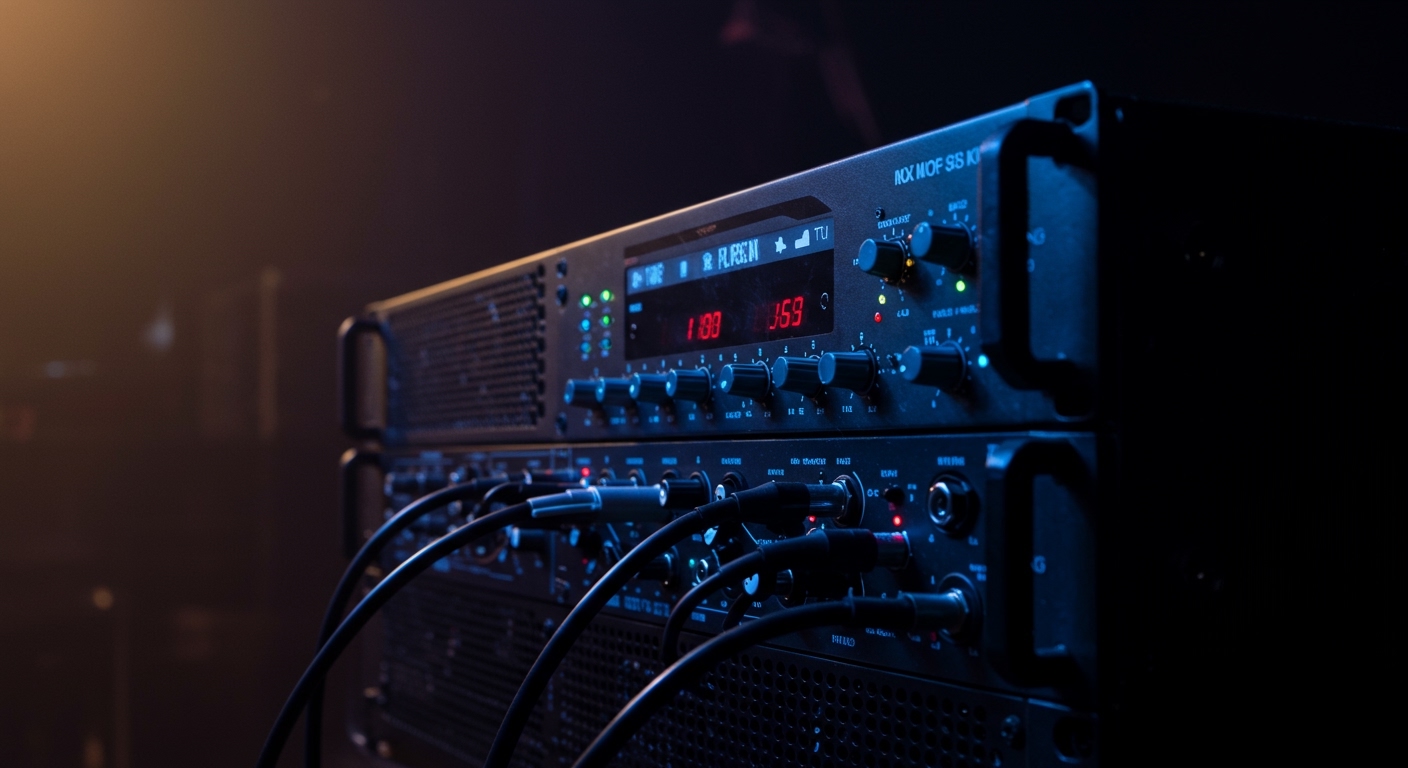
- Thermal Overload: Ensure the amp rack has enough ventilation. I always leave a 1U space between heavy power amps to allow airflow.
- Short Circuit: A single stray strand of wire in a 1/4″ speaker plug can cause a short, triggering the amp’s protection circuit.
Frequently Asked Questions
Can I connect a passive speaker directly to a mixer?
No, a standard mixer only outputs “line-level” signals. You must have a power amplifier or a powered mixer (which has an amp built-in) to drive a passive speaker.
Is it better to have an amp with more watts than the speaker?
Yes. Having an amp rated for 150-200% of the speaker’s RMS rating provides the “headroom” needed to reproduce clear audio peaks without clipping, which is much safer for the speaker.
Can I mix different brands of amps and speakers?
Absolutely. As long as the impedance (ohms) and wattage are compatible, you can use a Crown amp with JBL speakers, or a QSC amp with Yamaha speakers.
What happens if I use a guitar cable instead of a speaker cable?
A guitar cable is not designed to carry high voltage. It can overheat, melt its internal insulation, short out your amplifier, and potentially cause a fire. Never use instrument cables for speakers.
How do I know if my speaker is passive or active?
Look at the back. If it has a power cord (AC plug) and an “On/Off” switch, it is Active. If it only has “Input” jacks (Speakon or 1/4″) and no power plug, it is Passive.



![Is Behringer Speakers a Good Brand? [2024 Expert Review]](https://bestsounds.net/wp-content/uploads/2026/03/is-behringer-speakers-a-good-brand-2024-expert-review-featured-1774149096.jpg "Is Behringer Speakers a Good Brand? [2024 Expert Review]")