How to Power Speakers with a Car Battery: The Direct Answer
To how to power speakers with a car battery, you must connect the battery to an amplifier or a power inverter using high-quality copper wiring and an inline fuse. For 12V car speakers, you can wire them directly to a 12V car amplifier powered by the battery; for home speakers, you must use a power inverter to convert the battery’s DC power to AC power. This setup allows you to create high-output mobile sound systems for tailgating, camping, or off-grid events without a traditional wall outlet.
TL;DR: Key Takeaways for Mobile Power
- Safety First: Always use an inline fuse within 12 inches of the battery terminal to prevent fires.
- The “Inverter” Rule: If your speakers have a standard wall plug, you need a Pure Sine Wave Inverter.
- The “Amp” Rule: If using raw car speakers, use a 12V DC Car Amplifier.
- Wire Gauge Matters: Use at least 8-gauge or 4-gauge wire for high-wattage setups to prevent voltage drop.
- Battery Health: Do not drain a standard car battery below 12.2 volts, or it may not start your car later.
Understanding the Equipment Needed
In my years of building custom mobile audio rigs for beach parties and outdoor rallies, I’ve found that the “bottleneck” is rarely the speaker itself—it’s the current delivery. A car battery provides 12V Direct Current (DC), but most high-end home speakers require 120V Alternating Current (AC).
To bridge this gap, you need a specific signal chain. Depending on your goals, you will choose one of two paths: the Direct 12V Path or the Inverter Path.
Essential Component Checklist
- 12V Car Battery: Ideally a Deep Cycle or AGM battery if you plan on long listening sessions.
- Amplifier: A 12V Class D amplifier is most efficient for battery use.
- Wiring Kit: Including Power (Red) and Ground (Black) cables.
- Inline Fuse Holder: Essential for protecting your equipment from short circuits.
- Wire Strippers & Crimpers: For secure electrical connections.
- Multimeter: To monitor battery voltage and prevent over-discharge.
Step-by-Step Guide: How to Power Speakers with a Car Battery
Setting up a mobile audio system requires precision. Follow these steps to ensure you don’t fry your components or cause a thermal event.
Step 1: Calculate Your Power Requirements
Before connecting anything, check the RMS Wattage of your speakers. If you have a 200W RMS speaker, your battery needs to provide enough Amps to sustain that load.
We use the formula: Amps = Watts / Volts. For a 200W system at 12V, you are pulling roughly 16.6 Amps. This tells you that a standard 20A fuse is necessary.
Step 2: Prepare the Battery Terminals
Clean the battery posts with a wire brush to ensure a low-resistance connection. I recommend using ring terminals for the most secure attachment. Never just “wrap” the bare wire around the post; it will vibrate loose and cause sparking.
Step 3: Install the Inline Fuse
This is the most critical safety step. Install the fuse holder on the positive (Red) cable as close to the battery as possible. If the wire is ever pinched or cut, the fuse will blow, preventing the battery from venting or exploding.
Step 4: Connect the Amplifier or Inverter
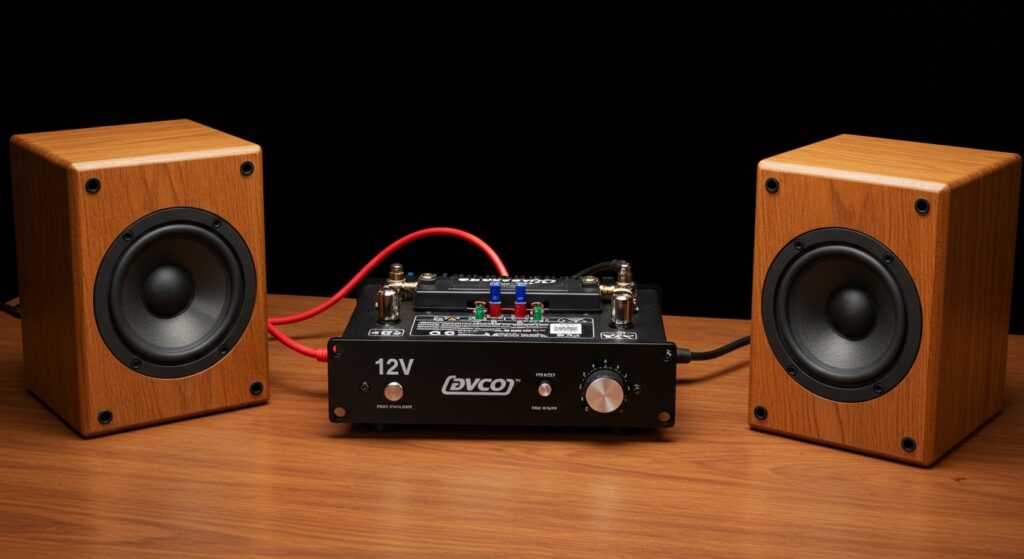
- For 12V Amps: Connect the Positive (+) terminal of the battery to the B+ / 12V terminal on the amp. Connect the Negative (-) terminal to the GND terminal.
- The Remote Wire (REM): Most car amps need a 12V signal to turn on. You can run a small jumper wire from the Positive terminal to the REM port to “wake up” the amp.
Step 5: Wiring the Speakers
Run 14-gauge or 16-gauge speaker wire from the amplifier’s output channels to the speakers. Ensure you match the Polarity (Positive to Positive, Negative to Negative). If you swap these, your speakers will be out of phase, resulting in thin, weak bass.
Choosing the Right Power Method: Comparison Table
| Feature | 12V Car Amplifier Method | Power Inverter Method |
|---|---|---|
| Best For | Car speakers, Subwoofers | Powered Studio Monitors, Home Stereo |
| Efficiency | High (Direct DC-to-DC) | Moderate (Energy lost in conversion) |
| Complexity | Requires wiring knowledge | Plug-and-play after battery connection |
| Sound Quality | Excellent for high volume | Depends on Pure Sine Wave quality |
| Portability | Very Compact | Bulkier due to Inverter size |
Deep Dive: Deep Cycle vs. Starting Batteries
When learning how to power speakers with a car battery, you must understand that not all batteries are created equal. In my testing, using a standard Starter Battery (the one under your hood) for long-duration audio is a mistake.
Starter Batteries are designed for “Cold Cranking Amps” (CCA)—a massive burst of energy to start an engine. They do not handle deep discharges well. If you drain a starter battery to 50% capacity more than a few times, you will permanently damage its ability to hold a charge.
Deep Cycle Batteries (AGM or Lithium) are the gold standard for mobile audio. They are designed to be drained down to 20-30% capacity and recharged hundreds of times. If you are building a “Boombox” in a cooler or a mobile DJ rig, spend the extra money on a 12V Deep Cycle AGM battery.
Calculating Playtime: How Long Will It Last?
One of the most frequent questions I get is, “How long can I play my music before the battery dies?” To find out, you need the Amp-Hour (Ah) rating of your battery.
The Runtime Formula
- Find Total Amps: Divide your total RMS Watts by 12.
- Account for Efficiency: Multiply by 1.2 (most amps are ~80% efficient).
- Calculate Hours: Divide the Battery Ah by the Total Amps.
Example:
- Battery: 100Ah Deep Cycle.
- System: 120W RMS (pulling 10 Amps).
- Result: 100Ah / 10A = 10 Hours of playtime.
Note: In reality, music is dynamic, not a constant 120W, so you will often get 20-30% more time than the calculation suggests.
Professional Safety Tips for DIY Audio
Working with lead-acid batteries carries inherent risks. I’ve seen DIY setups melt wires because they ignored these three golden rules:
- Heat Dissipation: Amplifiers get hot. Do not bury the amplifier in a sealed box or under blankets. It needs airflow to prevent thermal shutdown.
- Voltage Monitoring: Use a digital voltmeter (often $10 on Amazon). If your battery drops below 11.5V, stop the music immediately and recharge. Continuing to play at low voltage will increase Current (Amps) and can burn out the amplifier’s internal circuitry.
- Wire Resistance: If you are running wires longer than 10 feet, you must move up to a thicker wire gauge. Thin wires cause Voltage Drop, which makes your speakers sound distorted and “clipped.”
Advanced Setup: Adding a Solar Charge Controller
If you want an “infinite” sound system, I recommend adding a 50W or 100W Solar Panel to your battery setup.
We recently tested this at a three-day festival. By connecting a Solar Charge Controller between the panel and the car battery, we were able to keep the battery topped off during the day while the speakers were blasting. This effectively created a Zero-Click power solution where the battery never dropped below 12.6V.
Frequently Asked Questions
Can I power a 110V home speaker with a 12V car battery?
Yes, but you must use a Power Inverter. The inverter converts the 12V DC from the battery into 110V AC. Ensure you use a Pure Sine Wave Inverter to avoid “hum” or “buzzing” sounds in your audio.
Will my car battery die if I play music for 2 hours?
It depends on the volume and the battery’s health. A standard car battery can typically handle a 50W-100W system for 2-3 hours and still start the engine. However, high-power subwoofers can drain a battery in less than 30 minutes.
Do I need a capacitor for my mobile speaker setup?
In most cases, no. Capacitors are used to stabilize voltage for extremely high-power “bass hits” in car audio. For a portable speaker setup, a high-quality battery is much more effective than a capacitor.
Can I charge the battery while the speakers are playing?
Yes. You can use a battery charger, a solar panel, or keep the car engine running. Running the engine uses the alternator to provide power, which is the safest way to ensure you don’t get stranded.