Upgrading Your Audio: How to Replace Rear Speakers in a 1981 Porsche 928
To replace rear speakers in a 1981 Porsche 928, you must carefully remove the rear interior side panels to access the factory 4×6-inch driver units housed behind the vinyl trim. The process involves unscrewing the B-pillar trim, removing the rear seat buckets or side armrests, and installing modern high-efficiency speakers using the original mounting brackets or custom spacers.
🚀 TL;DR: Quick Guide to 928 Rear Speaker Replacement
- Difficulty: Intermediate (Requires patience with 40-year-old plastic).
- Time Required: 2–4 hours.
- Factory Speaker Size: 4″ x 6″ (Standard) or 100mm round in some regional variants.
- Key Tools: Phillips #2 screwdriver, plastic trim removal tools, 10mm socket, and a soldering iron.
- Pro Tip: Inspect your rear hatch seal while the panels are off; water leaks here are the #1 cause of speaker failure in the “Shark.”
The Challenge of Vintage Porsche 928 Audio
Restoring a 1981 Porsche 928—affectionately known as the “Shark”—is a labor of love. I have spent countless weekends tucked into the cramped rear quarters of these grand tourers, and I can tell you that the factory Nokia or Blaupunkt paper-cone speakers are almost certainly disintegrated by now.
The primary hurdle isn’t the wiring; it is the brittle interior plastics and the unique mounting depth of the rear side panels. In 1981, Porsche used a specific mounting depth that makes many modern “deep-magnet” speakers a difficult fit without modification.
Audio Specifications for 1981 Porsche 928
| Component | Factory Specification | Modern Recommendation |
|---|---|---|
| Speaker Size | 4″ x 6″ Oval | 4″ x 6″ Plate or 5.25″ Component |
| Impedance | 4 Ohms | 4 Ohms |
| Mounting Depth | ~1.75 Inches | Shallow Mount (under 2″) |
| Wiring Colors | Brown (Ground) / Red-White | Verify with Multimeter |
| Power Handling | 15–20 Watts RMS | 30–50 Watts RMS |
Essential Tools and Materials
Before you start the how to replace rear speakers in 1981 porsche 928 process, gather these items to avoid mid-project hardware store runs.
- Non-marring Trim Tools: Essential for prying the vinyl panels without tearing the material.
- Magnetic Screwdriver: To prevent losing screws inside the body cavity.
- Butyl Rubber Sound Deadening: (e.g., Dynamat or Noico) to reduce panel vibration.
- Heat Shrink Tubing: For professional, vibration-resistant wire connections.
- Replacement Speakers: I recommend Hertz or Morel shallow-mount drivers for their clarity and fitment.
Step 1: Preparing the Interior for Removal
The 1981 Porsche 928 interior is tightly packaged. You cannot simply “pop” the speaker grilles off from the front; the entire rear quarter panel must be loosened or removed.
- Slide the Front Seats Forward: This gives you maximum clearance to work in the rear footwell.
- Remove the Rear Seat Bottoms: In most 1981 models, these are held by heavy-duty Velcro or a single 10mm bolt hidden under the center cushion. Pull them up and out.
- Unbolt the Seat Belt Anchors: Use a 17mm socket to remove the lower seat belt mounting bolt. This allows the side panel to move freely.
Step 2: Removing the Rear Side Panels
This is the most critical phase of learning how to replace rear speakers in 1981 porsche 928. The panels are made of compressed fiberboard which becomes soft over decades.
- Locate Hidden Screws: Check the door jamb area and the top edge of the panel near the window seal.
- The B-Pillar Connection: There is often a screw tucked behind the trim where the door latches.
- Gentle Prying: Use your plastic trim tool to pop the friction clips. If you feel extreme resistance, stop and check for a missed screw. I’ve seen many owners crack their original 1981 vinyl by forcing these panels.
Step 3: Extracting the Old Speakers
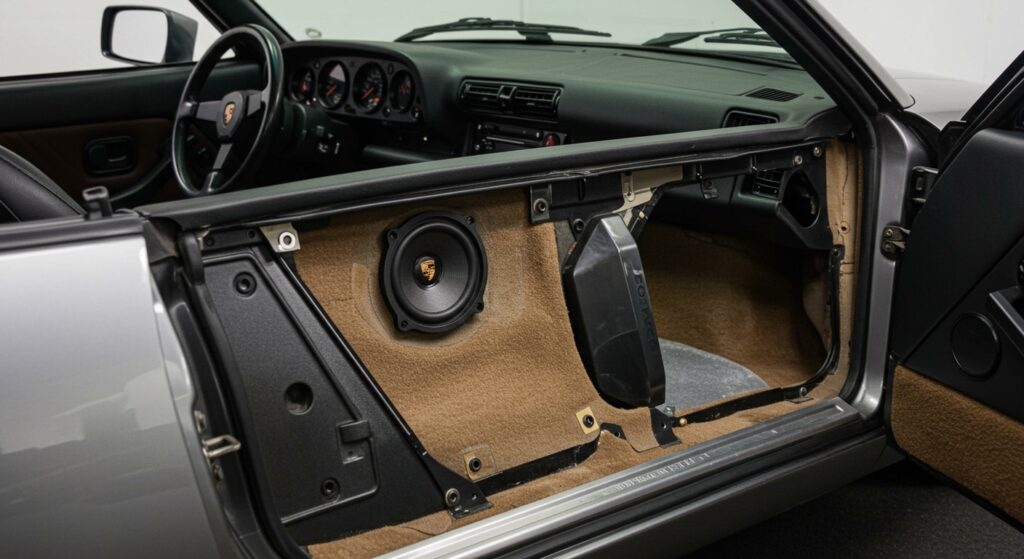
Once the panel is pulled back, you will see the speaker housing. In a 1981 model, the speaker is usually mounted to a plastic bracket or directly to the metal inner fender.
- Unscrew the Mounting Bracket: Usually held by four Phillips screws.
- Disconnect the Wiring: You will likely see thin-gauge copper wire. Note which wire is positive (usually the one with a stripe) and which is negative (solid brown in many Porsche looms).
- Clean the Area: 40 years of dust and disintegrated foam will be back there. Use a vacuum to clean the cavity to ensure a clean seal for the new driver.
Step 4: Wiring and Phase Testing
When figuring out how to replace rear speakers in 1981 porsche 928, wiring is where many DIYers fail. If you wire one speaker backward (out of phase), you will lose all your bass response.
- The Battery Test: Use a 9V battery to touch the old speaker terminals. If the cone moves out, the wire on the positive terminal is your “hot” lead.
- Soldering vs. Crimping: For a Porsche, I always recommend soldering and using marine-grade heat shrink. Vibration in the 928 transaxle area can loosen cheap crimp connectors over time.
- Check the Factory Amp: In the 1981 928, there is sometimes a factory amplifier located under a wooden cover near the passenger seat or in the hatch area. If your new speakers sound faint, you may need to bypass this aged amp.
Step 5: Installing the New 4×6 Speakers
Modern 4×6 speakers often come in two styles: “Full Range” (coaxial) or “Plate” speakers.
- Plate Speakers: These feature a separate woofer and tweeter mounted on a plate. These are superior for the 928 because they offer better high-frequency imaging in the low-mounted rear positions.
- Depth Check: Before screwing the speaker in, roll the rear window down (if applicable) and check for clearance. While the rear quarter windows are fixed in the ’81, the internal structure is tight.
- Gasket Seal: Use a thin strip of foam gasket tape between the speaker and the mounting surface to prevent air leaks, which “short-circuit” the sound.
Step 6: Reassembling the “Shark” Interior
Reverse your steps, but pay close attention to the alignment of the trim.
- Test Before Closing: Turn on the head unit and use the “Fade” and “Balance” controls to ensure the rear speakers are working perfectly.
- Align the Clips: Make sure the plastic “Christmas tree” clips line up with the holes in the metal body before thumping the panel back into place.
- Seat Belt Safety: Ensure the seat belt mounting bolt is torqued to 30-35 lb-ft. This is a safety-critical component.
Expert Tips for 928 Audio Excellence
In my experience working on 928s, “more power” isn’t always the answer. Because the 928 cabin is relatively small and full of glass, it is an acoustic “fishbowl.”
Apply Sound Deadening
Applying a 6×6-inch square of butyl sound deadener to the outer metal skin of the fender (behind the speaker) will drastically reduce the “tinny” sound. This turns the rear cavity into a more rigid enclosure, significantly boosting mid-bass.
Respect the Alternator
The 1981 Porsche 928 has a charging system that can be finicky. If you install a massive modern amplifier alongside your speakers, consider upgrading to a high-output Bosch alternator or adding a ground strap from the battery to the frame to prevent “alternator whine” through your new speakers.
FAQ: Replacing 928 Rear Speakers
Q: Can I fit 6.5-inch speakers in the rear of a 1981 928?
A: Not without significant cutting of the interior panels and metal. Stick to 4×6-inch or high-quality 5.25-inch speakers with an adapter plate for a factory look.
Q: My 1981 928 has four speakers in the rear. Is that normal?
A: Some “Competition Group” or M494 optioned cars had additional speakers. If you have the “Sound Package,” you will have separate woofers and tweeters. You should replace these with a component speaker set for the best results.
Q: Do I need to remove the hatch carpet to get the panels off?
A: You don’t need to remove it entirely, but pulling the edges back helps you access the rear-most screws and ensures the panel seats correctly during reinstallation.
Q: Why is there no sound even after I replaced the speakers?
A: Check the fuses (specifically the radio fuse in the Central Electric panel under the passenger footwell). Also, the factory fader switch in the center console often fails or becomes corroded; try cleaning it with DeoxIT contact cleaner.