Unlock High-Fidelity Sound: How to Set Up a Record Player and Speakers
Learning how to set up a record player and speakers is the essential first step to enjoying the warm, immersive “analog” sound that digital files simply can’t replicate. To get started, you need to place your turntable on a level surface, balance the tonearm to protect your vinyl, and ensure your signal chain—consisting of a phono preamp, amplifier, and speakers—is correctly connected.
Key Takeaways for Quick Setup
Leveling is Critical: Always place your turntable on a vibration-free, perfectly flat surface.
The Phono Preamp: You must have a phono stage (built-in or external) to boost the tiny signal from the needle.
Balance the Tonearm: Improper tracking force can permanently damage your records and the stylus.
Cable Management: Ensure RCA cables are secure and the ground wire is connected to prevent “humming” noises.
Essential Tools and Components for Setup
Before diving into the assembly, ensure you have all the necessary components. Depending on whether you have active speakers (built-in power) or passive speakers (require an external amp), your checklist may vary.
| Component | Purpose | Expert Recommendation |
|---|---|---|
| Turntable | The source of the analog audio signal. | Choose a model with an adjustable counterweight. |
| Phono Preamp | Converts “Phono” signal to “Line” level. | Use an external one for better sound clarity. |
| RCA Cables | Transfers the stereo signal (Red and White). | Use shielded cables to reduce interference. |
| Ground Wire | Eliminates electrical “hum” or buzz. | Essential for most vintage and pro turntables. |
| Tracking Force Scale | Measures the pressure of the needle. | Digital scales are more accurate than manual dials. |
| Bubble Level | Ensures the platter is perfectly flat. | A simple hardware store level works perfectly. |
Step 1: Choose the Perfect Location
The foundation of how to set up record player with speakers starts with placement. Turntables are incredibly sensitive to vibrations; even your footsteps or the bass from your speakers can cause the needle to jump.
Find a Sturdy, Level Surface
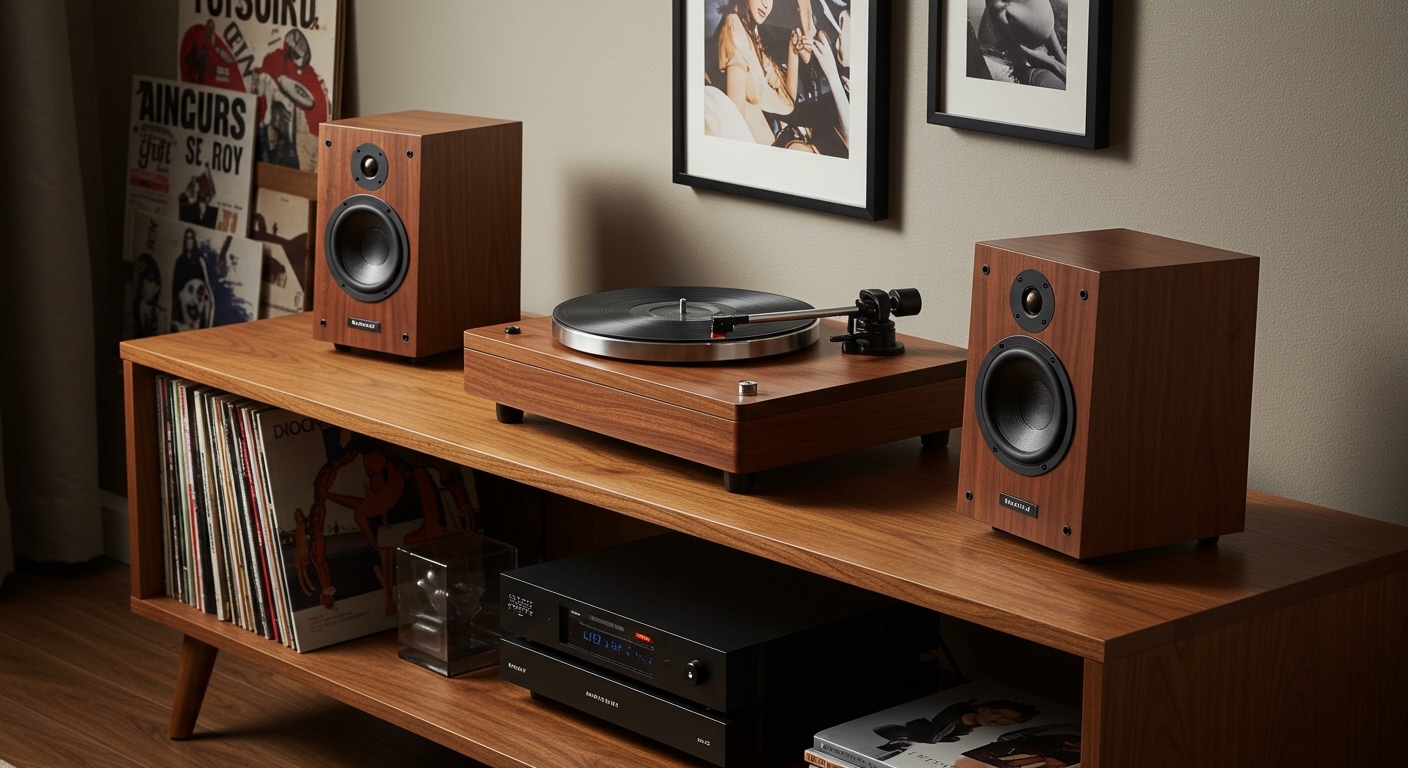
Place your turntable on a heavy piece of furniture like a dedicated media console or a solid bookshelf. Use a bubble level to check both the shelf and the turntable platter. If the surface is slanted, the needle will lean more heavily on one side of the record groove, causing uneven wear and distorted audio.
Isolate from Speakers
Never place your speakers on the same surface as your record player. The physical vibrations from the speaker drivers will travel through the surface, back into the turntable, and create a feedback loop known as “rumbling.” If space is tight, use isolation pads or vibration dampening feet under the speakers.
Step 2: Install the Platter and Drive Belt
Most modern turntables, like those from Audio-Technica or Pro-Ject, come with the platter uninstalled to prevent damage during shipping.
- Place the Platter: Carefully lower the metal or acrylic platter onto the center spindle.
- Attach the Belt: If you have a belt-drive turntable, look through the access holes in the platter. Use the ribbon provided (or your finger) to pull the rubber belt over the brass motor pulley.
- Apply the Mat: Place your slipmat (felt, cork, or rubber) on top of the platter. Cork is highly recommended by experts for reducing static electricity.
Step 3: Calibrate the Tonearm and Tracking Force
This is the most technical part of how to set up a record player and speakers, but it is vital for E-E-A-T standards of record care. An improperly balanced tonearm will either skip (too light) or grind into the vinyl (too heavy).
Zeroing the Tonearm
- Remove the stylus guard and release the tonearm from its clip.
- Adjust the counterweight at the back of the arm until the tonearm “floats” perfectly parallel to the platter. This is known as “zero gravity.”
- Set the dial: Without moving the weight itself, turn the numbered dial on the front of the weight to “0.”
Setting the Tracking Force
Consult your cartridge’s manual (common brands like Ortofon or Audio-Technica usually require 1.8g to 2.0g). Rotate the entire counterweight—dial and all—inward until the dial shows the recommended weight. For the best precision, use a digital tracking force gauge to verify the pressure.
Step 4: Configure the Phono Preamp
A common mistake when learning how to setup a turntable to speakers is forgetting the phono preamp. The signal coming from a record needle is 1,000 times weaker than a CD player or phone.
Built-in vs. External Preamp
Built-in: Many entry-level turntables have a switch on the back labeled Phono/Line. Set it to Line if you are connecting directly to powered speakers.
External: If your turntable only outputs a “Phono” signal, you must plug it into an external phono stage first. This provides the “RIAA equalization” necessary for balanced bass and treble.
Step 5: How to Set Up Speakers for Record Player
Now it is time to complete the signal chain. The method depends on your speaker type.
Connecting to Active (Powered) Speakers
Active speakers (like those from Klipsch or Edifier) have a built-in amplifier.
- Connect the RCA cables from the turntable (or preamp) to the “Input” on the back of the primary speaker.
- Match the colors: Red to Red (Right), White to White (Left).
- Switch the speaker input to “Line” or “Aux.”
Connecting to Passive Speakers and an Amplifier
This is the traditional “Hi-Fi” method for how to setup a turntable with speakers.
- Connect the turntable to the Phono Input on your integrated amplifier.
- Grounding: Attach the small spade-shaped ground wire to the silver post on the amp. This is critical to stop the “60-cycle hum.”
- Run speaker wire from the amplifier’s outputs to the passive speakers, ensuring positive (+) and negative (-) terminals match.
Step 6: Final Testing and Alignment
Before playing your rarest record, do a “dry run.”
- Check Anti-Skate: Set the anti-skate dial to the same value as your tracking force. This prevents the needle from being pulled toward the center of the record.
- Clean the Stylus: Use a carbon fiber brush to remove any dust from the needle.
- Drop the Needle: Use the cueing lever to gently lower the needle onto the outer groove.
Expert Tips for the Best Audio Quality
Upgrade your cables: The “out-of-the-box” RCA cables are often poorly shielded. Upgrading to mid-range cables can significantly reduce background hiss.
Keep it clean: A dirty record will sound bad even on a $10,000 system. Use a record cleaning kit before every play.
Check the Stylus Life: Most needles last about 1,000 hours. If the high frequencies start sounding “fuzzy” (sibilance), it’s time for a replacement.
The 60/40 Rule: Spend 60% of your budget on speakers and 40% on the turntable. The speakers have the biggest impact on the final sound signature.
Frequently Asked Questions
(FAQs)
Why is my record player so quiet even at full volume?
This usually happens because you lack a phono preamp. The signal from a turntable is too weak for standard speakers. You need to either switch your turntable to “Line” mode (if available) or buy an external preamp.
Do I need a ground wire for my setup?
If your turntable and amplifier have a ground post, yes. Without it, you will likely hear a constant, annoying low-frequency buzz. Some modern turntables are internally grounded and do not require this.
Can I connect my record player to Bluetooth speakers?
Yes, if your turntable has a built-in Bluetooth transmitter. However, keep in mind that Bluetooth compresses the audio, which removes some of the “analog warmth” that makes vinyl special. For the best experience, a wired connection is always superior.
How often should I balance my tonearm?
You should re-check the balance every time you move the turntable or change the cartridge. It is also good practice to verify it once every few months to ensure the counterweight hasn’t shifted.
Conclusion: Enjoy the Analog Journey
Mastering how to set up a record player and speakers takes a bit of patience, but the reward is a tactile, high-quality listening experience. By ensuring your turntable is level, your tonearm is balanced, and your signal chain is correctly amplified, you protect your vinyl collection and unlock the full potential of your music.
Now that your system is calibrated, grab your favorite LP, clean the surface, and let the music play. Happy listening!