Getting Started: Unboxing Your Klipsch Sound
You’ve just unboxed a new set of Klipsch speakers, and the excitement is palpable. You can almost hear that legendary, dynamic sound. But then you see the terminals, the wires, and the maze of settings on your receiver, and a little bit of anxiety creeps in. How do you go from a box of components to a breathtaking audio experience? Don’t worry, getting it right is easier than you think.
As someone who has set up countless Klipsch systems, from simple stereo pairs to complex Dolby Atmos home theaters, I can tell you that a few key steps make all the difference. This guide will walk you through everything you need to know, transforming a potentially confusing process into a simple, rewarding project. We’ll cover everything from basic placement to fine-tuning your receiver for that signature Klipsch sound.
Key Takeaways: Your Quick Setup Checklist
- Placement is Paramount: For stereo, form an equilateral triangle between your speakers and your listening position (the “Klipsch Triangle”). For home theater, follow the standard 5.1 or 7.1 layout.
- Use Quality Wire: Invest in 12 to 16-gauge speaker wire for the best signal transfer.
- Check Polarity: Always connect the positive (red) terminal on your speaker to the positive (red) terminal on your AV Receiver (AVR), and negative (black) to negative (black).
- Calibrate Your System: Use your AVR’s built-in room correction software (Audyssey, YPAO, Dirac Live) as a starting point.
- Set Crossovers Manually: A great universal starting point for most Klipsch speakers is a crossover frequency of 80Hz. This sends low-frequency sounds to your subwoofer, where they belong.
Before You Begin: Prepping Your Klipsch Speaker Setup
Proper preparation is 90% of the battle. Before you even touch a speaker, gathering the right tools and understanding the components will save you time and prevent headaches down the road.
Choosing the Right Speaker Wire
The connection between your receiver and speakers is critical. Don’t let low-quality wire be the weak link in your brand-new audio chain.
- Gauge Matters: Speaker wire thickness is measured in gauge (AWG). A lower number means a thicker wire. For most Klipsch setups, I recommend 14 or 16-gauge wire. If you have long runs (over 50 feet), stepping up to 12-gauge is a wise investment to prevent signal loss.
- Material: Look for Oxygen-Free Copper (OFC) wire. It provides excellent conductivity and resists corrosion over time, ensuring a clean signal for years.
- Termination (Optional but Recommended): Consider using banana plugs. They provide a more secure, reliable connection than bare wire and make plugging and unplugging speakers much easier. I use them in all my personal and professional setups.
Essential Tools for the Job
You don’t need a professional installer’s toolkit, but having these items on hand will make the process smooth and efficient.
- Wire Stripper/Cutter: A dedicated wire stripper is far better and safer than using a knife or scissors. It cleanly removes the insulation without damaging the copper strands.
- Tape Measure: Crucial for accurate speaker placement.
- Level: To ensure your tower or bookshelf speakers are perfectly level, which can subtly impact imaging.
- Flashlight or Headlamp: You’ll be glad you have it when you’re looking at the back of a dark AV receiver inside a cabinet.
Unboxing and Inspection
Carefully unbox your speakers on a soft surface like a carpet or blanket to avoid scratches. Remove all packaging and accessories. Take a moment to inspect each speaker for any signs of shipping damage. It’s rare, but it’s better to catch it now. Familiarize yourself with the binding posts on the back—this is where you’ll connect the speaker wire.
The Foundation: How to Set Up Klipsch Speakers for Perfect Placement
Where you place your speakers is the single most important factor in determining your system’s sound quality. Klipsch’s signature Tractrix Horn technology creates a controlled dispersion pattern, which means proper placement is rewarded with a stunningly clear and immersive soundstage.
Understanding the “Klipsch Triangle” for Stereo Setups
For a two-channel (2.0 or 2.1) music setup, the goal is to create a perfect stereo image where the sound feels like it’s coming from between the speakers, not from the speakers themselves.
- Form an Equilateral Triangle: Imagine a triangle between the two front speakers and your head at the main listening position. The distance between the left and right speakers should be the same as the distance from each speaker to your ears.
- “Toe-In” for Focus: Angle the speakers inward slightly so they are pointing directly at your listening position. This “toe-in” focuses the sound from the Tractrix Horns right at you, dramatically improving clarity and imaging. I’ve found that with Klipsch speakers, pointing them directly at my ears provides the best results.
- Distance from Walls: Pull your speakers away from the back and side walls. Placing them too close can cause bass to become boomy and muddy. A good starting point is 1-2 feet from the wall behind them.
Home Theater Placement: Setting Up a 5.1 System and Beyond
For home theater, the principles are similar but expanded to create an immersive bubble of sound.
- Front Left/Right Speakers: Place these on either side of your TV, following the same “Klipsch Triangle” rules as a stereo setup. The tweeters should be at roughly ear level when you are seated.
- Center Channel Speaker: This is the anchor of your home theater’s dialogue. Place it directly above or below your screen, as close to it as possible. Make sure it’s angled slightly up or down to point directly at the listeners’ ears.
- Surround Speakers: For a 5.1 system, these go to the sides and slightly behind your main listening position. They should be placed 1-2 feet above ear level to create a more diffuse, ambient sound field.
- Subwoofer Placement: This is more art than science, as low-frequency sound waves interact with a room in complex ways. The goal is to find a spot that provides smooth, even bass without “dead spots” or “boomy” corners.
* The Subwoofer Crawl: I know it sounds silly, but this is a pro-level technique that works every time. Place the subwoofer in your main listening chair. Play a bass-heavy music track. Then, crawl around the perimeter of the room where you might place the sub. Listen for the spot where the bass sounds the tightest and most even. That’s the best location for your subwoofer.
Quick-Reference Placement Table
Use this table as a starting point for your setup. All angles are relative to the main listening position.
| Speaker | Ideal Position | Height Guideline |
|---|---|---|
| Front Left/Right | 22-30 degrees off-center | Tweeter at ear level |
| Center Channel | Directly above/below the screen (0 degrees) | As close to ear level |
| Surround Left/Right | 90-110 degrees off-center | 1-2 feet above ear level |
| Surround Back (7.1) | 135-150 degrees off-center | 1-2 feet above ear level |
| Subwoofer | Corner or front wall (use the “Subwoofer Crawl”) | Floor level |
Making the Connection: A Step-by-Step Wiring Guide
With your speakers in position, it’s time to connect them to your AV Receiver (AVR) or amplifier. This is a straightforward process if you pay close attention to one critical detail: polarity.
Step 1: Preparing Your Speaker Wire
Measure the distance from your AVR to each speaker and add a couple of extra feet to give yourself some slack. Cut the wire to length.
Using your wire strippers, remove about half an inch (1/2″) of the plastic insulation from the ends of each wire, exposing the bare copper strands. Twist the strands tightly with your fingers so there are no loose frays.
Step 2: Connecting the Wire to Your Klipsch Speakers
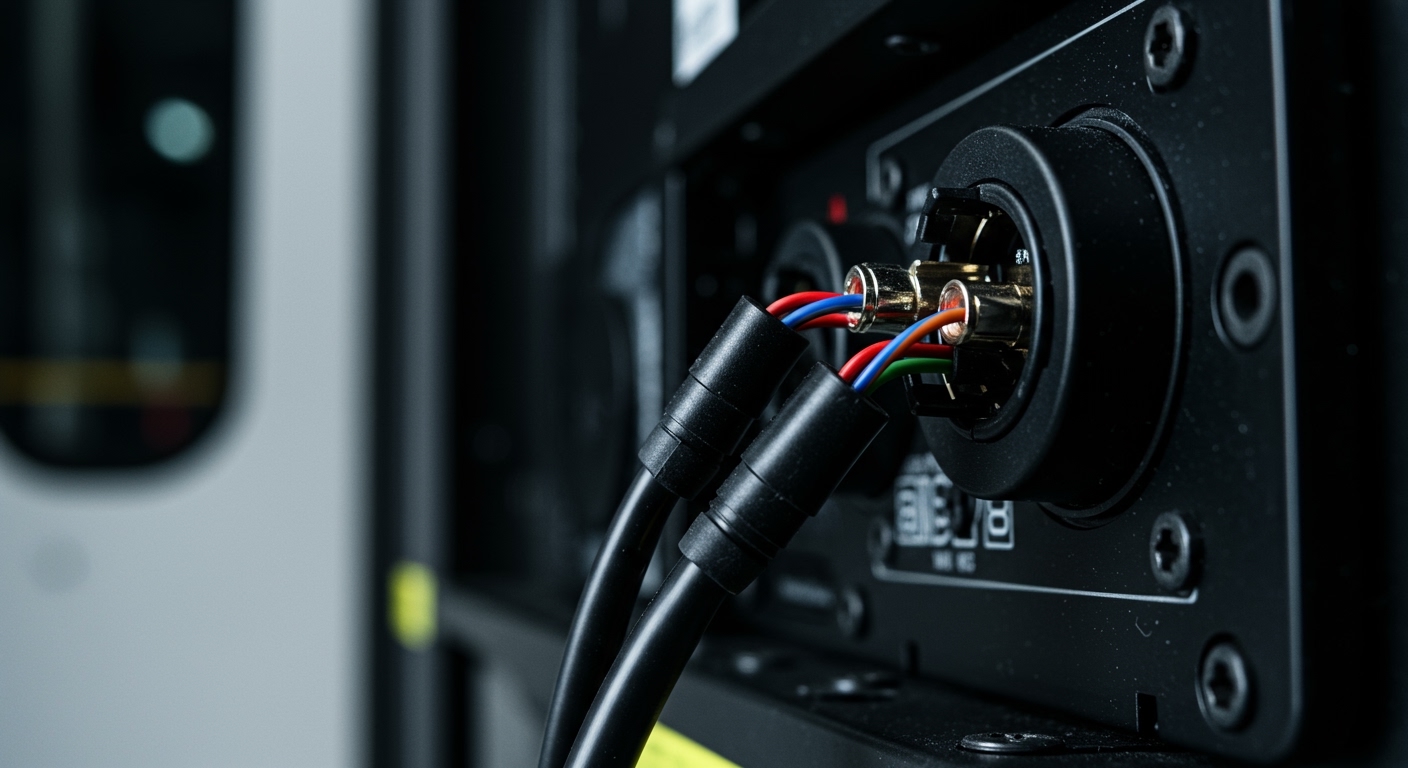
Most Klipsch speakers feature high-quality 5-way binding posts.
- Unscrew the colored caps on the back of the speaker. You’ll see a hole through the metal post.
- Identify the positive (red) and negative (black) terminals.
- Identify the corresponding positive and negative conductors on your speaker wire. Often, one side will have a stripe, ribbing, or different colored insulation to help you keep track.
- Insert the bare wire into the hole on the post (or, if using banana plugs, simply plug them into the back of the binding post).
- Tighten the cap down firmly to secure the wire. Give it a gentle tug to ensure it’s secure