To learn how to tap into rear speakers for amp installations, you must identify the factory speaker wires, use a Line Output Converter (LOC) to convert the high-level signal to RCA, or connect directly to an amplifier featuring high-level inputs. This process involves splicing into the positive and negative leads of the rear left and right channels to provide an audio signal to your aftermarket amplifier without replacing the factory head unit.
Why You Should Learn How to Tap Into Rear Speakers for Amp Upgrades
Upgrading your car’s sound system doesn’t always require a total overhaul of the dashboard. Many modern vehicles integrate climate controls and vehicle settings into the infotainment screen, making it nearly impossible to swap the “head unit.”
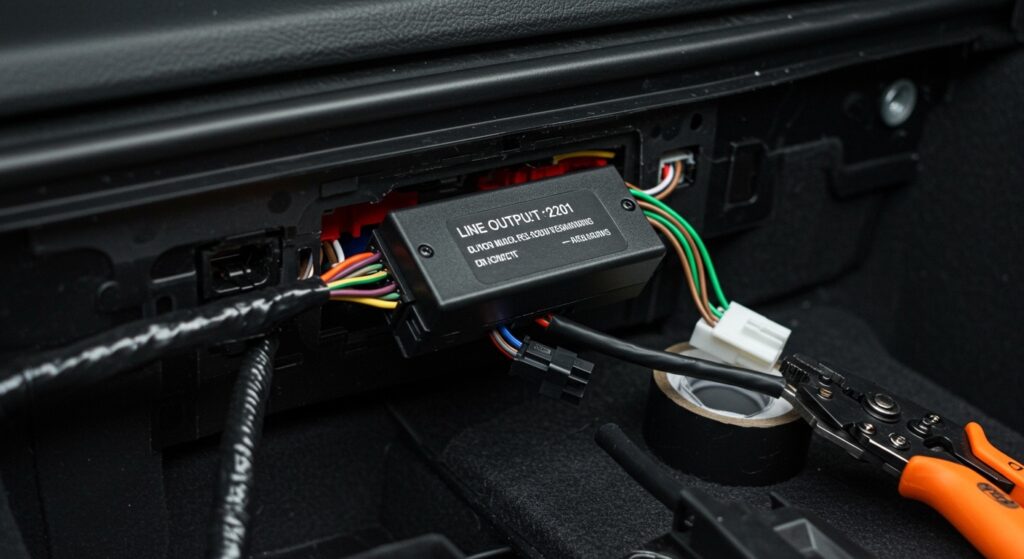
Learning how to tap into rear speakers for amp integration allows you to keep your factory look while adding the power of a dedicated amplifier. I have performed hundreds of these installs, and the rear speaker signal is often the most accessible entry point for adding a subwoofer or improved full-range speakers.
Key Takeaways (TL;DR)
- Best Tool: Use an Active Line Output Converter (LOC) for the cleanest signal.
- Connection Method: Use Posi-Tap connectors or a Military Splice for secure, solder-less connections.
- Signal Type: Tapping into rear speakers provides a “High-Level” signal that must be converted to “Low-Level” (RCA) for most amps.
- Remote Turn-on: Look for an amp with Signal Sensing to avoid running a separate wire to the fuse box.
Essential Tools and Materials for the Job
Before you begin the process of how to tap into rear speakers for amp power, gather these professional-grade tools. In my experience, using the right connectors prevents “alternator whine” and intermittent signal loss.
| Tool/Material | Purpose | Recommended Type |
|---|---|---|
| Line Output Converter | Converts speaker wire to RCA | AudioControl LC2i (Active) |
| Wire Strippers | Removing insulation safely | Self-adjusting strippers |
| Connectors | Joining wires without solder | Posi-Taps or T-Taps |
| Multimeter | Identifying positive/negative leads | Digital Auto-ranging |
| RCA Cables | Carrying signal to the amp | Shielded Twisted Pair |
| Speaker Wire | Extending the tap to the amp | 16-18 AWG Oxygen-Free Copper (OFC) |
Step 1: Locating Your Factory Rear Speaker Wires
The first challenge in learning how to tap into rear speakers for amp setups is finding the wires. You generally have three locations to choose from:
- Directly at the Speakers: If you have a sedan with speakers on the rear deck, the wires are easily accessible from the trunk.
- The B-Pillars: In many trucks and SUVs, you can find the rear door speaker wires inside the plastic pillar between the front and rear doors.
- Behind the Head Unit: This is the most central location but requires removing dash panels.
Expert Tip: I always recommend tapping at the B-Pillar or Rear Deck because it reduces the amount of RCA cable you need to run, which minimizes the chance of picking up electrical interference.
Step 2: Identifying Polarity (Positive vs. Negative)
When you figure out how to tap into rear speakers for amp inputs, polarity is critical. If you wire one side backward, your speakers will be “out of phase,” resulting in thin sound and almost zero bass.
- Consult a Wiring Diagram: Search for your specific year, make, and model online to find wire color codes.
- The 9V Battery Test: Briefly touch a 9V battery to the speaker wires. If the speaker cone moves outward, the wire on the battery’s positive terminal is the positive lead.
- Use a Multimeter: Set it to DC voltage. When music is playing, the positive lead will show a consistent positive fluctuation.
Step 3: Choosing Between Passive and Active Converters
You cannot simply plug a speaker wire into an RCA jack without a converter unless your amplifier has High-Level Inputs.
Passive Line Output Converters
These are inexpensive and don’t require power. However, they often “roll off” the bass frequencies at high volumes to protect factory speakers. I generally avoid these for high-end builds.
Active Line Output Converters (Recommended)
Devices like the AudioControl LC2i are game-changers. They require a 12V power source but provide a much higher voltage signal (up to 9.5 volts). This results in a crystal-clear signal and includes features like AccuBASS to recover bass lost by factory radio processing.
Step 4: Step-by-Step Guide on How to Tap Into Rear Speakers for Amp
Follow these steps to ensure a professional-grade installation.
Disconnect the Battery
Always disconnect the negative battery terminal. Modern vehicle ECUs are sensitive, and an accidental short can be a multi-thousand dollar mistake.
Expose the Wires
Remove the plastic trim panels or door sills covering the wire loom. Use a nylon panel tool to avoid scratching your interior plastics.
Perform the Tap
I recommend the Military Splice method for the best connection:
- Strip back about 1/2 inch of insulation on the factory wire without cutting the copper.
- Poke a hole through the center of the copper strands.
- Thread your new “tap” wire through the hole and wrap it tightly around the factory wire.
- Cover the joint with high-quality 3M Super 33+ electrical tape and a zip tie for strain relief.
Connect to the LOC or Amp
Run your new tap wires to the input side of your Line Output Converter or the High-Level Input plug of your amplifier. Ensure the Left Positive goes to Left Positive, and so on.
Secure the Ground
If using an Active LOC, you must ground it. Find a factory bolt on the chassis, sand away the paint to bare metal, and secure your ground wire. A poor ground is the #1 cause of “hissing” in car audio.
Step 5: Dealing with the Remote Turn-On Wire
Your amplifier needs to know when to turn on. Usually, this requires a “Remote” wire from the head unit. However, when you tap into rear speakers for amp signals, you may not have this.
Solutions:
- Signal Sensing: Many modern amps and LOCs (like the Kicker KEY series) automatically turn on when they “feel” an audio signal on the speaker wires.
- DC Offset: This detects the small amount of voltage used by factory radios to check speaker continuity.
- Fuse Tap: If the above fail, use a Circuit Tap to find a fuse in the fuse box that only has power when the ignition is on (e.g., the cigarette lighter fuse).
Step 6: Tuning for Maximum Performance
Once everything is connected, you must set your “Gain” or “Level” correctly.
- Set your factory radio volume to about 75%.
- Turn the gain on your Line Output Converter up until the “Maxized” or “Clipping” light flickers, then back it off slightly.
- Adjust the gain on your amplifier to match the output.
- Listen for distortion. If the speakers sound “crunchy,” you have too much gain.
Troubleshooting Common Issues
| Problem | Likely Cause | Solution |
|---|---|---|
| No Sound | Blown fuse or bad ground | Check the inline fuse on the power cable and the ground point. |
| Whining Noise | Ground Loop or poor wire routing | Move RCA cables away from power wires; improve ground contact. |
| Weak Bass | Speakers are “Out of Phase” | Reverse the positive/negative wires on one of the tapped channels. |
| Amp Stays On | Constant 12V on Remote wire | Move the remote wire to a switched ignition source. |
Frequently Asked Questions
Can I tap into just one rear speaker for a subwoofer?
While you can, it is not recommended. Many songs have “stereo bass” where different frequencies go to different channels. By tapping into both the Left and Right rear speakers, you ensure the amplifier receives the full audio signal.
Will tapping into my speakers void my car warranty?
Generally, no. Under the Magnuson-Moss Warranty Act, a dealer cannot void your entire warranty because of an aftermarket part unless they can prove the part caused the specific failure. Use Posi-Taps instead of cutting wires to keep the install “reversible.”
What is the best wire gauge for tapping speakers?
For the signal tap itself, 18 AWG or 16 AWG wire is perfect. There is very little current flowing through these wires as they are only providing a signal, not driving the actual speakers.
Do I need a Line Output Converter if my amp has speaker-level inputs?
No. If your amp has a plug for “High-Level” or “Speaker-Level” inputs, it has a built-in converter. You can wire the rear speaker leads directly to that plug. However, an external Active LOC often provides better sound quality and more tuning features.
How do I handle Active Noise Cancellation (ANC)?
Some modern cars (like newer Hondas and Fords) have microphones that “listen” to cabin noise and play a counter-signal through the speakers. If you tap into these for an amp/sub, the system will create a massive, low-frequency hum. You must disconnect the ANC module (usually located behind the glovebox or in the trunk) for the system to work correctly.