Learning how to wire car speakers to the radio is the single most rewarding DIY project for any vehicle owner. Whether you are replacing a blown factory driver or installing high-end components, proper wiring ensures your system delivers crisp highs and punchy bass without risking an electrical short. This guide provides a professional roadmap to mastering your car’s audio connections.
Key Takeaways: How to Wire Car Speakers to the Radio
Use a Wiring Harness: Always prioritize a vehicle-specific harness adapter to avoid cutting factory wires.
Match Polarity: Ensure the positive (+) and negative (-) terminals match between the radio and speaker to prevent “out-of-phase” audio.
Secure Connections: Use crimping or soldering with heat shrink tubing; never rely on electrical tape alone.
Safety First: Always disconnect the negative battery terminal before starting any electrical work.
Essential Tools and Materials
Before learning how to wire car stereo speakers, gather these professional-grade tools to ensure a clean installation.
| Tool/Material | Purpose | Expert Recommendation |
|---|---|---|
| Wire Strippers | Removing insulation from wires | Use an automatic self-adjusting stripper. |
| Crimping Tool | Securing butt connectors or terminals | Avoid using pliers; use a dedicated ratcheting crimper. |
| Multimeter | Testing for continuity and voltage | Essential for identifying factory wire functions. |
| Wiring Harness | Connecting radio to car’s factory plug | Brands like Metra or Scosche are industry standards. |
| Heat Shrink Tubing | Insulating and protecting connections | Superior to electrical tape for longevity. |
| Panel Poppers | Removing door panels without damage | Use nylon tools to prevent scratching plastic. |
Step 1: Preparation and Safety
The first step in how to wire new car speakers is ensuring a safe environment. Electrical surges can fry a sensitive head unit or trigger an airbag light if not handled correctly.
Disconnect the Battery
Locate your car battery and use a 10mm wrench to loosen the negative (black) terminal. Move the cable aside so it cannot touch the post. This simple step prevents short circuits while you are learning how to wire new speakers in a car.
Access the Radio and Speaker Locations
Remove the trim pieces surrounding your head unit using nylon pry tools. For the speakers, you will likely need to remove the door panels. Keep track of all screws in a magnetic tray; losing a single door screw often leads to annoying rattles later.
Step 2: Understanding Wire Color Codes
When learning how to wire speakers to car radio, you must distinguish between the radio’s output and the car’s factory wiring. Most aftermarket radios follow the EIA (Electronic Industries Association) standard.
Standard Aftermarket Radio Wire Colors
White: Front Left Speaker (+)
White/Black: Front Left Speaker (-)
Gray: Front Right Speaker (+)
Gray/Black: Front Right Speaker (-)
Green: Rear Left Speaker (+)
Green/Black: Rear Left Speaker (-)
Purple: Rear Right Speaker (+)
Purple/Black: Rear Right Speaker (-)
Identifying Factory Wiring
Factory wire colors rarely match aftermarket standards. If you aren’t using a harness, you can use a 9V battery to identify speaker pairs. Briefly touch the battery terminals to a pair of wires; when you hear a “pop” from a speaker, you have found that channel.
Step 3: How to Wire Speakers to Radio (The Connection)
There are three primary methods for how to wire up car speakers. As an expert, I recommend the “Harness Method” for 99% of users.
Method A: The Wiring Harness (Recommended)
- Purchase a harness specific to your vehicle’s make and model.
- Match the colors from the radio’s harness to the adapter harness (e.g., Green to Green).
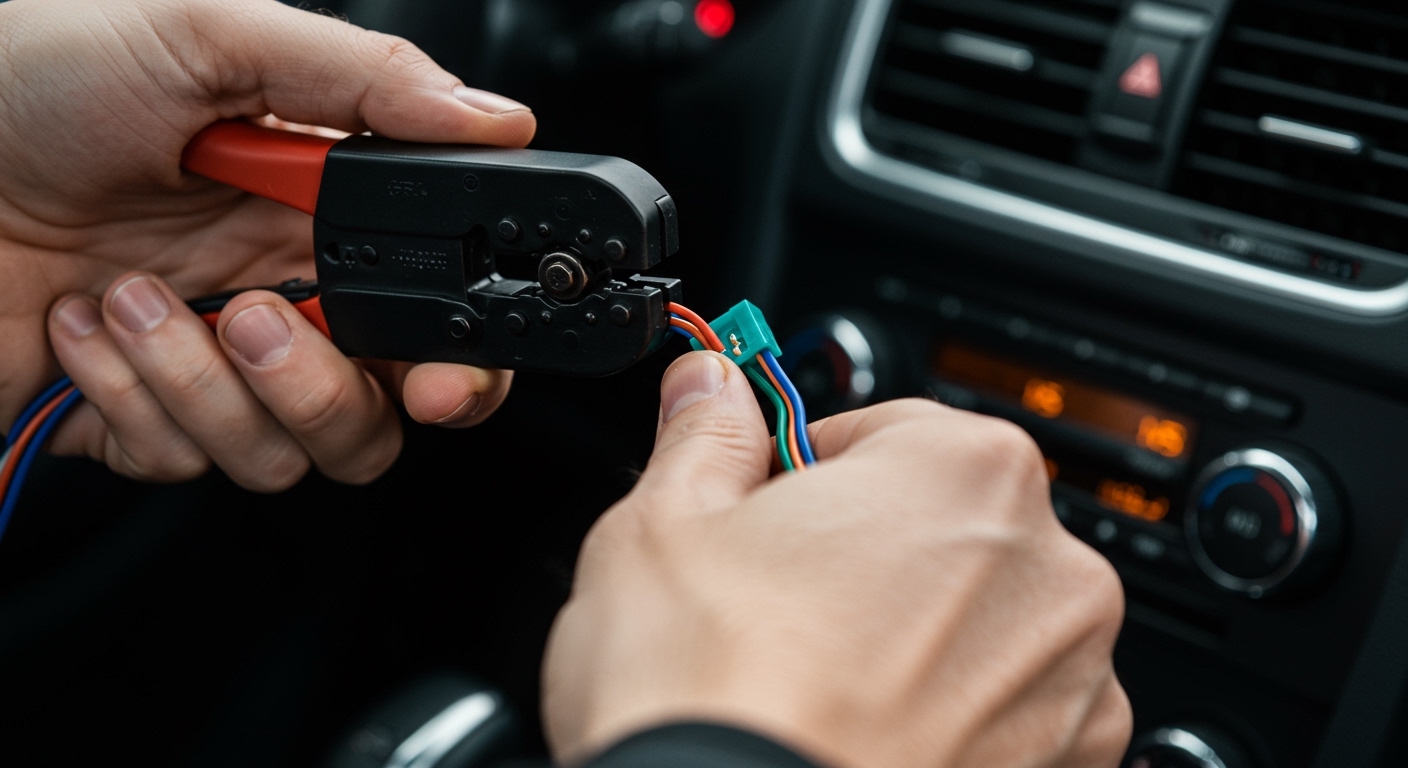
- Crimp or solder these connections on your workbench, not in the cramped car dashboard.
- Plug the finished assembly into the car’s factory plug.
Method B: Hardwiring (Direct Connection)
If no harness is available, you must learn how to wire speakers in a car by splicing.
- Cut the factory plug off (leave 2 inches of wire in case you need to reconnect it later).
- Strip 1/2 inch of insulation from both the radio and car wires.
- Use a butt connector or solder the wires together.
- Cover every connection with heat shrink tubing to prevent moisture ingress.
Step 4: Connecting the New Speakers
Once the radio side is prepped, you need to know how to wire speakers in car doors or decks.
Using Speaker Adapters
Most modern speakers use “spade” terminals of different sizes. The larger terminal is almost always Positive (+), and the smaller is Negative (-). I highly recommend buying speaker wiring adapters. These plug directly into your factory door plug and slide onto the new speaker terminals, requiring zero cutting or crimping.
Mounting the Speaker
Check Clearance: Roll the window down to ensure the speaker magnet doesn’t hit the glass.
Use Foam Gaskets: Apply a foam ring (like Fast Rings) between the speaker and the door. This forces the sound through the door grill rather than letting it leak into the door cavity.
Secure the Screws: Ensure the speaker is airtight against the mounting surface to maintain bass response.
Step 5: Testing and Troubleshooting
Before reassembling the dashboard and door panels, perform a functional test. Learning how to wire speakers into a car isn’t complete until you verify the “Phase.”
The Phase Test
If your speakers are “out of phase,” one speaker’s cone moves outward while the other moves inward. This results in a total loss of bass.
- Turn the radio on and play a track with heavy bass.
- Use the “Balance” setting to move sound entirely to the Left.
- Move it back to the Center.
- If the bass decreases when centered, one of your speakers is wired backward. Swap the (+) and (-) wires on one speaker to fix it.
Expert Tips for Professional Results
Gauge Matters: For standard door speakers (under 75W RMS), 18-gauge wire is sufficient. If you are running high-power components from an amplifier, upgrade to 16-gauge Oxygen-Free Copper (OFC).
Avoid “Twist and Tape”: Never just twist wires together and wrap them in electrical tape. Heat and vibration in a car will cause these connections to fail within months.
Label Everything: Use a piece of masking tape to label “Front Left” or “Rear Right” on your wires. It saves hours of frustration if a connection comes loose.
- Sound Deadening: While the door panel is off, apply a small square of butyl-based sound deadener (like Dynamat) behind the speaker. This significantly reduces “tinny” resonance.
FAQs: Car Speaker Wiring
What happens if I switch the positive and negative wires?
Switching the wires causes the speaker to be “out of phase.” While it won’t damage the speaker or radio immediately, the sound waves will cancel each other out, resulting in very thin, weak bass and a “hollow” sound stage.
Can I use home speaker wire in my car?
Technically yes, but it is not recommended. Home speaker wire often has a thicker, less flexible jacket that can crack in extreme car temperatures. Automotive-grade wire features multi-strand flexibility designed to handle constant vibration.
Do I need to run new wires from the radio to the doors?
In most cases, no. The factory wiring is capable of handling the power of any aftermarket head unit. You only need to run new, thicker wires if you are installing a high-power external amplifier (usually over 100W per channel).
How do I know which factory wire is positive?
Consult a wiring diagram for your specific vehicle. If unavailable, use a multimeter set to DC Volts. When the radio is on, the wire showing a small positive voltage is usually the signal wire. Alternatively, the “9V battery pop test” mentioned in Step 2 is the most reliable physical check.
Why is my new speaker making a crackling noise?
Crackling is usually caused by a loose connection or a wire touching the metal frame of the car (a short to ground). Check your crimps and ensure no bare copper is exposed.
Conclusion
Mastering how to wire car speakers to the radio is a fundamental skill for any car enthusiast. By using the right tools, following standard color codes, and ensuring your speakers are in phase, you can achieve professional-grade audio quality at a fraction of the cost.
Always prioritize secure connections and vehicle-specific harnesses to protect your car’s electrical integrity. Now that you have the knowledge, grab your wire strippers and transform your commute with the crystal-clear sound you deserve!