Understanding How to Wire Ceiling Speakers with Volume Control
To wire ceiling speakers with volume control, you must run a 4-conductor (16/4 or 14/4) CL3-rated speaker wire from your amplifier to the wall-mounted volume control location, and then run two separate 2-conductor (16/2 or 14/2) wires from the control to each individual ceiling speaker. This specific wiring path ensures that the volume control acts as a bridge, allowing you to manage local sound levels without affecting the rest of the house.
Most DIY enthusiasts struggle with “muddy” sound or overheating amplifiers because they fail to account for impedance matching. When I first started installing multi-room audio systems, the biggest mistake I saw was people daisy-chaining speakers directly, which can drop the electrical resistance too low and fry a receiver. By using an impedance-matching volume control, you protect your hardware while gaining the convenience of adjusting music levels right from the wall.
TL;DR: Key Takeaways for Success
- Wiring Path: Amp → Volume Control (4-conductor) → Speakers (2-conductor).
- Wire Type: Always use CL2 or CL3 rated wire for in-wall installations to meet fire codes.
- Impedance: Use impedance-matching volume controls if connecting more than two pairs of speakers to one amp.
- Gauge: Use 16 AWG for runs under 50 feet; use 14 AWG for longer runs to prevent signal loss.
- Tools: You will need a drywall saw, fish tape, wire strippers, and a voltage tester.
Planning Your Multi-Room Audio Layout
Before you cut a single hole in your ceiling, you need a blueprint. In my experience, the “measure twice, cut once” rule is the difference between a professional finish and a costly drywall repair bill. You need to identify where your central hub (amplifier) will sit and where the volume control is most accessible—usually near a light switch at the entrance of the room.
Consider the soundstage. For a standard rectangular room, placing speakers roughly 6 to 10 feet apart provides the best stereo separation. If you place them too close to corners, you might experience “bass loading,” which makes the audio sound boomy and distorted.
Recommended Materials and Tools
| Item | Purpose | Recommendation |
|---|---|---|
| Speaker Wire | Transfers audio signal | 16/4 CL3 (Amp to VC), 16/2 CL3 (VC to Speakers) |
| Volume Control | Adjusts local loudness | Impedance-matching rotary or slider |
| Ceiling Speakers | Audio output | 6.5-inch or 8-inch moisture-resistant |
| Low-Voltage Bracket | Mounts the volume control | Single-gang “old work” orange bracket |
| Fish Tape | Pulls wire through walls | 50ft Steel or Fiberglass fish tape |
Step 1: Selecting the Right Wire (The Backbone of Your System)
Choosing the wrong wire is the most common point of failure. When learning how to wire ceiling speakers with volume control, you must understand the difference between 2-conductor and 4-conductor cables.
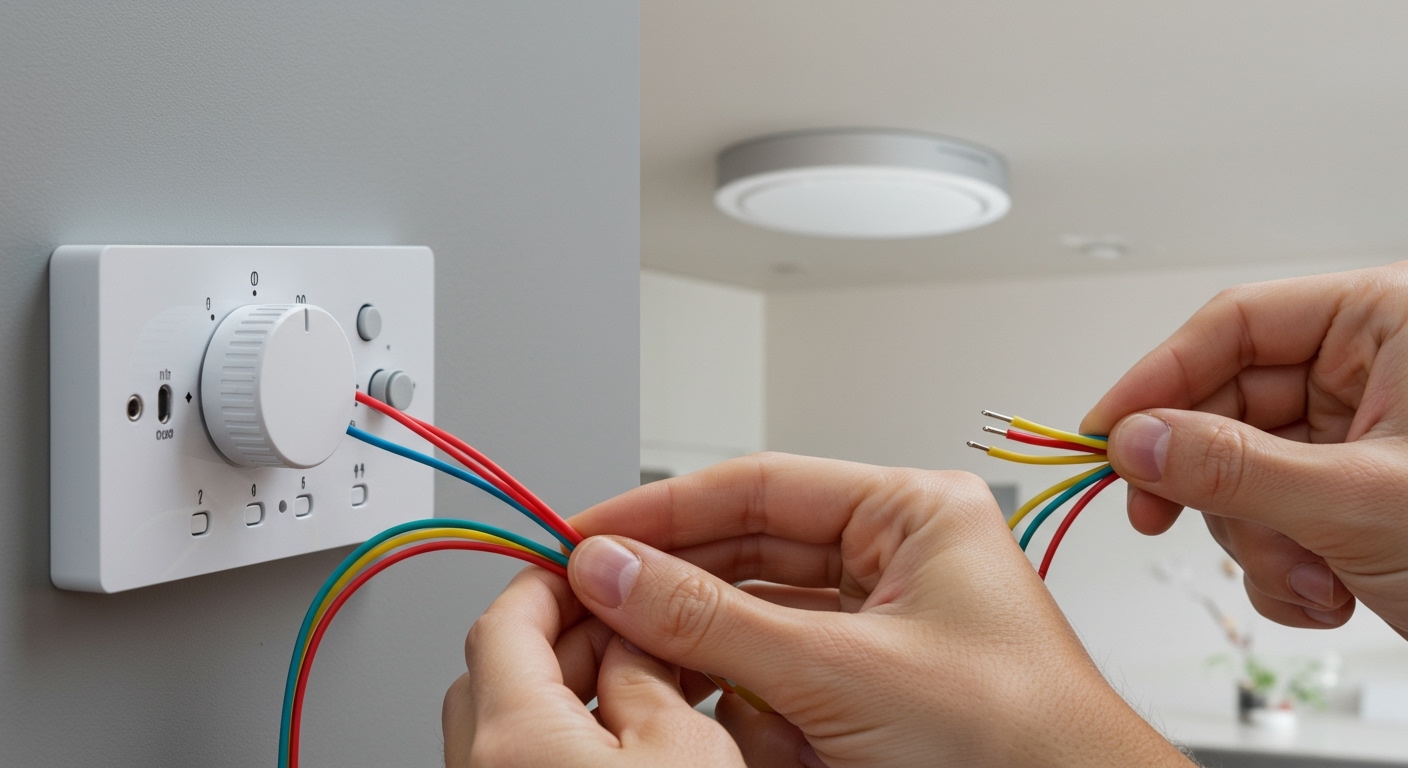
A 4-conductor wire contains four color-coded strands (typically Red, Black, White, and Green) inside one jacket. This allows you to send both the Left and Right channels from your amplifier to the volume control through a single cable. From the volume control to the speakers, you switch to 2-conductor wire (Red and Black) for each individual speaker.
Pro Tip: Always look for the UL Rating. In-wall wire must be CL2 or CL3 to comply with local building codes. If there is a fire, insurance companies may deny claims if non-rated “zip cord” was used inside the walls.
Step 2: Installing the Low-Voltage Mounting Bracket
Once you have identified the ideal spot for your volume control, it is time to prep the wall. I prefer placing the control at the same height as your light switches (typically 48 inches from the floor) for a cohesive look.
- Use a stud finder to ensure you aren’t cutting directly into a 2×4.
- Trace the inside of the low-voltage mounting bracket onto the drywall.
- Use a drywall saw to carefully cut the hole.
- Insert the bracket and tighten the “dog ear” screws until it is snug against the wall.
This bracket provides the structural support for the volume control unit. Unlike electrical outlets, these do not require a back-box, which gives you more room to manage your wires.
Step 3: Running Wire from the Amplifier to the Volume Control
This is the most labor-intensive part of the process. You are creating the “Home Run.” You need to get your 4-conductor wire from the back of your receiver/amplifier, up into the ceiling or through the floor joists, and down to the volume control hole you just cut.
If you have an attic above the room, your job is much easier. You can drill a small hole in the “top plate” (the horizontal wood member at the top of the wall studs) and drop the wire down to the bracket. Use fish tape if the wall has insulation, as the wire often gets snagged on fiberglass batts.
Safety Check: Ensure you are not running speaker wire parallel to high-voltage AC power lines. This can cause a 60Hz “hum” in your speakers. If you must cross power lines, do so at a 90-degree angle.
Step 4: Routing Wire from Volume Control to the Ceiling Speakers
Now that the input wire is at the wall bracket, you need to run two separate 2-conductor wires from that same bracket up to your speaker locations in the ceiling.
- Mark your speaker holes: Use the template provided by the manufacturer. Use a pilot bit to drill a small hole and poke a coat hanger through to check for obstructions (pipes, wires, or joists).
- Pull the wire: Run one wire to the “Left” speaker location and another to the “Right” speaker location.
- Label everything: Use masking tape to label the wires at the volume control bracket (e.g., “From Amp,” “Left Speaker,” “Right Speaker”). Trust me, they all look the same once they are behind the wall.
Step 5: Connecting the Volume Control (The Crucial Step)
The back of your impedance-matching volume control will have several screw terminals or a removable “Phoenix” connector. This is where the magic happens.
- Input Terminals: Connect the 4-conductor wire from the amplifier here.
- Output Terminals: Connect the wires leading to your speakers.
Important: Ensure no stray copper strands are touching adjacent terminals. A single “whisker” of wire can cause a short circuit that puts your amplifier into “Protect Mode.”
Step 6: Understanding and Setting Impedance Jumpers
Most modern volume controls like those from Niles, Russound, or OSD Audio feature “Impedance Matching” jumpers. If you are only connecting one pair of speakers to one amplifier, set the jumper to 1X.
However, if you are running four pairs of 8-ohm speakers off a single 2-channel amp, the total impedance would normally drop to 2 ohms, which can destroy the amp. By setting the volume control jumpers to 4X, the control uses an internal autotransformer to “truly” present an 8-ohm load back to the amplifier. This allows you to run multiple rooms safely without needing a separate expensive power amp for every zone.
Step 7: Mounting the Ceiling Speakers
With the wiring complete, it’s time to install the hardware.
- Strip the wire: Remove about 1/2 inch of the outer jacket from the wires in the ceiling.
- Connect to speakers: Press the spring-loaded terminals and insert the wire. Maintain polarity: Red wire to Red (+) terminal, Black wire to Black (-) terminal. If you swap these, the speakers will be “out of phase,” resulting in thin, tinny sound with zero bass.
- Secure the speaker: Insert the speaker into the hole. Use a screwdriver (not a drill, to avoid cracking the plastic) to tighten the mounting screws. This will engage the “dog legs” that grip the drywall.
- Attach the grille: Most modern speakers use magnetic grilles that simply snap into place.
Step 8: Final Testing and Calibration
Before you push the volume control into the wall and screw on the faceplate, perform a sound test.
- Turn the wall volume control to MAX.
- Turn your amplifier volume to ZERO.
- Start playing music and slowly increase the amplifier volume until the room is as loud as you would ever want it to be. This is your “ceiling.”
- Now, use the wall control to turn the volume down. This ensures you have a full range of motion on the knob without clipping the signal.
Troubleshooting Common Issues
- No Sound: Check the Phoenix connector on the volume control. It may not be seated fully.
- Distorted Audio: Your amplifier may be clipping. Lower the main amp volume and rely more on the wall control.
- One Speaker is Quieter: Check for a loose connection or ensure the wire gauge is the same for both runs.
- Volume Control is Hot: This usually indicates an impedance mismatch. Check your jumper settings immediately.
FAQ: Wiring Ceiling Speakers with Volume Control
Can I wire two speakers to one volume control?
Yes, this is the standard configuration. A single volume control is designed to handle a “Stereo Pair” (Left and Right). You run a 4-conductor wire from the amp to the control, and then two 2-conductor wires (one to each speaker) from the control.
Do I need a special amplifier for volume controls?
No, most standard Home Theater Receivers or Integrated Amplifiers work fine. However, if you plan to power more than two rooms, I highly recommend an impedance-matching speaker selector or ensuring your volume controls are “Impedance Matching” models to protect the amp.
What is the best wire gauge for ceiling speakers?
For most residential applications, 16 AWG is the industry standard. It is flexible enough to pull through walls but thick enough to maintain signal integrity over 50 feet. If your run exceeds 80-100 feet, step up to 14 AWG to prevent “Voltage Drop,” which can weaken bass response.
Can I use a dimmer switch as a volume control?
Absolutely not. A lighting dimmer works by “chopping” AC voltage and will destroy your speakers and amplifier instantly. You must use a dedicated Audio Volume Control (L-Pad or Autotransformer) designed for speaker-level signals.
Should I use Mono or Stereo ceiling speakers?
In small rooms like bathrooms or hallways, a Single-Stereo speaker (which has two tweeters and one woofer) is best because you don’t have space for two separate speakers. For living rooms or kitchens, a traditional pair of separate Left/Right speakers provides a better listening experience.
![What Cars Have Burmester Speakers? [2024 Luxury Guide]](https://bestsounds.net/wp-content/uploads/2026/03/what-cars-have-burmester-speakers-2024-luxury-guide-featured-1774152511.jpg "What Cars Have Burmester Speakers? [2024 Luxury Guide]")