Finding the Ultimate Volume: What Are the Loudest Car Door Speakers?
Tired of your favorite tracks being drowned out by road noise and wind? If you want to transform your vehicle into a mobile concert hall, you need to understand what are the loudest car door speakers and how to install them properly. Achieving extreme volume requires more than just buying the biggest magnets; it’s a precise science of Sensitivity, RMS Power, and Acoustic Environment.
🚀 Key Takeaways: Expert Summary
Sensitivity is King: Look for speakers with an SPL (Sound Pressure Level) rating of 95dB or higher.
Pro Audio vs. Car Audio: For maximum volume, Pro-Audio (PA) style midrange speakers (like those from DS18 or PRV) outperform traditional coaxial speakers.
Power Matters: You must match the RMS wattage of your speakers to a high-quality external amplifier; head units alone cannot drive the loudest speakers.
Sound Deadening: Adding Butyl-based vibration dampeners can increase perceived loudness by up to 3dB by reducing energy loss through vibrating metal.
Step 1: Research and Select What Are the Loudest Car Door Speakers
The first step in your journey is identifying the hardware. When asking what is the loudest car speakers option on the market, you aren’t looking for “standard” upgrades. You are looking for high-efficiency drivers.
Understanding Sensitivity (SPL)
Sensitivity measures how loud a speaker plays with just 1 watt of power. A speaker with 98dB sensitivity will be twice as loud as a speaker with 88dB sensitivity given the same power input. This is the most critical metric for volume.
Pro-Audio vs. Component Speakers
Pro-Audio Speakers: These are designed for sheer output. Brands like DS18, Skar Audio, and PRV Audio dominate this space. They focus on the midrange frequencies where the human ear is most sensitive.
High-End Components: Brands like Hertz (SPL Show line) or JL Audio (C7 series) offer a balance of extreme volume and high-fidelity sound.
| Speaker Model | Type | Sensitivity (1W/1M) | Power Handling (RMS) |
|---|---|---|---|
| DS18 PRO-X6.4BM | Midrange PA | 94 dB | 250 Watts |
| PRV Audio 6MB600 | Midrange PA | 95 dB | 300 Watts |
| Hertz SV 165.1 | SPL Midrange | 97 dB | 200 Watts |
| Skar Audio FSX65 | Midrange | 92.5 dB | 150 Watts |
Step 2: Match Power Requirements for What Speakers Are the Loudest
You cannot achieve record-breaking volume using the built-in amplifier of a factory radio. Most factory “head units” only provide 10-15 watts RMS per channel. To power what are the loudest door speakers, you need an external Class D or Class AB amplifier.
Calculate the Power Gap
If your chosen speakers are rated for 150W RMS, you need an amplifier that can provide at least 150W to 200W RMS per channel. This “headroom” prevents clipping, which is the #1 killer of high-volume speakers.
Wire for Impedance
Most high-volume speakers come in 4-ohm or 8-ohm versions.
- 4-ohm: Standard for car audio, pulls more power from the amp.
- 8-ohm: Common in Pro-Audio, allows you to wire multiple speakers in parallel to drop the final impedance to 4-ohms or 2-ohms.
Step 3: Prepare the Door Cavity with Sound Treatment
Even the best speakers will sound thin and quiet if they are mounted to vibrating sheet metal. To maximize what are the loudest car speakers‘ potential, you must treat the door.
Apply Vibration Dampening
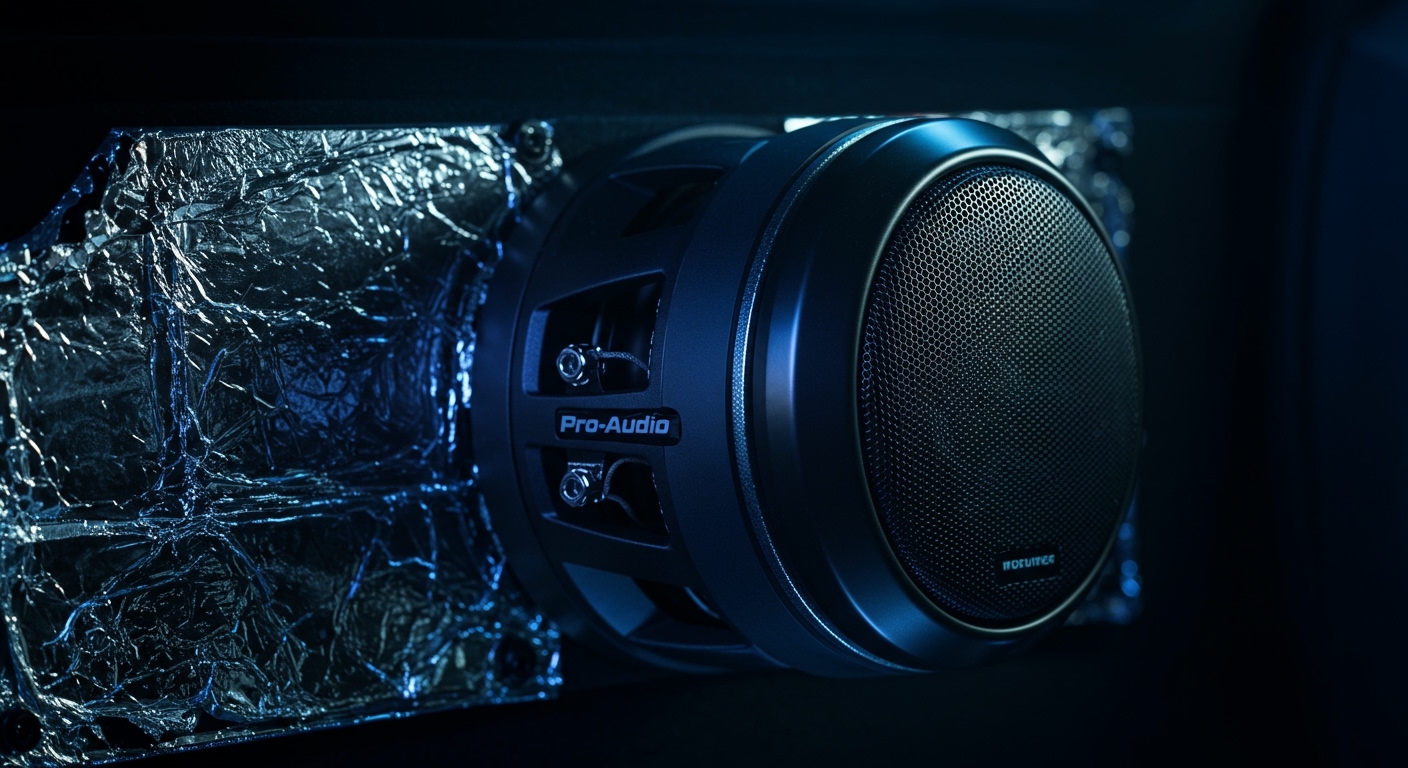
Use Butyl rubber sheets (like Dynamat or SoundQUBED) on the inner and outer metal skins of the door. This stops the metal from “eating” your mid-bass energy.
Create an Acoustic Seal
Use Silicon speaker baffles or Fast Rings. These foam rings bridge the gap between the speaker face and the door panel, forcing all the sound energy through the grille and into the cabin rather than letting it leak into the door cavity.
Step 4: Install High-Current Wiring and Hardware
To drive what are the loudest car door speakers, you need a robust electrical backbone. Standard factory wiring is often 20-gauge or 22-gauge, which is too thin for high-wattage signals.
Tools and Materials Needed
| Item | Purpose | Recommendation |
|---|---|---|
| OFC Speaker Wire | Signal Delivery | 14-gauge Oxygen-Free Copper |
| Amplifier Installation Kit | Power Delivery | 4-gauge or 0-gauge (based on total RMS) |
| Speaker Adapters | Mounting | Vehicle-specific plastic or MDF rings |
| Crimping Tool/Solder | Connection | Solder and heat shrink for permanent bonds |
Run New Speaker Wires
Avoid using factory wires if you are pushing more than 75W RMS. Run new 14-gauge OFC (Oxygen Free Copper) wire from your amplifier directly into the doors. This minimizes resistance and ensures maximum voltage reaches the voice coils.
Step 5: Mounting and Proper Phasing
Mounting is where many DIYers fail. If a speaker is loose, it loses “punch.” If it is wired out of phase, it will cancel out the sound of the other speakers.
- Secure the Adapter: Bolt the adapter ring to the metal door frame using screws and a thin layer of foam gasket to prevent air leaks.
- Mount the Speaker: Screw the speaker into the adapter. Ensure it is perfectly centered.
- Check Phasing: Use a 9V battery to “pop” the speaker. If the cone moves outward, the terminal connected to the battery’s positive side is your Positive (+) lead. Ensure all speakers in the car move outward simultaneously to avoid phase cancellation.
Step 6: Tune for Maximum SPL Without Distortion
Installing the hardware is only 50% of the job. Tuning determines if your setup is “loud and clear” or “loud and broken.”
Set the High-Pass Filter (HPF)
Most loud door speakers are not designed for deep bass. Set your HPF on the amplifier to roughly 80Hz to 100Hz. This removes the low-end frequencies that cause distortion and allows the speaker to play much louder without over-excursion.
Adjust Gain with a Multimeter or Oscilloscope
Never use the “Gain” knob as a volume control.
Use a Digital Multimeter (DMM) to set the gain based on your amplifier’s target AC voltage.
Formula: $sqrt{RMS times Impedance} = Voltage$.
This ensures you are getting the maximum clean power without sending a clipped signal to your expensive new speakers.
Expert Advice: Pro Tips and Common Mistakes
Pro Tips for Maximum Volume
Add Super Tweeters: Midrange speakers are loud, but they lack high-frequency “sparkle.” Pair your door speakers with Bullet Tweeters mounted on the A-pillars or door sails to cut through the road noise.
The “Big 3” Upgrade: If your lights dim when the music hits, your alternator can’t keep up. Upgrade the wires between your alternator, battery, and chassis to 0-gauge wire.
Common Mistakes to Avoid
Ignoring RMS Ratings: Never buy speakers based on “Peak” or “Max” power. These are marketing numbers. Always look for RMS (Root Mean Square).
Mixing Brands Randomly: Try to keep your front and rear speakers within the same “series” to maintain a consistent tonal balance.
Skipping the Crossovers: Sending low bass to a Pro-Audio midrange will destroy it in minutes. Always use an Active Crossover or the HPF on your amp.
Frequently Asked Questions
(FAQs)
What car has the loudest speakers from the factory?
Currently, the Tesla Model S/X with its 22-speaker system and the Cadillac Escalade with the 36-speaker AKG Studio Reference system are considered the loudest and most immersive factory options. However, even these can be outperformed by a basic aftermarket setup focusing on Pro-Audio drivers.
Can I install the loudest car door speakers without an amp?
Technically, yes, but it is a waste of money. High-volume speakers (especially those with high sensitivity) have heavy magnets and stiff suspensions. A factory head unit won’t have the “swing” to move the cone effectively, resulting in sound that is actually quieter and thinner than your stock speakers.
Will 6.5-inch or 6×9 speakers be louder?
Generally, 6×9 speakers are louder because they have more cone surface area (Sd), allowing them to move more air. However, a high-quality 6.5-inch Pro-Audio midrange with a massive magnet will usually outperform a budget 6×9 in raw decibel output.
How do I know if my speakers are clipping?
If the vocals start to sound “scratchy,” “fuzzy,” or “thin” at high volumes, your amplifier is clipping. This generates heat and can melt the voice coils of even the most expensive speakers. Immediately turn the volume down and recalibrate your gain settings.
Conclusion: Building Your Wall of Sound
Finding what are the loudest car door speakers is the first step toward a world-class audio build. By focusing on High Sensitivity (SPL), pairing your drivers with a powerful External Amplifier, and properly Sound Deadening your doors, you can achieve volume levels that were previously only possible at live concerts.
Remember, volume without clarity is just noise. Invest the time in proper tuning and OFC wiring to ensure your system stays loud, clear, and reliable for years to come. Ready to start your build? Begin by measuring your door depth and choosing a Pro-Audio driver that fits your vehicle’s specific mounting requirements.