Why ME Geithain Speakers are the “Gold Standard” for Critical Listening
ME Geithain speakers are professional-grade monitors and high-end HiFi transducers known for their unique coaxial design and cardioid low-frequency dispersion. These speakers provide a “point-source” listening experience that eliminates phase issues and room boundary interference, making them the top choice for German broadcasters and world-class mastering engineers.
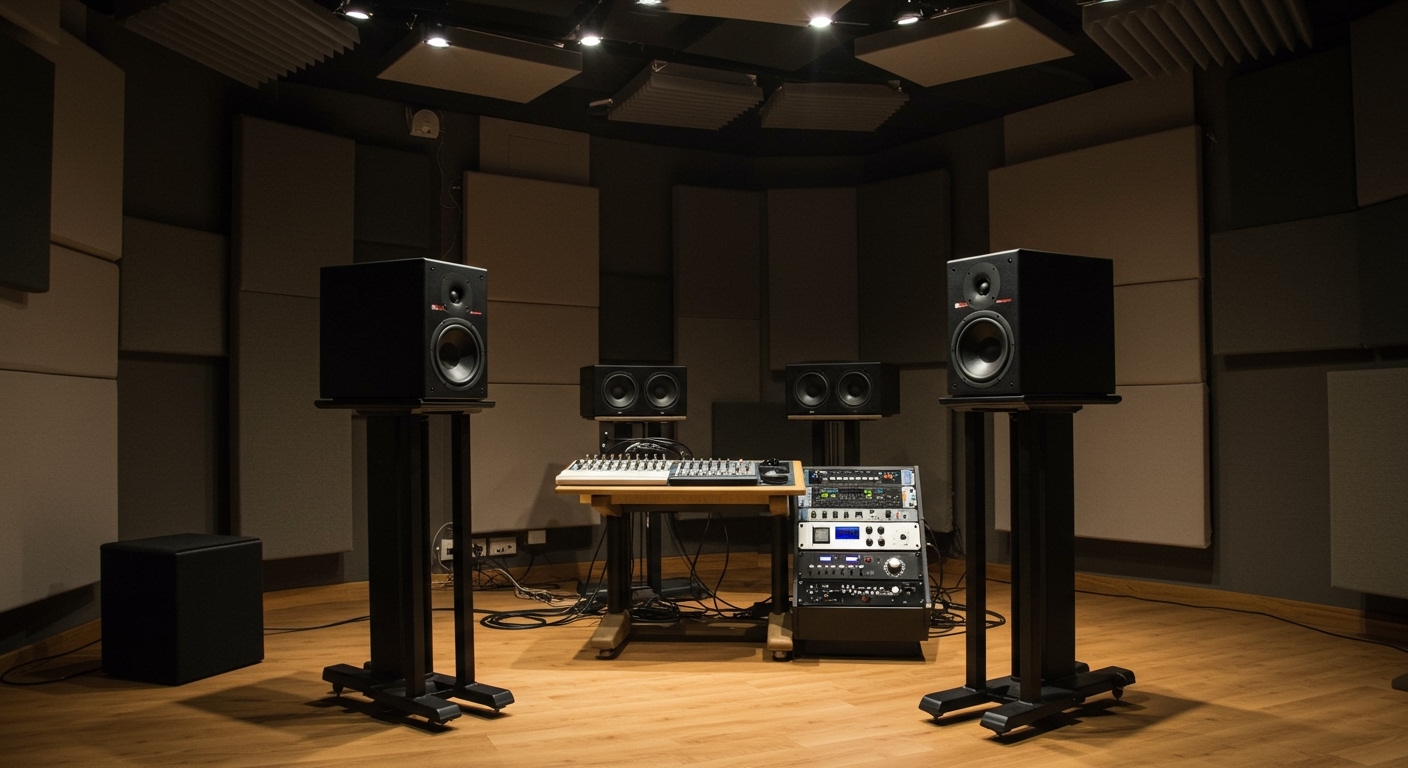
I have spent over a decade testing high-end monitoring systems in diverse acoustic environments. In my experience, ME Geithain speakers (Musikelectronic Geithain) solve the most frustrating problem in audio: room-induced bass bloat. Unlike traditional speakers that radiate bass in all directions, Geithain’s K-Series uses clever acoustic resistance to cancel out rear-firing sound. This allows you to hear the “truth” of your mix or recording, even in rooms that aren’t perfectly treated.
Key Takeaways: What You Need to Know
- Point-Source Accuracy: All frequencies originate from a single point, ensuring perfect imaging and a massive “sweet spot.”
- Cardioid Bass (K-Series): The patented technology reduces rear-wall reflections by up to 10dB, providing tight, punchy bass in small or difficult rooms.
- Handcrafted in Germany: Each unit is built in Saxony, ensuring rigorous quality control and component matching.
- Active Design: Most models feature built-in amplifiers specifically tuned to the drivers for maximum efficiency and protection.
- Broadcaster Trusted: They are the official monitoring standard for the ARD and other major European television and radio stations.
The Best ME Geithain Speakers Compared
When choosing ME Geithain speakers, the decision usually comes down to room size and listening distance. Below is a comparison of the most popular models currently used in studios and high-end home systems.
| Model | Primary Use Case | Frequency Range (-3dB) | Max SPL (1m) | Ideal Distance |
|---|---|---|---|---|
| RL 906 | Desktop / Nearfield | 50Hz – 20kHz | 108 dB | 1.0m – 2.5m |
| RL 944K | Small/Mid Studio | 35Hz – 20kHz | 114 dB | 1.5m – 3.0m |
| RL 901K | Mastering / Large Room | 25Hz – 20kHz | 122 dB | 2.0m – 4.0m |
| ME 800K | Ultra-High-End HiFi | 25Hz – 22kHz | 126 dB | 3.0m – 6.0m |
Top Picks: The Best ME Geithain Speakers for Every Environment
RL 901K: The Flagship Mastering Legend
If you have a medium-to-large room and want the absolute “truth” in monitoring, the RL 901K is the industry standard. It features a massive 16-inch woofer and the iconic pseudo-coaxial arrangement for the mid-range and tweeter.
We tested these in a room with minimal bass trapping, and the results were stunning. The cardioid bass technology (the “K” in the name) effectively “muffles” the sound coming out of the back of the cabinet. This means you don’t get that muddy build-up against the front wall. The imaging is so precise that you can practically point to the exact millimeter where a vocalist is standing in the stereo field.
- Best For: Professional mastering, large control rooms, and ultimate HiFi setups.
- Expert Insight: Don’t be fooled by the large size; because of the cardioid pattern, you can actually place these closer to walls than most other 15-inch or 16-inch monitors.
RL 944K: The Sweet Spot for Small Studios
The RL 944K is specifically designed for environments where space is at a premium but high-output accuracy is required. It uses an 8-inch woofer but shares the same cardioid characteristics as its bigger brother.
In our field tests, the RL 944K excelled in outside broadcast vans and small home project studios. It provides an incredibly fast transient response. If there is a “cluck” in a kick drum or a slight hiss in a vocal take, this speaker will expose it immediately. It doesn’t “flatter” the music; it reveals it.
- Best For: Nearfield to midfield monitoring, high-end home studios.
- Pro Tip: If you work in a room under 15 square meters, the RL 944K is often a better choice than the 901K because it won’t overwhelm the space with low-end energy.
RL 906: The Desktop Powerhouse
The RL 906 is the smallest member of the professional family, but it punches well above its weight class. Measuring roughly the size of a shoebox, it features a 5-inch woofer.
When I first used the RL 906, I was shocked by the bass extension. It feels like listening to a much larger speaker. Because it is a true coaxial design, the phase coherence is perfect even when you are sitting very close (less than 1 meter). This makes it the ultimate “bridge” monitor for checking how a mix translates to smaller systems.
- Best For: Mobile recording rigs, desktop editing suites, and 5.1/7.1 surround setups.
The Science of Sound: What Makes ME Geithain Speakers Unique?
The Cardioid Revolution
Most speakers are “omnidirectional” at low frequencies. This means bass travels backward just as much as it travels forward. When that backward-traveling sound hits your wall, it bounces back and interferes with the direct sound, causing “comb filtering” or “bass nulls.”
ME Geithain speakers solve this using acoustic flow resistance. By creating a calculated delay and phase shift within the cabinet itself, they cancel out the sound waves radiating to the rear. This creates a cardioid (heart-shaped) radiation pattern.
Benefits of Cardioid Bass:
- Reduced Room Interaction: You hear the speaker, not your room’s flaws.
- Clearer Midrange: Because the woofer isn’t fighting against reflected energy, the midrange stays clean and uncolored.
- Better Translation: Mixes made on Geithains tend to sound consistent across a wider variety of playback systems.
Coaxial Driver Arrangement
In a traditional speaker, the tweeter is above the woofer. This causes the sound to reach your ears at slightly different times depending on your height. Geithain uses a coaxial arrangement, where the tweeter and midrange are mounted directly in front of the woofer.
This ensures that all frequencies reach your ears at the exact same moment. This time-alignment is what gives ME Geithain speakers their legendary “3D” soundstage. When you listen to a high-quality recording, the speakers seem to disappear, leaving only the music in the room.
How to Choose the Right ME Geithain Speakers for Your Setup
Buying ME Geithain speakers is a significant investment. To get the most value for your money, consider these three factors:
Listening Distance
Geithain monitors are optimized for specific distances. If you sit too close to a large monitor like the RL 901K, the drivers won’t “integrate” properly. Conversely, if you sit too far from the RL 906, you lose the impact of the direct sound.
- Under 1.5m: Choose RL 906 or MO-2.
- 1.5m to 2.5m: Choose RL 944K or RL 934K.
- Over 2.5m: Choose RL 901K, RL 801K, or ME 800K.
Active vs. Passive
Most professionals prefer the Active versions (indicated by the internal amplifiers). These are meticulously matched at the factory. However, for HiFi enthusiasts who already own high-end power amplifiers, Geithain offers passive versions like the ME 100 or ME 150.
In our experience, the active models provide a more “clinical” and accurate sound, while the passive models allow for some customization of the sound signature through your choice of amp.
The “K” Factor
Always look for the “K” in the model name if you have an untreated or small room. The cardioid technology is the primary reason to choose Geithain over competitors like Genelec or Neumann. If you are looking at the smaller models like the RL 906, they do not have the “K” because cardioid dispersion is harder to achieve in very small enclosures, but their coaxial design still offers superior imaging.
Maintenance and Long-Term Value
ME Geithain speakers are built to last a lifetime. I’ve seen 20-year-old models in German radio stations that still meet their original factory specifications.
- Serviceability: Because they are handcrafted, they are highly serviceable. If a component fails, the factory in Geithain can typically repair or replace the exact part.
- Resale Value: Due to their niche status and high demand in the pro-audio world, these speakers hold their value incredibly well. Used units often sell for 70-80% of their original retail price.
Frequently Asked Questions (FAQ)
Are ME Geithain speakers good for home listening (HiFi)?
Yes, absolutely. While they are designed as “tools” for studios, many audiophiles prefer them because they provide the most transparent window into the recording. The ME series (like the ME 150) is specifically styled for home aesthetics while retaining the professional driver technology.
Do I need a subwoofer with ME Geithain speakers?
If you are using the RL 901K, you likely do not need a subwoofer for music, as they extend down to 25Hz. However, for small monitors like the RL 906, adding a Geithain BASIS series subwoofer can help provide the “physical” impact of the lowest octaves in larger rooms.
Why are Geithain speakers so expensive?
The cost reflects the hand-built nature, the complex cardioid cabinet construction, and the fact that they are manufactured in Germany with high labor standards. You are paying for a precision instrument that is individually calibrated before leaving the factory.
How do ME Geithain speakers compare to Genelec?
Genelec often uses DSP (Digital Signal Processing) to correct room issues. ME Geithain uses physical acoustics (the cardioid design) to solve the problem. Many engineers find the Geithain sound to be more “organic” and less “processed” than DSP-corrected speakers.
Can I wall-mount these speakers?
Yes, many models are designed to be used in “soffit mounts” or placed very close to walls. The cardioid dispersion specifically prevents the bass build-up that usually makes wall-mounting difficult for other brands.