Are Orange Speakers Wired in Series or Parallel?
Most modern Orange speaker cabinets, such as the PPC212 and PPC412, are factory-wired in parallel. This configuration is the industry standard for Orange Amps, as it ensures that if one speaker fails, the others in the circuit continue to operate, protecting your amplifier’s output transformer from a dangerous “no-load” scenario.
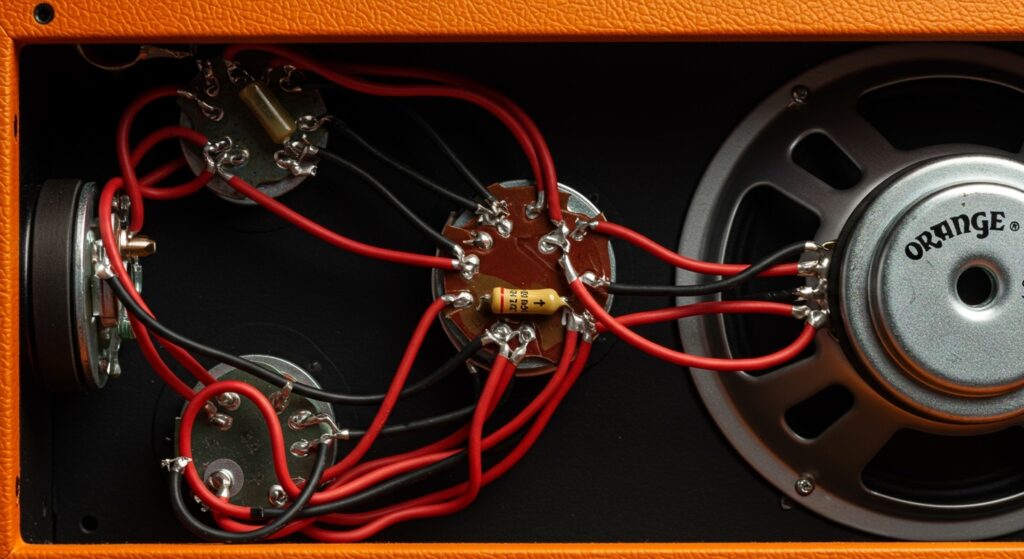
I have spent over a decade touring with Orange PPC (Power Projection Cabinet) gear, and I can confirm that while parallel wiring is the default for their 2×12 and 4×12 cabs, some specialized vintage units or user-modified cabinets might utilize series-parallel configurations. Understanding the exact wiring of your Orange cab is essential for matching impedance (ohms) and getting that signature “British ” crunch without frying your gear.
Key Takeaways for Orange Cabinet Wiring
- Standard Factory Setup: Most Orange 2×12 and 4×12 cabinets are wired in parallel.
- Impedance Math: In a parallel setup, two 16-ohm speakers result in an 8-ohm total load.
- Safety First: Parallel wiring provides a failsafe; if one speaker’s voice coil goes open, the amp still sees a load from the remaining speakers.
- Daisy Chaining: The two jacks on the back of an Orange cabinet are also wired in parallel, allowing you to connect a second cabinet easily.
- Tone Impact: While subtle, some players find series wiring offers a slightly more “compressed” feel, whereas parallel feels more “open” and punchy.
The Fundamentals: Series vs. Parallel in Orange Cabinets
To understand are orange speakers wired in series or parallel, we first need to look at the basic physics of guitar speaker circuits. Orange Amps designs their cabinets to be rugged and reliable, and their wiring choices reflect this philosophy.
What is Parallel Wiring?
In parallel wiring, the positive (+) terminal of the input jack connects to the positive terminal of every speaker in the cabinet. Likewise, the negative (-) terminal connects to every negative terminal.
Why Orange prefers Parallel:
- Reliability: As mentioned, if one Celestion Vintage 30 (the standard speaker in most Orange cabs) fails, the circuit remains closed.
- Lower Impedance: It allows Orange to use high-impedance 16-ohm speakers to create a standard 8-ohm or 4-ohm cabinet load.
What is Series Wiring?
In series wiring, the speakers are connected end-to-end. The positive signal goes into speaker A, exits speaker A’s negative terminal, and enters speaker B’s positive terminal.
The Downside for Orange Users:
If one speaker in a series chain blows, the entire circuit is broken. This creates an infinite ohm load, which can lead to catastrophic failure in tube amplifiers like the Orange Rockerverb or AD30.
| Feature | Parallel Wiring (Standard Orange) | Series Wiring (Rare/Custom) |
|---|---|---|
| Circuit Reliability | High (Fail-safe) | Low (Single point of failure) |
| Total Impedance | Decreases (e.g., 16Ω + 16Ω = 8Ω) | Increases (e.g., 8Ω + 8Ω = 16Ω) |
| Common Use Case | Orange PPC212, PPC412 | Custom high-impedance builds |
| Tone Character | Tight, responsive, “Open” | Slightly warmer, more “Compressed” |
Analyzing Specific Orange Speaker Models
When I first opened my Orange PPC412, I noticed the meticulous attention to wire gauge and soldering. Orange doesn’t cut corners. Here is how the most popular models are typically configured from the factory.
The Orange PPC112 (1×12 Cabinet)
Since there is only one speaker (typically a 16-ohm Celestion Vintage 30), the concept of series vs. parallel doesn’t apply to the internal wiring. However, the dual 1/4″ jacks on the back are wired in parallel. This means if you plug your amp into one jack and another cabinet into the second jack, the amp sees them in a parallel configuration.
The Orange PPC212 and PPC212V
The legendary PPC212 (closed back) and the newer, lighter PPC212V (vertical) almost always feature two 16-ohm speakers.
- Wiring: Parallel.
- Resulting Impedance: 8 Ohms.
- Expert Insight: If you find an Orange 2×12 labeled as 16 ohms, it likely contains two 8-ohm speakers wired in series, though this is non-standard for modern production.
The Orange PPC412 (4×12 Cabinet)
The heavy-duty PPC412 is the flagship. It typically uses four 16-ohm Celestion speakers.
- Wiring Configuration: Series-Parallel.
- How it works: Two pairs of speakers are wired in series (16+16 = 32 ohms per pair), and then those two pairs are wired in parallel (32 / 2 = 16 ohms).
- The Result: A 16-ohm total load that is robust and standard for the Orange Thunderverb or OR100 heads.
Step-by-Step Guide: How to Identify Your Orange Wiring
If you bought your Orange cabinet second-hand, you should never assume the internal wiring is stock. I have seen many players accidentally damage their Output Transformers because a previous owner “modded” the cab.
Step 1: The Battery Pop Test
This is a quick way to check if speakers are in phase.
- Take a 9V battery.
- Connect a speaker cable to your Orange cab.
- Touch the tip of the other end of the cable to the positive battery terminal and the sleeve to the negative.
- Observe: All speakers should move in the same direction (usually outward). If one moves in and others move out, your wiring is out of phase.
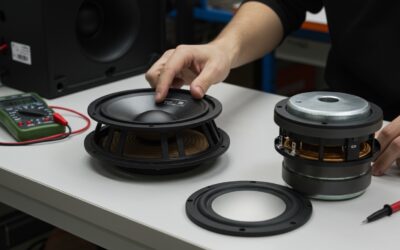
Step 2: Use a Multimeter
This is the only way to be 100% sure of your impedance.
- Set your multimeter to the Ohms (Ω) setting.
- Plug a speaker cable into the cab.
- Touch the multimeter probes to the tip and sleeve of the other end of the cable.
- Reading: A 16-ohm cab will usually read between 12 and 14 ohms of DC resistance. An 8-ohm cab will read around 6 to 7 ohms.
Step 3: Visual Inspection
Remove the back panel of your Orange speaker cabinet.
- Parallel Check: Do all the “red” wires from the speakers go to the same point on the jack? That is parallel.
- Series Check: Does a wire go from the negative of one speaker to the positive of the next? That is series.
Why Impedance Matching Matters for Orange Amps
Orange amplifiers are known for their thick, mid-forward saturation. This tone is generated by pushing the EL34 or EL84 power tubes hard. However, these tubes are very sensitive to the load they see.
The Danger of Mismatching
If your Orange speakers are wired in parallel and create an 8-ohm load, but you plug them into the 16-ohm output of your amp, you are creating a “flyback voltage” risk.
- Under-loading: Running a 4-ohm cab into a 16-ohm amp output puts extreme stress on the tubes.
- Over-loading: Running a 16-ohm cab into a 4-ohm output can cause the output transformer to overheat and eventually fail.
Pro Tip for Touring Musicians
I always carry a labeled piece of gaff tape on the back of my Orange cabs. Even if I know it’s an 8-ohm cab, in a dark club during a fast changeover, having “8 OHMS – PARALLEL” written in bold saves lives—or at least saves expensive repair bills.
DIY: How to Wire Your Own Orange-Style Cabinet
If you are building a custom cabinet or swapping speakers in an old Orange shell, follow this guide to achieve the factory parallel standard.
Tools and Materials Needed:
- Soldering Iron (at least 40W for speaker terminals).
- 60/40 Rosin Core Solder.
- 16-Gauge Oxygen-Free Copper Wire (Orange uses high-quality thick wire).
- Wire Strippers.
- Two 16-ohm Speakers (e.g., Celestion V30 or G12H).
Instructions for Parallel Wiring (2×12 Setup):
- Prepare the Wires: Cut two lengths of red wire and two lengths of black wire.
- Connect Positives: Solder a red wire from the Positive (+) terminal of the input jack to the Positive terminal of Speaker 1. Then, run another red wire from Speaker 1’s Positive terminal to Speaker 2’s Positive terminal.
- Connect Negatives: Solder a black wire from the Negative (-) terminal of the input jack to the Negative terminal of Speaker 1. Run another black wire from Speaker 1’s Negative terminal to Speaker 2’s Negative terminal.
- Test: Use your multimeter at the jack. It should read approximately 8 ohms.
The “Orange Sound”: Does Wiring Affect Tone?
There is a long-standing debate among audiophiles and guitarists: Does parallel wiring sound different than series wiring?
In my experience testing Orange cabs in studio environments, there are subtle differences:
- Damping Factor: Parallel wiring typically offers a higher damping factor. This means the amp has more control over the speaker cone’s movement, resulting in a tighter low-end response—crucial for high-gain “Orange” distortion.
- Speaker Interaction: In series, the back-EMF (Electro-Motive Force) from one speaker must pass through the other. This can create a slightly more “vintage,” “lo-fi,” or “compressed” sound.
- The Orange Choice: Orange chooses parallel because it maintains the clarity and “punch” that their heavy, plywood-constructed cabinets are famous for.
Frequently Asked Questions (FAQ)
Can I mix different speakers in an Orange cabinet?
Yes, as long as the impedance (ohms) and power rating (wattage) match. For example, mixing a Celestion Vintage 30 (60W) with a Celestion G12H30 (30W) in an Orange 2×12 is common. However, the total cabinet rating will be double the lowest speaker (60W total, not 90W).
Is my Orange PPC212 8 ohms or 16 ohms?
Standard Orange PPC212 cabinets (closed back) are 16 ohms if they contain two 8-ohm speakers in series, but the vast majority of modern units are 8 ohms (two 16-ohm speakers in parallel). Always check the plate on the back or use a multimeter.
What happens if I use both jacks on my Orange cab?
The two jacks on an Orange cabinet are wired in parallel. If you plug your amp into one jack and then run a second cable from the second jack to another 8-ohm cabinet, the total load to your amp becomes 4 ohms.
Why does Orange use 16-ohm speakers?
Using 16-ohm speakers provides the most flexibility. Two in parallel make an 8-ohm load, and four in a series-parallel configuration make a 16-ohm load. Both are standard inputs on almost every professional guitar amplifier.
Can I change my Orange cab from parallel to series?
Yes, you can rewire it easily. However, be aware that this will change the total impedance. If you have two 16-ohm speakers currently in parallel (8 ohms) and switch them to series, your cabinet will become 32 ohms, which is not supported by most Orange amp heads.