Are Reference Speakers Compatible With Vintage Stereo Systems?
Yes, reference speakers are compatible with vintage stereo systems, provided you match the impedance (Ohms) and power ratings (Watts) correctly. Most vintage receivers use standard analog outputs that work perfectly with modern reference monitors, though you may need specific adapters for wire connections.
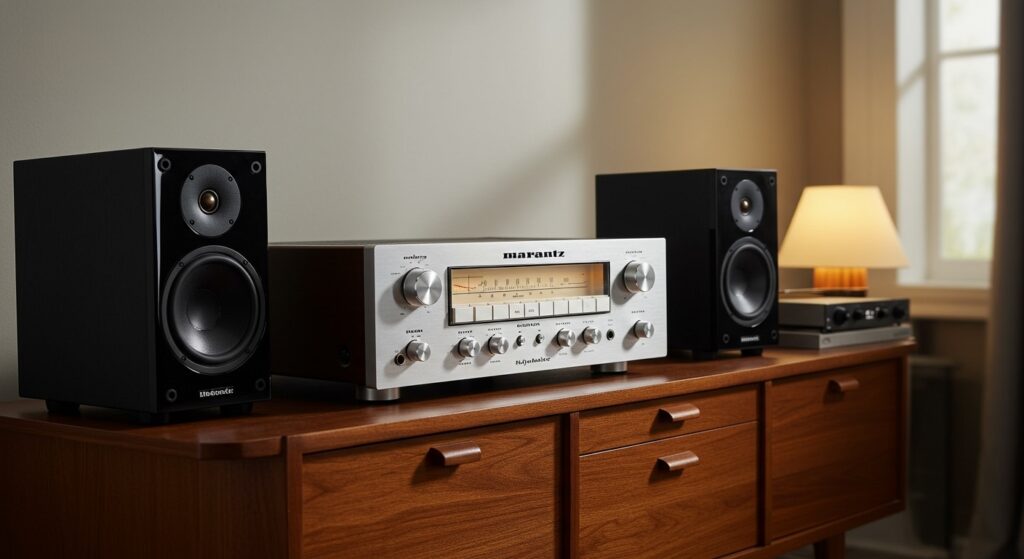
Mixing modern reference speakers with vintage hi-fi gear creates a unique “best of both worlds” scenario. You get the surgical accuracy of modern drivers powered by the “warm” harmonic distortion of vintage transistors or tubes. However, failure to check impedance compatibility can result in overheating your vintage amplifier or damaging your new speakers.
Key Takeaways: Quick Compatibility Checklist
- Impedance Check: Ensure your vintage receiver supports the Ohms rating of the reference speakers (usually 4, 6, or 8 ohms).
- Connection Type: You may need pin connectors or banana plug adapters to bridge the gap between vintage spring clips and modern binding posts.
- Power Matching: Vintage “Watts” were often measured more conservatively than modern ratings; don’t over-drive low-wattage vintage amps.
- Sound Profile: Expect a very transparent sound that highlights any background hiss or “hum” present in older equipment.
Understanding the Technical Synergy
When asking are reference speakers compatible with vintage stereo, we have to look at the electrical physics behind the components. Reference speakers are designed for a “flat” frequency response, meaning they don’t add bass or treble boosts. Vintage receivers, like those from Marantz, Pioneer, or Sansui, are famous for their “coloration” or warmth.
In my years of restoring 1970s gear, I’ve found that high-end reference monitors like the KEF LS50 or Yamaha HS series (passive versions) can breathe new life into an old system. The reference speakers act as a magnifying glass, revealing the high-quality craftsmanship of early solid-state engineering.
Impedance: The “Make or Break” Factor
Most vintage receivers from the “Golden Era” (1970–1980) were designed for 8-ohm or 16-ohm loads. Modern reference speakers are frequently rated at 4 ohms.
If you connect a 4-ohm speaker to a vintage receiver only rated for 8 ohms, the amp will try to draw more current than it can handle. This leads to thermal runaway—essentially melting your output transistors. Always check the back panel of your vintage unit for the “Speaker Load” range.
| Feature | Vintage Speakers (Typical) | Modern Reference Speakers | Compatibility Impact |
|---|---|---|---|
| Impedance | 8 – 16 Ohms | 4 – 8 Ohms | High Risk (Requires matching) |
| Sensitivity | High (90dB+) | Moderate (85-88dB) | Requires more volume/power |
| Terminals | Spring Clips / Screw Terminals | 5-way Binding Posts | Requires cable adapters |
| Sound Goal | Musicality / Warmth | Accuracy / Transparency | Creates a “Hybrid” sound |
How to Connect Reference Speakers to Vintage Gear
Connecting these two eras of technology is straightforward, but the physical hardware has changed significantly over 40 years.
Step 1: Check Your Terminals
Most vintage receivers use spring clips that accept only thin, bare wire. Modern reference speakers use binding posts designed for banana plugs or thick-gauge wire.
I recommend using flexible pin connectors on the amplifier end and gold-plated banana plugs on the speaker end. This ensures a secure connection that won’t fray and cause a short circuit—a common killer of vintage Pioneer SX series receivers.
Step 2: Gauge the Wire
For vintage setups, 16-gauge oxygen-free copper (OFC) wire is usually the “sweet spot.” It is thin enough to fit into vintage clips but thick enough to carry a clean signal to your reference monitors without resistance buildup. Avoid “CCA” (Copper Clad Aluminum) wire, as it has higher resistance and can degrade the signal quality of your reference-grade audio.
Step 3: Verify Phasing
Consistency is critical. Ensure the positive (+) terminal on your vintage amp (usually red) connects to the positive (+) terminal on the speaker. If you swap these on one side, the speakers will be “out of phase,” resulting in a total loss of bass and a hollowed-out center image.
Why You Might (Or Might Not) Want This Setup
While the answer to are reference speakers compatible with vintage stereo is a technical “yes,” the subjective experience varies.
The Benefits of Accuracy
Using reference monitors allows you to hear exactly what your vintage receiver is doing. If you have a refurbished McIntosh or Luxman unit, a reference speaker will showcase the incredible detail and “air” these units produce. It removes the “muddy” veil often found in aged, vintage paper-cone speakers.
The Risks of Transparency
Reference speakers are unforgiving. If your vintage receiver has leaky capacitors or a noisy power supply, you will hear a constant 60Hz hum or a high-frequency hiss.
- Vintage speakers often roll off the high end, which hides these defects.
- Reference speakers extend into the 20kHz+ range, exposing every flaw in your signal chain.
Expert Tips for Protecting Your Gear
I have seen many beginners blow the fuses on a pristine Marantz 2245 because they didn’t respect the power limits.
- Watch the Volume: Reference speakers often have lower sensitivity (dB). You might be tempted to turn the volume knob to “3 o’clock” to get the desired loudness. This can cause clipping, sending a square wave to your tweeters and blowing them instantly.
- Use DeoxIT: Before connecting high-end speakers, clean the “Tape Monitor” and “Function” switches of your vintage amp with DeoxIT D5. A dirty switch can cause intermittent signals that send “pops” to your speakers, potentially damaging delicate reference drivers.
- Heat Management: Vintage amps run hot. If you are driving a 4-ohm reference load, ensure the receiver has at least 3 inches of clearance on all sides for ventilation.
Frequently Asked Questions
Can I use active reference monitors with a vintage receiver?
Generally, no. Active monitors have their own built-in amplifiers and require a “Pre-Amp Out” signal. Most vintage receivers are integrated amps that output “Speaker Level” signals, which will destroy an active monitor’s circuitry. You would need a vintage unit with Pre-Out/Main-In jumpers to make this work.
Do I need a DAC if I’m using vintage gear and reference speakers?
If your source is a computer or phone, yes. To truly benefit from reference-grade accuracy, you need a high-quality Digital-to-Analog Converter (DAC) to feed a clean signal into the “Aux” or “Tape” input of your vintage stereo.
Will 4-ohm reference speakers damage my 8-ohm vintage amp?
It is very likely if played at high volumes. If the amp is not rated for 4 ohms, the increased current draw will stress the output transistors and the power transformer. Always verify the Ohmic compatibility before long listening sessions.
**
**
**
**