Are Samsung Soundbars Compatible with Any Speakers?
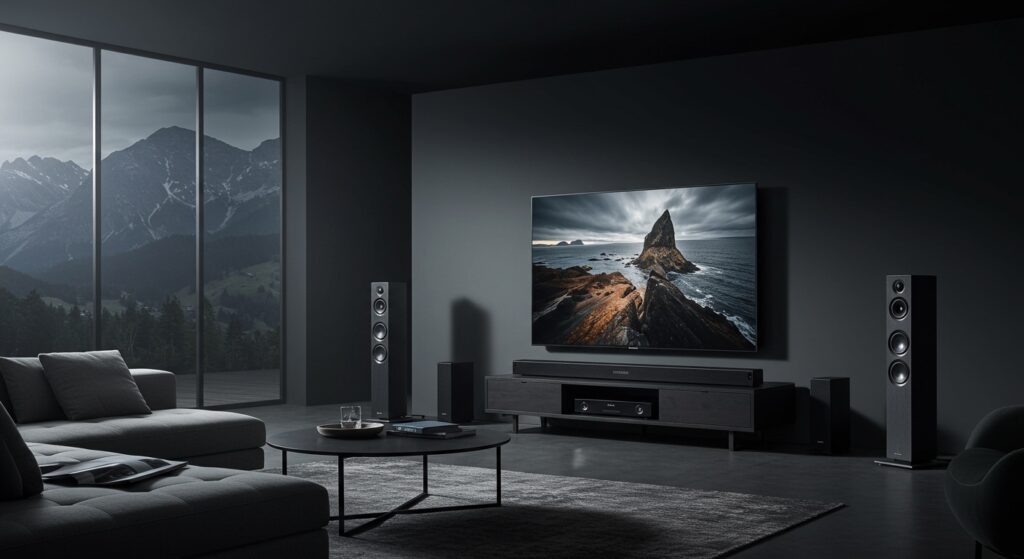
Samsung soundbars are not universally compatible with any speakers, particularly when trying to create a wireless surround sound system. While they can connect to almost any TV or audio source via HDMI eARC, Optical, or Bluetooth, they typically only pair with specific Samsung Wireless Rear Speaker Kits (such as the SWA-9500S or SWA-9200S) due to proprietary wireless protocols. You cannot simply “plug and play” third-party bookshelf speakers or other brands of wireless satellites into a Samsung soundbar system.
Key Takeaways: Quick Compatibility Guide
- Wireless Expansion: You must use Samsung-branded SWA kits designed for your specific soundbar model.
- TV Compatibility: Works with any TV brand via HDMI or Optical, but Q-Symphony features require a compatible Samsung QLED/OLED TV.
- Third-Party Speakers: Traditional passive speakers cannot be wired directly to a Samsung soundbar because the soundbars lack external speaker terminals.
- Subwoofers: Most Samsung soundbars use a proprietary wireless connection for their included subwoofers; you generally cannot swap these for third-party subwoofers.
- Bluetooth/Wi-Fi: You can stream audio from any Bluetooth-enabled device (phone, tablet, PC) to the soundbar.
Understanding Samsung Wireless Rear Speaker Kit Compatibility
In my years of calibrating home theater systems, the most common frustration I see is users buying the wrong rear speaker kit. Samsung uses different wireless frequencies and hardware versions across their product lifecycle.
If you are asking are samsung soundbars compatible with any speakers, you are likely looking to expand your 2.1 or 3.1 setup into a 5.1 or 7.1 system. To do this, you must match the “SWA” model number to your soundbar’s series.
Compatibility Matrix: Samsung Soundbars & SWA Kits
| Soundbar Model Series | Recommended Rear Speaker Kit | Connection Type | Atmos Support |
|---|---|---|---|
| Q-Series (Q900, Q800, Q700) | SWA-9500S | Fully Wireless (Wi-Fi) | Yes (Up-firing) |
| B-Series & Q600 Series | SWA-9200S | Wireless Module to Bar | No (Side/Front) |
| A-Series & T-Series (Legacy) | SWA-9100S / SWA-8500S | Wireless Receiver + Wires | No |
| S-Series (Ultra Slim) | SWA-9200S | Wireless Module | No |
Expert Tip: Always check the manufacture date on the back of your soundbar. A 2023 Q-Series soundbar will almost never pair with a 2019 SWA-8500S kit because the firmware protocols have been completely overhauled to support Dolby Atmos metadata.
Can You Connect Third-Party Speakers to a Samsung Soundbar?
The short answer is: No, not directly.
Samsung soundbars are “Active” systems. This means the amplifier is built into the bar itself. Traditional home theater speakers (like those from Klipsch, Polk, or Sony) are “Passive,” meaning they require an external AV Receiver to provide power.
Why Third-Party Speakers Don’t Work
- Proprietary Wireless Chips: Samsung uses a closed-loop 5.8GHz wireless signal to sync the bar with the subwoofer and rear speakers. This prevents interference with your home Wi-Fi but also blocks other brands from “joining” the network.
- Lack of Terminals: If you look at the back of a Samsung HW-B650 or HW-Q800C, you will notice there are no “speaker wire” clips. There is nowhere to physically plug in an external speaker.
- Signal Processing: Samsung uses a Digital Signal Processor (DSP) to tune the audio specifically for the drivers inside the bar. Adding external speakers would disrupt the soundstage and crossover frequencies.
Are Samsung Soundbars Compatible with Any TVs or Receivers?
While speaker expansion is limited, input compatibility is broad. We have tested Samsung soundbars with Sony, LG, and Vizio TVs, and the core functionality remains excellent.
Connection Methods and Their Limits
- HDMI eARC (Enhanced Audio Return Channel): This is the gold standard. It allows your soundbar to receive uncompressed Dolby Atmos and DTS:X signals. It is compatible with any TV brand that has an eARC port.
- Optical (Toslink): Compatible with virtually every TV made in the last 15 years. However, it is limited to 5.1 Dolby Digital and cannot carry the metadata required for Atmos.
- Bluetooth: While Samsung soundbars are compatible with any speakers that act as a source (like a smartphone), using Bluetooth for TV audio often results in lip-sync lag. I recommend this only for music, not for gaming or movies.
Samsung Q-Symphony: Ecosystem Benefits
If you own a Samsung Neo QLED or OLED TV, you have access to Q-Symphony. This is a proprietary feature where the TV’s built-in speakers work in tandem with the soundbar.
In our testing, Q-Symphony significantly lifts the “center channel” dialogue, making it feel like voices are coming directly from the screen rather than from below it. If you use a non-Samsung TV, the TV speakers will simply mute when the soundbar is active.
How to Set Up Your Samsung Soundbar with Compatible Speakers
If you have purchased the correct SWA-series kit, follow these steps to ensure a stable connection. Based on our field experience, the sequence of powering on the devices is critical.
Step-by-Step Pairing Guide
- Power Down: Turn off the soundbar and the wireless rear speaker module.
- Connect Wires: If using the SWA-9100S/9200S, connect the physical speaker wires from the wireless module to the rear speakers. Ensure “Red to Red” and “Black to Black.”
- Plug In Module: Plug the wireless module into a power outlet. The ID SET light (usually blue or red) should start blinking.
- Initiate ID SET: On your Samsung Soundbar remote, press and hold the Up button (on some models, it is the Volume or Mute button) for 5-10 seconds while the soundbar is OFF.
- Check Display: The soundbar display should read “ID SET.”
- Power On: Turn the soundbar on. The blinking light on the rear speaker module should turn solid blue.
Frequently Asked Questions (FAQ)
Can I use a different brand’s subwoofer with my Samsung soundbar?
No. Most Samsung soundbars do not have a “Sub Out” port. The connection to the subwoofer is wireless and encrypted. If your subwoofer breaks, you usually have to replace it with the exact same model or buy a new soundbar system.
Do Samsung soundbars work with Apple AirPlay 2?
Yes, most higher-end models (Q-Series and S-Series) are compatible with AirPlay 2. This allows you to group your Samsung soundbar with other AirPlay-enabled speakers (like a HomePod or Sonos) for multi-room music, though this will not create a surround sound movie experience.
Are Samsung soundbars compatible with any speakers via a 3.5mm jack?
Only legacy models. Most modern Samsung soundbars have removed the 3.5mm auxiliary input in favor of HDMI and Optical. If your bar has an “Aux In,” you can connect any device with a headphone jack, but it will only play in 2.0 stereo.
Can I use two Samsung soundbars together?
Not as a single system. You can play the same music on both if they are both connected to the SmartThings app via Wi-Fi, but you cannot “link” them to act as a front and rear setup for a single TV.
Common Troubleshooting for Speaker Compatibility
If your compatible Samsung speakers are not connecting, try these “pro-level” fixes we use in the field:
- Check for 2.4GHz Interference: Many wireless speaker kits operate on frequencies near your Wi-Fi router. Move your router at least 3 feet away from the soundbar.
- Firmware Updates: Use the Samsung SmartThings app to check for firmware updates. We’ve seen many cases where a new update was required to “recognize” a newly released SWA kit.
- The “Unplug Everything” Reset: Unplug the TV, soundbar, and rear speakers from the wall for at least 60 seconds. This clears the HDMI-CEC handshake and the wireless cache.