Understanding the Fundamentals of a Spanish Speakers Sense of Personal Space
A spanish speakers sense of personal space is significantly smaller than that of individuals from “low-contact” cultures like the United States, UK, or Germany, typically ranging from 1.5 to 2 feet for social interactions. In most Spanish-speaking cultures, physical proximity and frequent touch are viewed as essential indicators of trust (confianza), warmth, and active engagement rather than an intrusion.
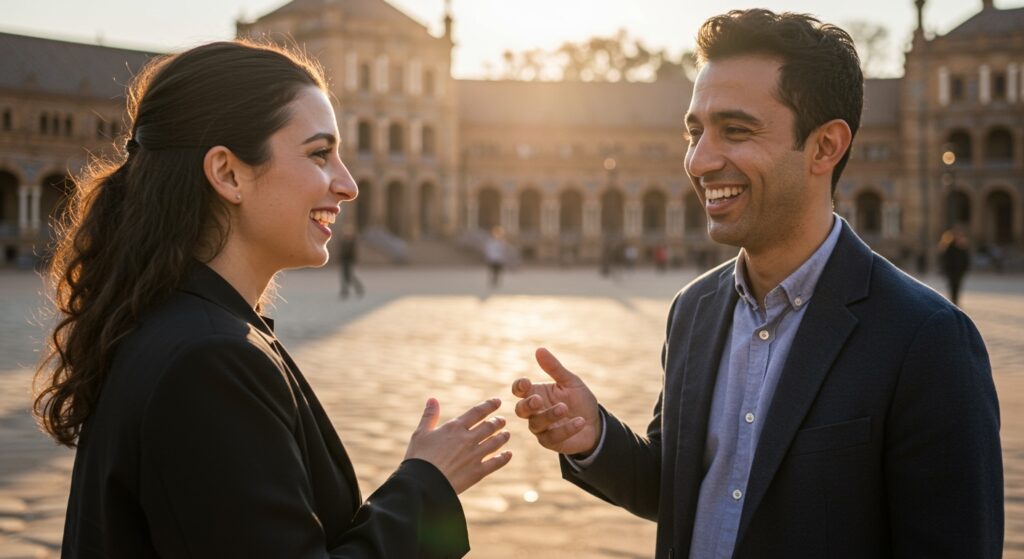
Navigating a conversation in Madrid, Mexico City, or Buenos Aires often involves what researchers call high-contact proxemics. During my years living in both Spain and Colombia, I quickly learned that maintaining a “buffer zone” is often interpreted as being cold, untrustworthy, or even elitist. To succeed in these environments, you must shift your mindset from “protecting your bubble” to “sharing a space.”
Key Takeaways: Navigating Cultural Proximity
- Proximity equals Trust: Standing closer signifies that you are fully present and value the relationship.
- Expect Frequent Touch: Light touches on the arm, shoulder, or back are common punctuation marks in conversation.
- The “Step Back” Signal: If you move away to reclaim space, a Spanish speaker will likely step forward to close the gap, leading to a “cultural dance.”
- Regional Nuances: While the general trend is high-contact, the specific etiquette (like the number of kisses) varies between Spain and Latin America.
The Science of Proxemics: Why Space Matters
To master a spanish speakers sense of personal space, we must look at the work of anthropologist Edward T. Hall, who coined the term Proxemics. He categorized cultures into “high-contact” and “low-contact” groups. Spanish-speaking nations almost universally fall into the high-contact category.
In these societies, the “intimate zone” (usually reserved for family in the US) often overlaps with the “social zone.” This means a business colleague might stand at a distance that a North American would find uncomfortably close. This isn’t a lack of manners; it is a different social grammar.
Comparison of Personal Space Zones by Culture
| Culture Type | Personal Space Distance | Common Behaviors |
|---|---|---|
| Spanish-Speaking (High Contact) | 1.5 – 2.5 Feet | Frequent touching, intense eye contact, “Dos Besos” greeting. |
| North American (Medium Contact) | 3.0 – 4.0 Feet | Handshakes, occasional arm touch, “Arm’s Length” rule. |
| East Asian (Low Contact) | 4.0+ Feet | Bowing, minimal physical contact, focus on personal “bubble.” |
Step 1: Adjust Your Physical Proximity Expectations
When interacting with someone from a Spanish-speaking background, the first step is to consciously shorten your standing distance. If you are used to keeping a 4-foot gap, try reducing it to 2 feet.
During my first business meetings in Mexico City, I noticed that my natural instinct to lean back was being read as “disinterest.” I had to train myself to lean in. This signals that you are listening and that you respect the other person’s presence. A spanish speakers sense of personal space relies on the idea that physical distance creates emotional distance.
Practical Tips for Proximity:
- Observe the Lead: Let the local resident set the initial distance and try to maintain it.
- Avoid the “Retreat”: If they move closer, try to hold your ground. Moving back can be seen as a “rejection” of their friendliness.
- Use Body Angling: If the closeness feels overwhelming, angle your body slightly to the side rather than backing away directly.
Step 2: Master the Art of the Greeting (The Kiss and the Hug)
In the context of a spanish speakers sense of personal space, greetings are the most high-contact moments. This is where most “intercultural crashes” happen.
In Spain, the standard greeting is the “dos besos” (two kisses), starting with the right cheek then the left. In most Latin American countries, such as Mexico, Colombia, or Peru, the standard is often a single kiss on the right cheek. It is important to note that these are usually “air kisses” where cheeks touch but lips do not.
Regional Variations in Greetings:
- Spain: Two kisses (Right then Left) are common between women, and between men and women. Men usually shake hands or give a “bro-hug.”
- Argentina/Uruguay: It is very common for men to greet other men with a single kiss on the cheek, especially among friends and family.
- Business Settings: A firm handshake is still the professional standard for first meetings, but don’t be surprised if it quickly evolves into a “brazo” (a combination of a handshake and a pat on the shoulder).
Step 3: Interpret Physical Touch as Communication
For many, a spanish speakers sense of personal space includes a high frequency of “haptic” communication. This means touch is used to emphasize a point, show empathy, or keep the conversation flowing.
We have found that in Madrid or Buenos Aires, a hand on your forearm during a joke isn’t a flirtatious gesture—it’s a social lubricant. If you stiffen up when touched, it sends a signal that you are uncomfortable with the person, not just the gesture.
Common Touch Points to Expect:
- The Forearm Tap: Used to grab attention or emphasize a specific word.
- The Shoulder Pat: A sign of camaraderie and “good vibes.”
- The Double-Handed Handshake: Where the person uses their left hand to cover your right hand during a greeting to show extra sincerity.
Step 4: Navigate Public Spaces and Crowds
Understanding a spanish speakers sense of personal space also applies to how people move through the world. In crowded places like the Barcelona Metro or a Mercado in Guatemala, you will notice that people don’t apologize for every minor physical brush.
In low-contact cultures, “bumping” into someone requires an immediate “I’m sorry.” In many Spanish-speaking countries, a certain level of physical contact in public is expected and ignored. It isn’t considered rude; it is simply a byproduct of living in a high-density, social society.
How to Handle Crowds:
- Lower Your Sensitivity: Don’t take accidental bumps personally.
- Shorten Your “Apology Loop”: A quick “perdón” or “con permiso” is sufficient; there is no need for a lengthy apology.
- Accept the Flow: People will walk closer to you on the sidewalk than you might be used to. Keep a steady pace.
Step 5: Recognize the Role of Eye Contact
You cannot discuss a spanish speakers sense of personal space without mentioning eye contact. In these cultures, looking someone directly in the eye is a sign of honesty and respect.
If you avoid eye contact while standing close, it creates a “mixed signal” that can be very confusing for a native speaker. They may feel you are hiding something. When you are in their “space,” you are expected to be fully engaged—and that means looking at them.
Expert Advice on Eye Contact:
- Maintain Focus: During a toast (un brindis), it is culturally mandatory in Spain to look everyone in the eye. Failing to do so is sometimes jokingly said to bring “seven years of bad luck.”
- Soft vs. Hard Gaze: You don’t need to stare intensely, but “checking out” of a conversation by looking at your phone or the floor is considered highly offensive in a small-space culture.
Professional vs. Social Space: The Nuances
While a spanish speakers sense of personal space is generally smaller, it does change based on the environment. Professional settings in large corporations in Santiago or Mexico City might mirror international standards more closely than a backyard BBQ.
However, the “ice-breaking” phase in Spanish-speaking business is often much shorter. You might find that after just 15 minutes of coffee, the physical distance drops significantly. This is a sign that the business relationship is progressing well.
Social Dynamics Table: Proximity by Setting
| Setting | Expected Distance | Key Behavior |
|---|---|---|
| First Business Meeting | 2.5 – 3.0 Feet | Handshake, Formal titles (Usted). |
| Established Client Meeting | 1.5 – 2.0 Feet | Shoulder pats, closer seating at tables. |
| Family Dinner/Party | 1.0 – 1.5 Feet | Constant movement, hugs, communal seating. |
| Public Transport | 0.5 – 1.0 Feet | Acceptance of “shoulder-to-shoulder” contact. |
Frequently Asked Questions
Why do Spanish speakers stand so close when talking?
It is a cultural manifestation of collectivism and warmth. Standing close signals that there are no barriers between you and the other person, fostering a sense of community and mutual trust.
Is it rude to move back if I feel my personal space is being invaded?
While not “illegal,” it is often interpreted as a sign of coldness or “arrogance.” If you must move back, try to do it naturally (e.g., reaching for a drink) rather than a sudden defensive step.
Do these rules apply to all Spanish-speaking countries?
Generally, yes, but the intensity varies. Caribbean cultures (Caribbean coast of Colombia, Cuba, Dominican Republic) tend to be the highest contact, while Andean cultures (parts of Peru, Bolivia) might be slightly more reserved but still higher-contact than the US.
How should I handle the “double kiss” if I’m uncomfortable?
If you really prefer not to kiss, extend your hand for a firm handshake early in the greeting process. This “sets the distance” before they can lean in. However, in social settings, following the local custom will help you integrate much faster.
What is the best way to show respect for a Spanish speakers sense of personal space?
The best way is to “mirror” their behavior. If they lean in, lean in. If they use touch to emphasize a point, remain relaxed. Showing that you are comfortable in their presence is the highest form of respect in these cultures.