Understanding What Sensitivity Means in Speakers: A Practical Guide
Have you ever wondered why some speakers seem to sing with just a whisper of power from an amplifier, while others need a muscular, high-wattage beast to even wake up? The difference often comes down to one of the most important yet misunderstood specifications in audio: speaker sensitivity. Getting this right is the key to creating a perfectly matched system that sounds dynamic and effortless.
This guide will demystify what sensitivity means in speakers. We’ll break down the numbers, explain how it directly impacts your amplifier choice, and give you the practical knowledge to select the right speakers for your room and your gear.
Key Takeaways: Speaker Sensitivity Explained
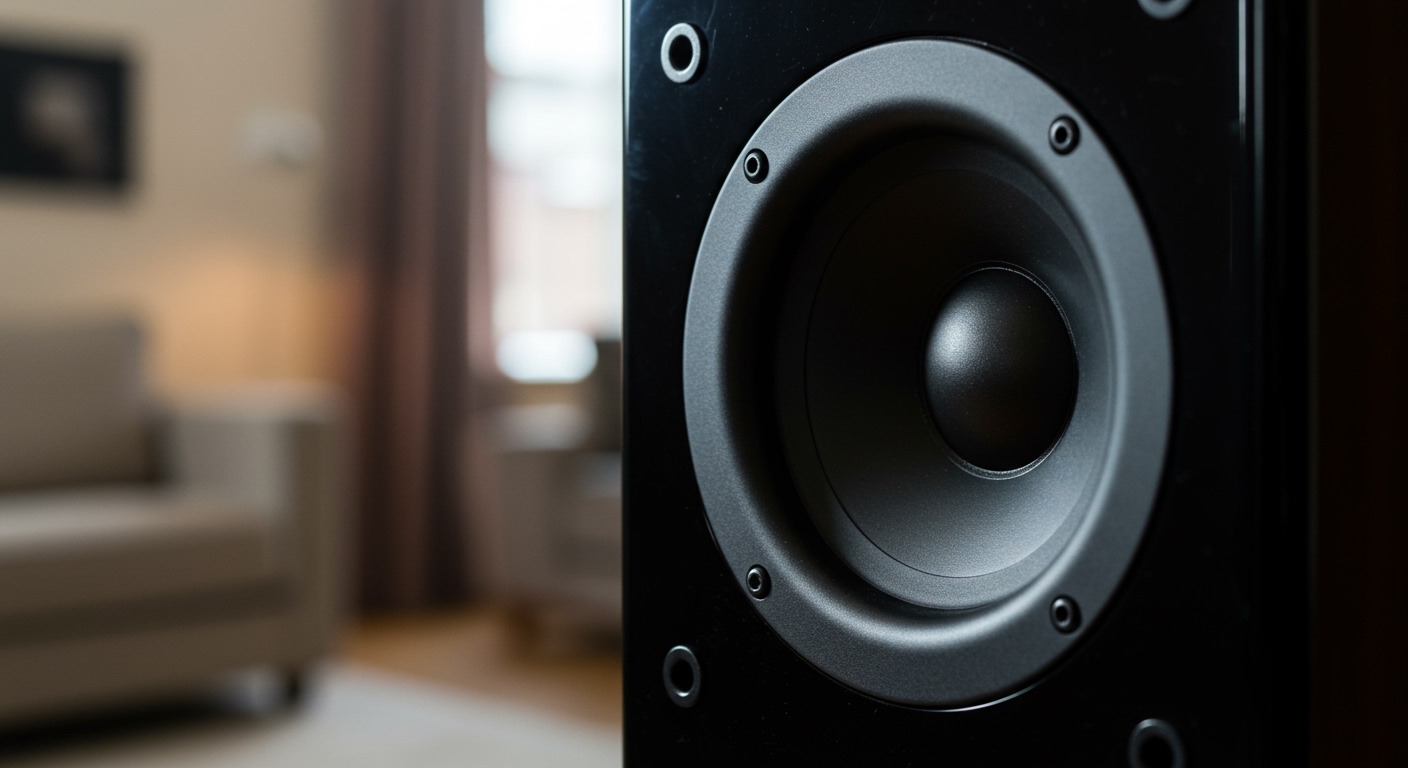
- What It Is: Speaker sensitivity is a measurement of how efficiently a speaker converts amplifier power into sound. It tells you how loud a speaker will play (in decibels) when fed a standard signal (1 watt or 2.83 volts) and measured from one meter away.
- The Unit: It’s always expressed in decibels (dB). For example, a speaker might have a sensitivity rating of 88 dB.
- Higher is More Efficient: A speaker with a higher sensitivity rating needs less amplifier power to produce the same volume as a speaker with a lower rating.
- The 3 dB Rule: This is critical. For every 3 dB increase in sensitivity, a speaker needs only half the power to reach the same loudness. This has a massive impact on your amplifier requirements.
- What’s a Good Rating? What is a good sensitivity for speakers depends on your setup. Generally, 88 dB or higher is great for most home audio and home theater systems. For low-power tube amps, enthusiasts often seek out speakers with 95 dB sensitivity or more.
A Deep Dive Into What Sensitivity Means in Speakers
At its core, speaker sensitivity is a measure of efficiency. It answers the simple question: “For a given amount of power, how loud is this speaker?” The industry has a standard way of measuring this to ensure we can compare different models fairly.
The standard measurement is conducted like this:
- A speaker is placed in an anechoic chamber (a room designed to absorb all sound reflections).
- A microphone is placed exactly one meter away from the front of the speaker.
- The speaker is fed a one-watt signal from an amplifier.
- The microphone measures the resulting sound pressure level (SPL), and that number, in decibels (dB), is the sensitivity rating.
Think of it like the fuel efficiency of a car. A high-sensitivity speaker is like a car with great miles-per-gallon (MPG). It can produce a lot of output (distance/volume) from very little input (gas/power). A low-sensitivity speaker is like a gas-guzzler; it needs a lot more input to achieve the same result.
The Power of Decibels: Why a Few dB Matters a Lot
It’s easy to look at two ratings, like 87 dB and 90 dB, and think they’re pretty close. In reality, that 3 dB difference is huge. Because the decibel scale is logarithmic, the relationship between power and volume isn’t linear.
Remember this simple, powerful rule:
- +3 dB: Requires double the amplifier power.
- -3 dB: Requires half the amplifier power.
Let’s say you’re listening to a pair of 87 dB speakers and it takes 50 watts to reach your favorite listening level. To get that same volume from a pair of 84 dB speakers, you would need 100 watts. To get it from a pair of 90 dB speakers, you’d only need 25 watts.
A Quick Note: 1 Watt vs. 2.83 Volts
Sometimes you’ll see a sensitivity spec listed as “2.83V/1m” instead of “1W/1m”. This is a crucial detail.
- For an 8-ohm speaker, 2.83 volts is exactly 1 watt. The numbers are interchangeable.
- For a 4-ohm speaker, 2.83 volts is actually 2 watts of power.
This means a 4-ohm speaker’s sensitivity rating can look artificially inflated by 3 dB if it’s rated at 2.83V. When comparing speakers, always check the impedance. If you’re comparing an 8-ohm speaker to a 4-ohm speaker, and the 4-ohm model uses the 2.83V rating, you should mentally subtract 3 dB from its spec to get an apples-to-apples comparison.
How Speaker Sensitivity Dictates Your Amplifier Choice
This is where the theory becomes practice. Your speaker’s sensitivity is the single most important factor in determining how much amplifier power you actually need. Pairing them correctly is the difference between a system that sounds strained and one that is powerful and dynamic.
Low-Sensitivity Speakers (< 86 dB)
These speakers are considered “power-hungry.” They are inefficient at converting power to sound, so they need an amplifier with plenty of watts in reserve to play at loud volumes without struggling.
- Characteristics: Often found in certain high-end audiophile designs like acoustic suspension or planar magnetic speakers. These designs often prioritize other performance goals, like deep bass from a small box, over raw efficiency.
- Amplifier Pairing: You need a robust, high-current amplifier. I’d recommend at least 100 watts per channel for a medium-sized room,