Master the Art of Persuasion: A Speaker’s Guidebook Essential Guide to Rhetoric
A speakers guidebook essential guide to rhetoric is a strategic framework used to craft messages that persuade, inform, and inspire an audience through the calculated use of language and structure. By mastering the core pillars of ethos, pathos, and logos, and applying the five canons of rhetoric, you can transform a standard presentation into a powerful vehicle for change.
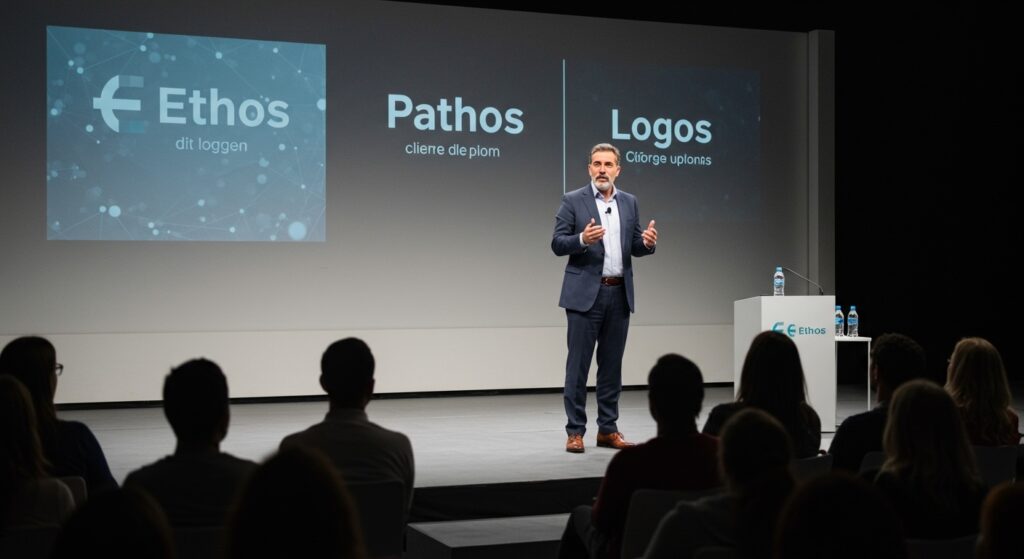
In my years of coaching executives and public speakers, I have found that the difference between a speech that falls flat and one that receives a standing ovation is rarely the topic—it is the rhetorical strategy behind it. Whether you are pitching a startup or delivering a keynote, understanding these timeless principles is your greatest competitive advantage.
TL;DR: Key Takeaways for Effective Rhetoric
- The Three Pillars: Balance Ethos (credibility), Logos (logic), and Pathos (emotion) to build a bulletproof argument.
- The Five Canons: Focus on Invention, Arrangement, Style, Memory, and Delivery to structure your content.
- Know Your Audience: Persuasion only happens when the message meets the listener’s current needs and values.
- Simplicity is Key: Use clear, Markdown-friendly structures (like lists and tables) to help your audience retain information.
Why Every Leader Needs a Speakers Guidebook Essential Guide to Rhetoric
In an era of information overload, your ability to cut through the noise is determined by your mastery of rhetoric. Many people mistakenly believe rhetoric is about “empty words” or “manipulation.” In reality, it is the science of communication.
I remember working with a CEO who had incredible data (Logos) but couldn’t get his board to approve a new initiative. He lacked Pathos. Once we re-framed his data into a story about the people the company served, the board was sold within ten minutes. This is the power of a speakers guidebook essential guide to rhetoric.
The Three Modes of Persuasion (The Rhetorical Triangle)
To persuade effectively, you must satisfy three specific requirements in the mind of your listener. According to Aristotle, these are non-negotiable.
| Pillar | Focus | What it Accomplishes |
|---|---|---|
| Ethos | Credibility | Establishes you as a trustworthy and knowledgeable authority. |
| Logos | Logic | Provides the “meat” of the argument using data, facts, and reason. |
| Pathos | Emotion | Connects with the audience’s values, fears, or aspirations. |
The Five Canons: Your Step-by-Step Rhetoric Guide
To create a cohesive message, we use a process known as the Five Canons of Rhetoric. These were formalized by Cicero and remain the gold standard for speech preparation today.
Invention (Inventio)
This is the “brainstorming” phase. You are not just choosing a topic; you are finding the arguments that will resonate most with your specific audience.
- Ask yourself: What does my audience care about most?
- Identify the “Stasis”: What is the core point of conflict or the question you are answering?
- Gather Evidence: Collect first-hand experiences, case studies, and statistical data.
Arrangement (Dispositio)
The order of your points determines how well your audience follows your logic. A classic rhetorical structure includes:
- Exordium (Introduction): Hook the audience and establish Ethos.
- Narratio (Statement of Facts): Provide context.
- Confirmatio (Proof): Present your strongest Logos-driven arguments.
- Refutatio (Refutation): Address counter-arguments proactively.
- Peroratio (Conclusion): Summarize and end with a high-impact Pathos appeal.
Style (Elocutio)
This is how you use language to make your ideas memorable. In our speakers guidebook essential guide to rhetoric, we focus on three levels of style:
- Low Style: For instruction (clear and plain).
- Middle Style: For pleasure (engaging and conversational).
- High Style: For moving an audience to action (powerful and poetic).
Memory (Memoria)
While few speakers memorize word-for-word today, Memory is about internalizing your key points. I recommend the “Memory Palace” technique or using mnemonic devices to ensure you never lose your place during a high-stakes presentation.
Delivery (Pronuntiatio)
This is the physical act of speaking. It includes your vocal inflection, eye contact, and body language. Research from Albert Mehrabian suggests that non-verbal cues can carry more weight than the actual words spoken when communicating feelings and attitudes.
Essential Rhetorical Devices to Boost Your Influence
Beyond the structure, using specific linguistic “tools” can make your points “sticky.” Here are the ones I use most frequently when ghostwriting speeches for industry leaders:
The Rule of Three (Tricolon)
Things that come in threes are inherently more satisfying and memorable. Think: “Veni, vidi, vici” (I came, I saw, I conquered).
- Practical Advice: Whenever you list benefits, try to group them into three distinct points.
Anaphora
Repeating a word or phrase at the beginning of successive clauses.
- Example: “We shall fight on the beaches, we shall fight on the landing grounds, we shall fight in the fields…”
- Why it works: It builds emotional momentum and emphasizes commitment.
Kairos: The Element of Timing
Kairos is the Greek word for “the opportune moment.” A great speech delivered at the wrong time will fail. You must sense the “mood” of the room and the cultural zeitgeist. If you are delivering a speakers guidebook essential guide to rhetoric to a room of skeptical engineers, lead with heavy Logos. If you are speaking at a charity gala, lead with Pathos.
Actionable Tips for Modern Speakers
- Audit Your Credibility: Before you speak, ensure the audience knows why you are the expert. Mention your years of experience or a specific successful project.
- Use Visual Data: Don’t just say “profits are up.” Show a chart. Visual Logos is often more persuasive than spoken numbers.
- Record and Review: I always tell my clients to record their rehearsals. You will notice “filler words” and awkward pauses that you didn’t know existed.
- The “So What?” Test: After every point you make, ask “So what?” If it doesn’t provide Information Gain or value to the listener, cut it.
FAQ: Frequently Asked Questions about Rhetoric
What is the most important part of a speakers guidebook essential guide to rhetoric?
The most important part is Audience Analysis. You can have the most logical argument in the world, but if it doesn’t align with your audience’s values (Ethos and Pathos), they will not be persuaded.
Is rhetoric the same as “propaganda”?
No. While propaganda uses rhetorical techniques to manipulate, rhetoric itself is a neutral tool. It is simply the art of finding the best possible means of persuasion in any given situation.
How do I improve my rhetorical skills quickly?
Start by identifying rhetorical devices in others. Watch a TED Talk and look for where the speaker uses a story (Pathos) or a statistic (Logos). Analyzing others is the fastest way to learn how to apply it yourself.
Can rhetoric be used in written communication?
Absolutely. This article uses rhetoric through its structure, use of bold text for emphasis, and credibility-building anecdotes. The same principles of Invention and Arrangement apply to emails, blogs, and reports.