The Core Debate: Are Speakers or Reciever More Important for Vinyl Sound?
When building a high-fidelity turntable setup, the most common question I encounter from new enthusiasts is: are speakers or reciever more important for vinyl sound? The short answer is that speakers are significantly more important because they are the physical transducers that convert electrical signals into the sound waves you hear, ultimately defining the “color” and character of your music. While the receiver acts as the crucial “brain” and “engine” of the system, your speakers will account for roughly 70% of the audible difference in your listening experience.
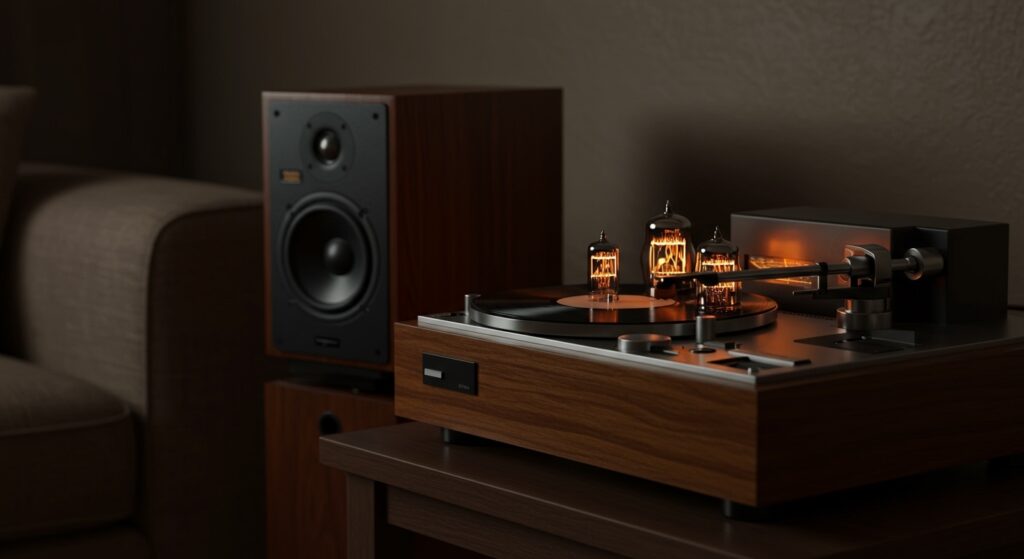
In my years of testing various vintage and modern setups—from Marantz 2230 units to high-end KEF towers—I have found that even an entry-level receiver can sound decent with elite speakers, but a $5,000 amplifier cannot save a pair of poor-quality speakers. To get the most out of your vinyl collection, you should prioritize your budget toward your speakers first, followed closely by a receiver with a high-quality Phono Stage.
Key Takeaways: Quick Guide to Component Priority
- The 60/40 Rule: Allocate approximately 60% of your hardware budget to speakers and 40% to your receiver and turntable.
- Speakers = Personality: Your speakers determine the soundstage, imaging, and frequency response (bass vs. treble balance).
- Receiver = Accuracy: The receiver (or integrated amplifier) ensures the signal from the record is amplified without adding distortion or noise.
- Synergy is Vital: A high-sensitivity speaker (measured in dB) requires less power from a receiver to reach loud volumes.
- Phono Preamp Factor: For vinyl specifically, the quality of the Phono input on the receiver is the “secret sauce” for warm, analog sound.
Why Speakers are the Top Priority for Vinyl Enthusiasts
If you are wondering are speakers or reciever more important for vinyl sound, you have to look at the physics of sound. Speakers are the only part of your system that interacts with your room’s air and your ears directly.
The Role of the Transducer
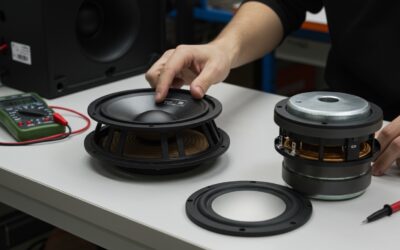
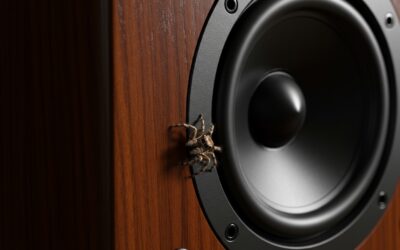
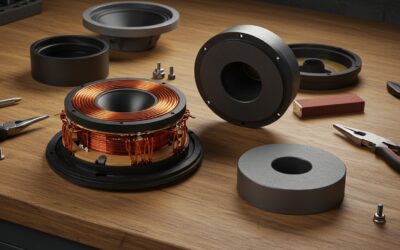
A speaker is a transducer, meaning it converts one form of energy (electrical) into another (mechanical/acoustic). This process is inherently “imperfect” and creates the most variation in sound. In my testing, swapping a pair of Klipsch Reference speakers for Wharfedale Lintons changed the entire “mood” of a Pink Floyd record, whereas switching receivers produced a much more subtle improvement in clarity and “grip” on the bass.
Frequency Response and Coloration
Every speaker has a unique frequency response curve. Some are “bright” (emphasizing high frequencies), while others are “warm” (emphasizing the mids and lows). Vinyl is naturally a mid-range-heavy medium. Therefore, choosing a speaker that complements the analog warmth of vinyl is the most impactful decision you will make.
Imaging and Soundstage
The way a speaker disperses sound determines if the music feels like it is “stuck in a box” or if it sounds like a live band is playing in your living room. High-quality speakers provide better imaging, allowing you to pinpoint exactly where the drummer or guitarist was standing during the recording session.
The Vital Support Role: Why the Receiver Still Matters
While speakers take the lead, the receiver is far from a “secondary” component. If the receiver is the “weak link,” your expensive speakers will never reach their full potential.
The Power of the Phono Stage
Vinyl records are recorded with a specific EQ curve (the RIAA curve) that reduces bass and boosts treble to fit the music into the grooves. A receiver’s Phono Preamp must reverse this process and amplify the tiny signal from the needle. If your receiver has a cheap, noisy phono stage, you will hear a persistent “hiss” or “hum,” regardless of how good your speakers are.
Damping Factor and Control
A high-quality receiver has a high damping factor, which refers to its ability to control the movement of the speaker’s woofer. I often use the analogy of a car: the speakers are the tires, but the receiver is the engine and suspension. A powerful receiver keeps the bass “tight” and prevents it from sounding “muddy” or “boomy.”
Total Harmonic Distortion (THD)
Look for a receiver with a THD rating of less than 0.1%. Higher-end receivers provide “clean” power, ensuring that even when you turn the volume up, the music remains crisp. When analyzing are speakers or reciever more important for vinyl sound, remember that the receiver provides the foundation of “cleanliness” upon which the speakers build.
Comparing Speakers vs. Receivers: At a Glance
| Feature | Speakers (The Voice) | Receiver (The Brain) |
|---|---|---|
| Primary Function | Converts electricity to sound waves. | Amplifies signal & manages inputs. |
| Impact on Tone | High (70-80%) | Moderate (20-30%) |
| Longevity | Can last 20-30+ years. | Often needs tech updates (Bluetooth/HDMI). |
| Critical Spec | Sensitivity (dB) & Impedance (Ohms). | Watts per Channel & THD. |
| Budget Priority | High (Spend more here). | Moderate (Don’t buy the cheapest). |
Step-by-Step Guide: How to Balance Your Vinyl System
To achieve the best sound, follow this workflow which I’ve developed over a decade of hi-fi consulting.
Step 1: Determine Your Room Size
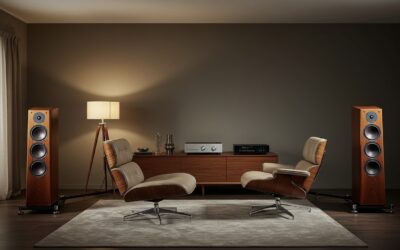
Before buying, measure your space. Small rooms benefit from Bookshelf Speakers, while large, open-concept rooms require Floorstanding (Tower) Speakers to move enough air.
Step 2: Match Speaker Sensitivity to Receiver Power
This is where most beginners fail.
- If you have low-sensitivity speakers (85dB or lower), you must have a high-wattage receiver (100W+ per channel).
- If you have high-sensitivity speakers (90dB or higher), you can use a smaller, lower-wattage “Tube” amp or a vintage receiver for that classic warm sound.
Step 3: Evaluate the Phono Input
Check the back of your receiver. Does it have a dedicated “Phono” input? If not, you will need to buy an external phono preamp. When considering are speakers or reciever more important for vinyl sound, the inclusion of a high-grade internal phono stage can actually make the receiver more important in your specific budget.
Step 4: Test with a Reference Record
Always test your setup with a high-quality “Direct-to-Disc” or 180g heavyweight vinyl. I personally use Fleetwood Mac’s “Rumours” or Miles Davis’ “Kind of Blue” because of their exceptional production quality. Listen for the “breath” in the vocals and the “snap” of the snare drum.
Expert Perspective: The “Bottleneck” Theory
In my professional experience, your system is only as good as its weakest link. While we established that speakers are more important, you must avoid the “Bottleneck Effect.”
I once visited a client who had $4,000 Bowers & Wilkins speakers hooked up to a $100 “mini-amp” from an online marketplace. The sound was thin, harsh, and lacked any emotional impact. The receiver was the bottleneck.
Conversely, hooking up $100 thrift-store speakers to a $2,000 McIntosh amplifier is equally wasteful. The goal is balance. If you spend $1,000 on speakers, aim to spend at least $600-$700 on your receiver.
Technical Entity Checklist for Buyers:
- Impedance (Ohms): Ensure your receiver is rated to handle the Ohms of your speakers (usually 4, 6, or 8 Ohms).
- Class AB vs. Class D: For vinyl, many purists (including myself) prefer Class AB amplification for its natural, linear warmth.
- Crossover Frequency: Ensure your speakers have high-quality internal crossovers to split the signal between the tweeter and the woofer accurately.
Actionable Advice: Where to Spend Your Next $500
If you have a basic setup and $500 to spend on an upgrade, here is how I would prioritize it:
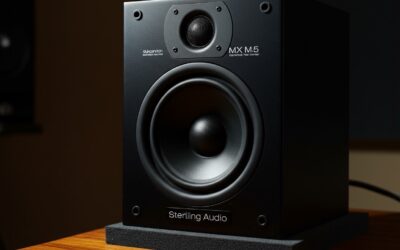
- If you have “kit” speakers (the ones that came in a box): Spend the full $500 on a pair of reputable bookshelf speakers like the ELAC Debut 2.0 B6.2 or SVS Prime Bookshelfs.
- If your speakers are already decent: Spend $400 on a dedicated External Phono Preamp (like the Schiit Mani 2) and $100 on a better Phono Cartridge (like the Ortofon 2M Blue). This will improve the signal before it even hits the receiver.
- If your music sounds “static-y”: Spend $100 on a professional Spin-Clean record washer and save the rest. Sometimes the “bad sound” is just dirty vinyl!
Frequently Asked Questions (FAQ)
Can a good receiver make cheap speakers sound better?
A good receiver can provide cleaner power and better control, which might marginally improve the bass response and clarity of cheap speakers. However, it cannot change the fundamental physical limitations of cheap speaker drivers and thin cabinets. You will always see a bigger improvement by upgrading the speakers.
Do I need a receiver if my speakers are “Active” or “Powered”?
No. Powered speakers (like the Klipsch The Fives or Audioengine A5+) have the amplifier built directly into the cabinet. In this case, the “receiver” components are integrated, and you only need to worry about the quality of the speakers themselves and the turntable’s output.
Why is the “Phono” input different from “Aux”?
A turntable’s signal is roughly 1,000 times weaker than a CD player or phone. The Phono input has a specialized circuit that provides massive amplification and applies the RIAA equalization necessary to make vinyl sound correct. Never plug a turntable into an “Aux” port unless the turntable has a built-in preamp.
Does the age of the receiver matter for vinyl?
Vintage receivers from the 1970s (the “Silver Era”) often have superior Phono stages because vinyl was the primary music source at the time. Modern receivers are often “Home Theater” focused, and their Phono inputs can sometimes be an afterthought. If you are serious about vinyl, look for a modern “Stereo Integrated Amplifier” rather than a 7.1 Surround Sound receiver.
**
**
**
**