What Are the Glass Panels in Front of Speakers?
Have you ever watched a high-profile keynote or a presidential address and wondered about those mysterious transparent rectangles flanking the podium? What are the glass panels in front of speakers? Simply put, they are Presidential Teleprompters—specialized tools that allow a speaker to read a script while maintaining direct eye contact with the audience.
These devices use beamsplitter glass to reflect text from a hidden floor monitor while remaining virtually invisible to the crowd and cameras. By using this setup, speakers avoid the “head-down” posture of reading paper notes, projecting an image of confidence, authority, and professional preparedness.
Expert Summary: Key Takeaways
Definition: These panels are beamsplitter mirrors that reflect text from a high-brightness monitor placed at the base of the stand.
Function: They allow for a “natural” delivery where the speaker looks left and right at the audience while actually reading their speech.
Transparency: To the audience, they look like clear glass; to the speaker, they show scrolling text in high contrast.
The “Cluster 240” Standard: Refers to the professional configuration of dual panels set at specific 45-degree angles for maximum visibility.
Understanding the Technology: What Are the Clear Screens in Front of Speakers?
To the untrained eye, they look like simple teleprompter glass, but the science behind what are the clear screens in front of speakers is quite sophisticated. They rely on a 70/30 optical glass ratio, meaning 70% of the light from the room passes through to the audience, while 30% of the light from the monitor is reflected back to the speaker.
This specific ratio ensures that the speaker can see the text clearly even under bright stage lights, while the audience sees only a transparent pane. In professional circles, this is often called the “Presidential Glass” setup because it has been the gold standard for world leaders since the mid-20th century.
Why Use Two Glass Panels?
You will almost always see what are the two glass panels in front of speakers instead of just one. This dual-panel configuration serves two vital purposes:
- Audience Engagement: It allows the speaker to turn their head naturally to the left and right, addressing the entire room without losing their place in the script.
- Redundancy: If one monitor fails or a cable is tripped, the speaker can pivot to the other panel seamlessly without interrupting the flow of the presentation.
Required Tools and Materials for Cluster 240 Setup
Setting up a professional Cluster 240 (dual-panel) system requires precision equipment. Below is a summary of the essential components used by professional AV technicians.
| Component | Technical Specification | Purpose |
|---|---|---|
| Beamsplitter Glass | 70/30 or 60/40 Optical Grade | Reflects text while remaining transparent to cameras. |
| High-Brightness Monitors | 1000+ Nits (Reversed Image) | Ensures text is visible under heavy stage lighting. |
| Telescoping Poles | Carbon Fiber or Polished Chrome | Adjusts the height of the glass to the speaker’s eye level. |
| Prompting Software | WinPlus-IP or Teleprompter Pro | Controls scroll speed, font size, and text mirroring. |
| VGA/HDMI Splitters | 1-in-2-out Powered Splitter | Sends the same synchronized script to both panels. |
| Black Shrouds | Heavy-duty felt or velvet | Prevents “light leak” from the monitor from hitting the stage. |
Step-by-Step: How to Set Up the Cluster 240 Teleprompter System
Setting up what are the glass panels in front of speakers requires a methodical approach to ensure the speaker feels comfortable and the text is legible.
Step 1: Position the Base Monitors
Place the high-brightness monitors on the floor or on low-profile stands on either side of the podium. Ensure they are centered and angled slightly upward. The monitors must be capable of “mirroring” or “flipping” the image horizontally because the glass reflection will naturally reverse the text.
Step 2: Assemble the Telescoping Stands
Mount the telescoping poles directly behind or adjacent to the monitors. Based on my experience in live event production, it is crucial to use heavy-duty weighted bases. You do not want a speaker accidentally bumping the podium and knocking over a fragile glass panel during a live broadcast.
Step 3: Attach and Angle the Beamsplitter Glass
Slide the glass panels into the brackets at the top of the poles. What are the two glass panels in front of speakers doing at this stage? They are being calibrated. Tilt the glass at a 45-degree angle relative to the floor monitor. This is the “sweet spot” where the reflection is brightest for the speaker.
Step 4: Adjust for Speaker Height
Align the center of the glass with the speaker’s eye line. If the glass is too high, the speaker will look like they are staring at the ceiling; if it is too low, they will appear to be looking at the audience’s chest. The goal is a “neutral” gaze that mimics natural eye contact.
Step 5: Configure the Software and Scroll Speed
Load the script into your prompting software. Ensure the font is a high-contrast sans-serif (like Arial or Helvetica) and set the background to black with white or yellow text. Use a dedicated scroll controller to match the speaker’s natural cadence.
Pro Tips for a Flawless Presentation
Having managed Cluster 240 setups for Fortune 500 CEOs, I have learned that the technical setup is only half the battle. Here are expert insights to ensure success:
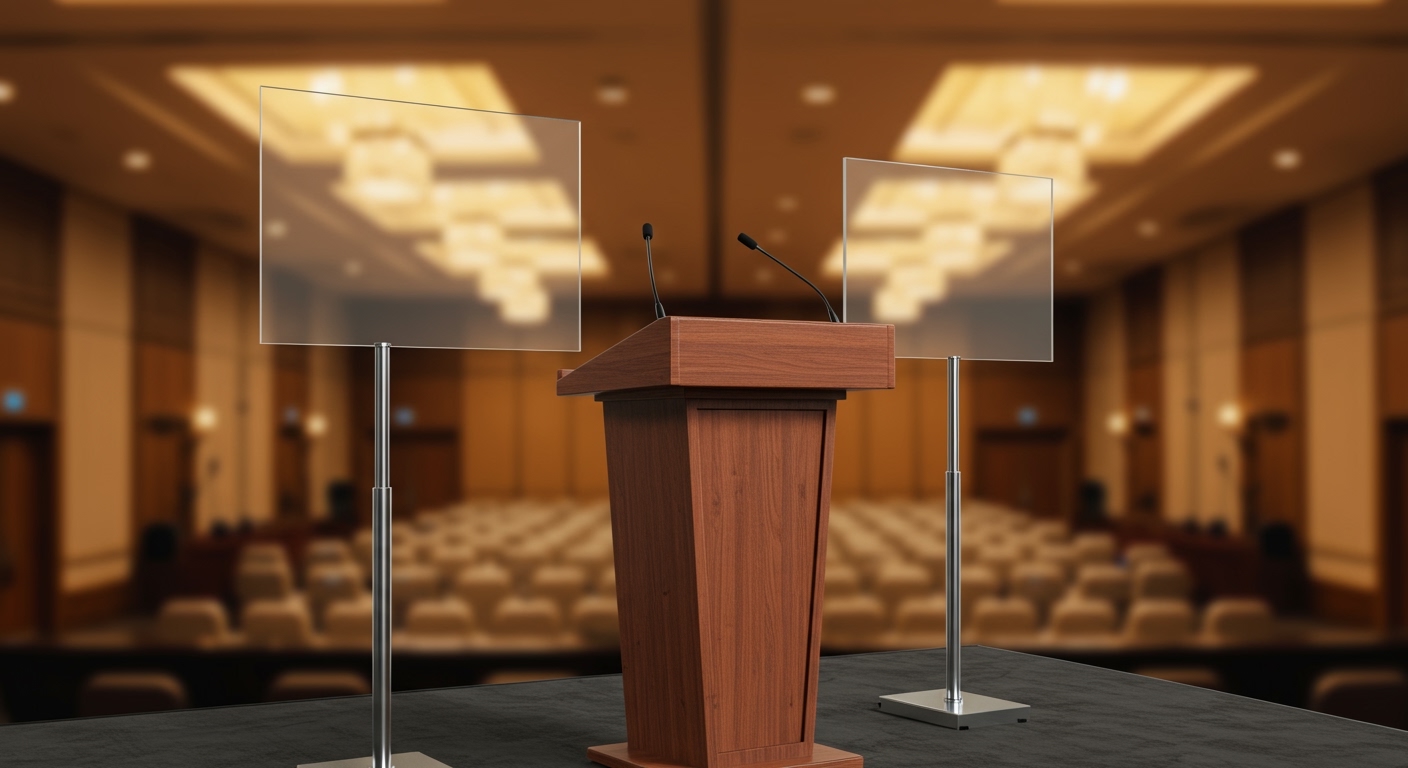
The “V” Formation: Angle the two panels in a slight “V” shape toward the speaker. This creates a wider viewing angle, allowing the speaker to scan the room more effectively.
Anti-Reflective Coating: Always check if your glass has a specialized anti-reflective (AR) coating on the audience side. This prevents stage lights from creating a “ghosting” effect that can distract the crowd.
The “Safety” Script: Always have a printed copy of the speech on the podium. Even the best clear screens in front of speakers can suffer from power surges or software freezes.
Lighting Control: Avoid placing a bright spotlight directly behind the speaker, as this can wash out the reflection on the glass. Use side-lighting or diffused overhead lights instead.
Common Mistakes to Avoid
- Incorrect Mirroring: Forgetting to flip the monitor image. If the text on the glass is backwards, the speaker cannot read it, and the presentation will stall.
- Dirty Glass: Smudges or fingerprints on the beamsplitter glass are highly visible under stage lights. Always use a microfiber cloth and specialized lens cleaner before the event.
- Too Much Text: Overloading the screen with text makes it hard to track. Keep the font size large (usually 60-80pt) so the speaker can read from 5-7 feet away.
- Static Speed: Never use an “auto-scroll” feature. A human operator should always control the speed to account for the speaker’s pauses, jokes, or ad-libs.
FAQs: Expert Answers on Stage Glass Panels
What are the glass panels in front of speakers called?
They are technically known as Presidential Teleprompters or Stage Speech Prompters. They utilize beamsplitter glass to project a script that only the speaker can see.
Why are there two glass panels instead of one?
Using two glass panels in front of speakers allows the presenter to look at both the left and right sides of the audience. This makes the speech feel more personal and engaging compared to staring straight ahead at a single point.
Can the audience see the text on the clear screens?
No. Because of the optical coating on the glass, the text is only reflected toward the speaker. From the audience’s perspective, the screens look like simple, clear pieces of glass or decorative elements.
Do these panels work in outdoor settings?
Yes, but they require Ultra-High Brightness (HB) monitors. Standard monitors are often washed out by sunlight, making the clear screens in front of speakers useless without at least 1500-2000 nits of brightness.
How much do these systems cost?
A professional-grade Cluster 240 setup typically ranges from $2,000 to $5,000, depending on the quality of the glass and the brightness of the monitors.
Conclusion: Mastering the Art of the Invisible Script
The mystery of what are the glass panels in front of speakers is rooted in the desire for seamless communication. By using a Cluster 240 teleprompter setup, speakers can bridge the gap between prepared remarks and authentic engagement. Whether you are a production professional or an aspiring public speaker, understanding how these clear screens function is the first step toward commanding any stage with confidence.
Ready to elevate your next presentation? Invest in high-quality beamsplitter glass and practice your delivery to turn those “glass panels” into your greatest public speaking asset.