Understanding What Do Watts and Ohms Mean in Speakers
In the simplest terms, Watts represent the amount of power a speaker can handle or an amplifier can produce, while Ohms measure the electrical resistance (impedance) the speaker provides against that power. To get the best sound and avoid damaging your gear, you must match the Wattage output of your amplifier with the Ohm rating of your speakers to ensure a stable flow of electricity.
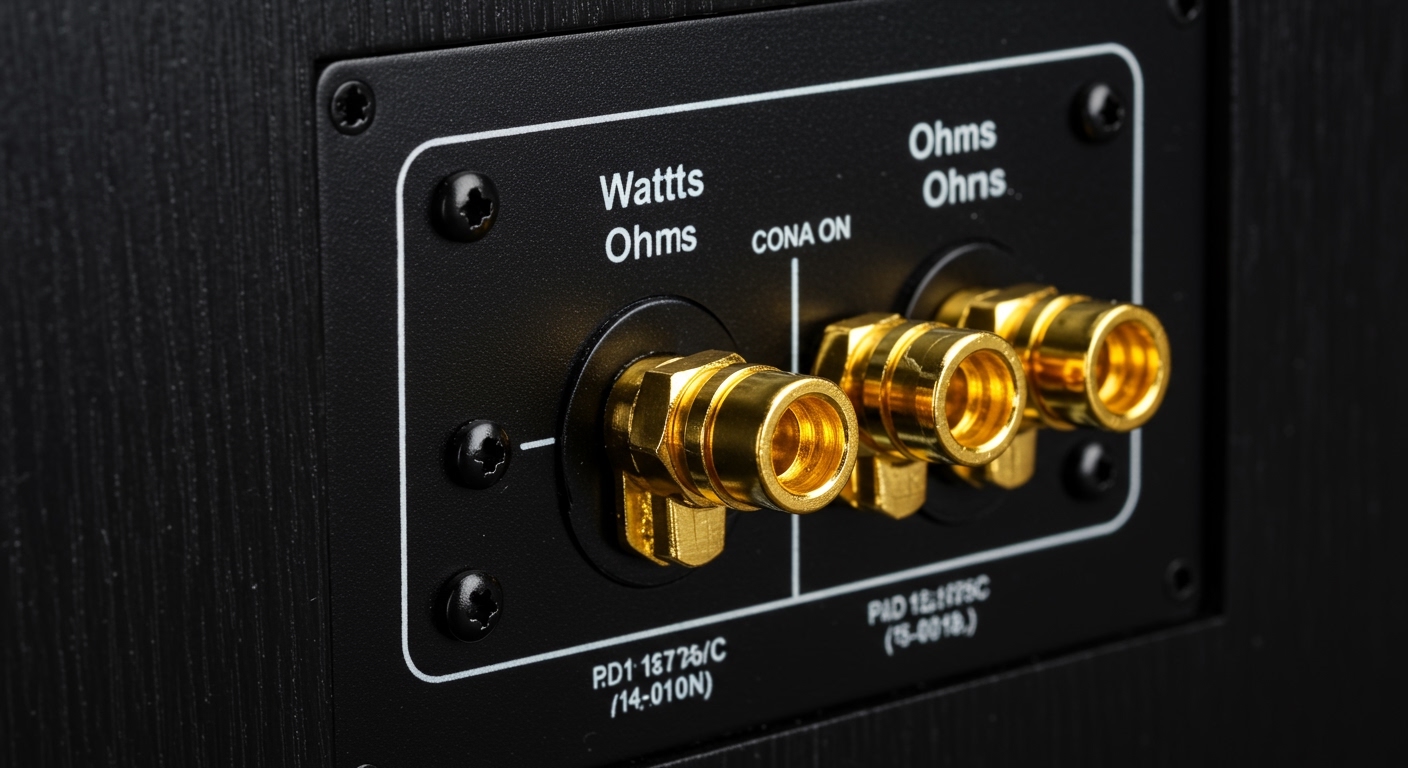
If you have ever stared at the back of an audio receiver and felt overwhelmed by the numbers, you are not alone. I remember my first high-end setup; I assumed more Watts always meant more volume, and I completely ignored the Ohm rating. The result? A very expensive amplifier that overheated and shut down within twenty minutes.
This guide will demosytify these technical specs using my years of experience in audio engineering and home theater installation. We will break down exactly how to read these labels so you can build a system that sounds incredible and lasts for decades.
TL;DR: Key Takeaways for Speaker Specs
- Watts (Power): Measures how much energy is being used. Look for RMS Watts, not Peak Power, for a true measurement.
- Ohms (Impedance): Measures electrical resistance. Most home speakers are 8 Ohms, while car audio is often 4 Ohms.
- The Golden Rule: Ensure your amplifier is rated to handle the Ohm load of your speakers to prevent overheating.
- Sensitivity: This rating (in dB) actually tells you how loud a speaker is, more so than the Wattage alone.
- Compatibility: A 100W amplifier into 8 Ohms is a standard, safe starting point for most bookshelf and floorstanding speakers.
The Deep Dive: What Do Watts Mean in Speakers?
When people ask what do watts and ohms mean in speakers, they usually start with Watts because it is the most advertised number. In the world of audio physics, a Watt is a unit of power that describes the rate of energy transfer.
For speakers, Wattage is divided into two categories: Power Handling (the speaker) and Power Output (the amplifier). Think of the amplifier as a water pump and the speaker as a water balloon. The Watts represent how much water the pump can push and how much the balloon can hold before it bursts.
RMS vs. Peak Power: Don’t Be Fooled
You will often see “1000W Peak Power” plastered on cheap speaker boxes. This is a marketing gimmick.
- RMS (Root Mean Square): This is the continuous power a speaker can handle over a long period. This is the only number you should care about for high-fidelity audio.
- Peak/Max Power: This is the absolute maximum burst of energy a speaker can handle for a fraction of a second. If you run a speaker at its Peak Power for more than a moment, the voice coil will likely melt.
How Much Wattage Do You Actually Need?
I have found that for a standard living room, 50 to 100 Watts RMS per channel is more than enough. If you are powering a massive home cinema or an outdoor venue, you might look toward 200 Watts or more.
Remember, doubling the Wattage does not double the volume. In fact, to get a noticeable increase in loudness (a 3dB gain), you have to double the power. To double the perceived volume (a 10dB gain), you need ten times the power.
Understanding Ohms: The Resistance Factor
If Watts is the flow of energy, Ohms is the “narrowness” of the pipe. Impedance, measured in Ohms (Ω), tells you how much the speaker resists the electrical current coming from the amplifier.
Most home audio speakers are rated at 8 Ohms. Some high-end audiophile speakers or car audio components are rated at 4 Ohms or even 2 Ohms.
The “Pipe” Analogy
- 8 Ohms (High Resistance): Think of a narrow pipe. It is harder for the amplifier to push current through, which keeps the amplifier cool but limits total power.
- 4 Ohms (Low Resistance): Think of a wide pipe. Electricity flows very easily. This allows the amplifier to put out more Watts, but it also makes the amplifier work much harder.
Why Ohm Matching Matters
If you connect 4-Ohm speakers to an amplifier that is only rated for 8 Ohms, the speaker will “demand” more current than the amp is designed to provide. This leads to clipping, distortion, and eventually, the amplifier’s internal protection circuit (or its fuse) will blow.
| Speaker Rating | Amplifier Compatibility | Risk Level |
|---|---|---|
| 8 Ohms | Compatible with almost all Amps | Very Low |
| 6 Ohms | Compatible with most modern Receivers | Low |
| 4 Ohms | Requires High-Current / Specialized Amps | Moderate |
| 2 Ohms | High-end Car Amps / Pro Audio only | High |
How to Match Watts and Ohms: A Step-by-Step Guide
Matching your gear isn’t just about safety; it’s about headroom. You want an amplifier that can provide clean power without struggling. Follow these steps that I use when designing custom audio systems.
Step 1: Check the Speaker’s Nominal Impedance
Look at the sticker on the back of your speaker. It will usually say something like “Nominal Impedance: 8 OHMS.” This is the “average” resistance the speaker provides during operation.
Step 2: Identify the Amplifier’s Power Ratings
Look at your amplifier’s manual or back panel. You are looking for a spec that says something like:
100 Watts RMS into 8 Ohms*
150 Watts RMS into 4 Ohms*
Step 3: Apply the “1.5x Rule” for Best Sound
For the best performance and to avoid clipping (which kills tweeters), I recommend choosing an amplifier that can deliver 1.5 times the RMS rating of the speaker.
- Example: If your speaker is rated for 100W RMS at 8 Ohms, look for an amplifier that provides 150W RMS at 8 Ohms. This provides “headroom,” ensuring the amp never has to “strain” to reach high volumes.
Step 4: Verify Low-Impedance Support
If your speakers are 4 Ohms, ensure your amplifier explicitly states it is “4-Ohm Stable.” Many entry-level Home Theater Receivers (like those from Sony or Denon) are optimized for 6-8 Ohms and can overheat if pushed with 4-Ohm loads.
Sensitivity: The “Missing Link” in Speaker Specs
While you are focusing on what do watts and ohms mean in speakers, you cannot ignore Sensitivity. This is perhaps the most important spec that most people miss.
Sensitivity is measured in decibels (dB). It tells you how loud a speaker will play with exactly 1 Watt of power from 1 meter away.
- Low Sensitivity (80dB – 84dB): These speakers are “power hungry.” You need a beefy amplifier to make them sing.
- High Sensitivity (90dB – 100dB+): These speakers are “efficient.” You can make them incredibly loud with just a tiny 5-Watt tube amplifier.
When I build systems for clients, I always prioritize Sensitivity. If you buy a speaker with 93dB sensitivity instead of 87dB, it is effectively like quadrupling your amplifier power.
Practical Wiring: How Ohms Change with Multiple Speakers
If you are wiring multiple speakers to a single channel (common in whole-house audio or car audio), the Ohm load changes based on your wiring method.
Parallel Wiring
This is the most common method. You connect the positive leads of both speakers to the positive terminal of the amp.
Formula: (R1 R2) / (R1 + R2)
- Real World: Connecting two 8-Ohm speakers in parallel creates a 4-Ohm load. Your amplifier now sees less resistance and produces more heat.
Series Wiring
You connect the positive of the amp to the positive of speaker A, the negative of speaker A to the positive of speaker B, and the negative of speaker B back to the amp.
- Formula: R1 + R2
- Real World: Connecting two 8-Ohm speakers in series creates a 16-Ohm load. This is very safe for the amplifier, but your total volume will be lower because the resistance is so high.
Common Myths About Watts and Ohms
In my years of consulting, I’ve heard these three myths more than any others. Let’s clear the air.
Myth 1: Higher Wattage Speakers Sound Better
False. Wattage is a measure of durability, not quality. A 50W speaker from a high-end brand like KEF or Bowers & Wilkins will sound infinitely better than a “1000W” speaker from a generic big-box store.
Myth 2: You Can’t Use 4-Ohm Speakers with an 8-Ohm Amp
Mostly False, but risky. You can do it, but you cannot turn the volume up high. The amplifier will draw too much current and likely go into “Protect Mode.” I always advise against this unless you are using a dedicated high-current power amplifier.
Myth 3: Watts Tell You How Loud a Speaker Is
False. As we discussed, Sensitivity tells you the loudness. Watts only tell you how much energy the speaker can survive before failing.
Expert Tips for Choosing the Right Setup
- Check the Manual, Not the Box: Marketing teams write the box copy; engineers write the manual. Always look for the RMS and Nominal Impedance specs in the back of the user guide.
- Feel the Heat: If you are running a system and the amplifier is too hot to touch, you likely have an impedance mismatch (Ohms are too low) or you are under-powering the speakers.
- Invest in Gauge: If you are running long distances (over 50 feet), use 14-gauge or 12-gauge speaker wire. Thin wire increases resistance, which messes with your Ohm calculations and degrades sound quality.
- Listen for Distortion: If the sound gets “crunchy” or “thin” at high volumes, your amplifier is likely out of Watts (clipping). Turn it down immediately to save your speakers.
Frequently Asked Questions
What happens if I use an amp with more Watts than my speakers?
This is actually safer than using an amp with too few Watts. A powerful amplifier provides clean, undistorted signals. As long as you don’t turn the volume up to a point where the speaker physically distorts, your speakers will be fine.
Can I mix 4-Ohm and 8-Ohm speakers on the same receiver?
It is not recommended. Most receivers apply a single power setting across all channels. Mixing impedances can cause uneven volume levels across your room and may put uneven stress on the amplifier’s power supply.
Is 8 Ohms better than 4 Ohms?
Neither is inherently “better.” 8-Ohm speakers are easier to drive and compatible with more equipment. 4-Ohm speakers allow high-end amplifiers to deliver more power, but they require more expensive, robust electronics to run safely.
Why do some speakers have two sets of terminals?
This is for Bi-wiring or Bi-amping. It allows you to use separate amplifier channels for the woofer (low frequencies) and the tweeter (high frequencies), which can improve clarity and reduce intermodulation distortion.
How do I know if my amp is “4-Ohm Stable”?
Check the back panel near the speaker terminals. It will often say “Caution: Speaker Impedance 4-16 Ohms” or similar. If it only says “8-16 Ohms,” do not use 4-Ohm speakers with that unit.