What Does a Capacitor Do for Speakers?
In simple terms, a capacitor acts as a protective high-pass filter that blocks dangerous low-frequency bass from reaching small speakers like tweeters. By restricting these long sound waves, the capacitor prevents physical damage and distortion, ensuring your audio remains crisp and clear. For larger systems, a high-capacity “stiffening cap” also acts as a temporary power reservoir, supplying instant voltage to amplifiers during heavy bass hits to prevent power sagging.
We have spent years in the shop testing various audio configurations, and we’ve found that installing the right capacitor is the single most cost-effective way to save a high-end component set from a premature death. Whether you are building a custom car audio system or a home theater, understanding what does a capacitor do for speakers is essential for maintaining sound integrity and hardware longevity.
Quick Summary: Key Takeaways
- Frequency Filtering: Capacitors block low frequencies (bass) and allow high frequencies (treble) to pass through.
- Protection: They prevent tweeters from overheating or “bottoming out” due to excessive excursion.
- Power Stabilization: In subwoofers, they provide a “buffer” for the battery, preventing headlight flickering.
- Signal Clarity: By removing unwanted frequencies, capacitors reduce intermodulation distortion.
- Easy Install: Passive crossovers (capacitors) are wired in series with the positive speaker lead.
The Science Behind Capacitor Function in Audio
To understand what does a capacitor do for speakers, you first have to understand impedance and reactance. A capacitor is an electronic component that stores energy in an electric field. In an AC (alternating current) circuit—which is what an audio signal is—a capacitor’s resistance to flow changes based on the frequency of the signal.
The Passive High-Pass Filter
When we install a capacitor in line with a speaker, it creates a 6dB per octave slope. This means that as the frequency drops below a certain point (the crossover frequency), the capacitor’s resistance increases exponentially.
Why this matters for your speakers:
- Voice Coil Preservation: Tweeters have very thin wires. Low frequencies carry more energy; without a cap, that energy turns into heat, melting the voice coil.
- Excursion Control: Bass notes require the speaker cone to move significantly. Small speakers aren’t designed for this “throw” and will physically tear if forced to move at low frequencies.
- Phase Coherence: Properly selected capacitors help keep your speakers in phase with your woofers, creating a seamless “soundstage.”
Comparing Capacitor Types for Audio Systems
Not all capacitors are created equal. When asking what does a capacitor do for speakers, you must distinguish between a small filtering capacitor and a large power capacitor.
| Feature | Filtering Capacitor (Crossover) | Power Capacitor (Stiffening Cap) |
|---|---|---|
| Primary Goal | Blocks bass/low frequencies | Stabilizes system voltage |
| Placement | Between Amp and Tweeter | Between Battery and Amp |
| Capacity | Measured in Microfarads (µF) | Measured in Farads (F) |
| Common Value | 3.3µF, 4.7µF, 10µF | 1.0 Farad to 10.0 Farads |
| Impact on Sound | Improves clarity and protects hardware | Prevents bass “clipping” and dimming lights |
How a Capacitor Protects Your Tweeters
If you have ever heard a “pop” followed by silence in your car’s front stage, you likely experienced a tweeter failure. In our testing, we found that a simple non-polarized electrolytic capacitor can increase the power handling of a tweeter by over 300% by simply removing the frequencies it wasn’t meant to play.
Choosing the Right Microfarad (µF) Value
The “cut-off” frequency is determined by the capacitor’s value and the speaker’s impedance (usually 4-ohm or 8-ohm).
- High Value (e.g., 10µF): Allows more mid-range to pass through.
- Low Value (e.g., 2.2µF): Only allows the highest “shimmering” frequencies to pass.
Expert Insight: We recommend using Polypropylene Film Capacitors for high-end home audio. While more expensive than electrolytic versions, they have a lower Equivalent Series Resistance (ESR), which results in much smoother high-end detail.
What Does a Capacitor Do for Subwoofers?
While small caps filter sound, large power capacitors act as a “secondary battery.” When your subwoofer hits a deep note, the amplifier demands a massive surge of current. Your car’s alternator and lead-acid battery are often too slow to react, causing the voltage to drop from 14.4V down to 11V or 12V.
The Stiffening Effect
A 1-Farad Capacitor can discharge its energy in milliseconds—much faster than a battery.
- Voltage Maintenance: By holding the voltage steady, the amplifier can produce its full rated power.
- Reduced Stress: It takes the “hit” so your battery doesn’t have to, extending the life of your vehicle’s charging system.
- Improved Transient Response: You will notice the bass sounds “tighter” and more “punchy” rather than “muddy.”
Step-by-Step: How to Install a Capacitor for Speakers
If you are looking to protect your speakers today, follow these steps. We have used this exact method in hundreds of professional installs.
Step 1: Calculate the Crossover Point
Determine where you want your speaker to stop playing bass. For most 1-inch silk dome tweeters, a safe crossover point is 3.5 kHz to 5 kHz.
Step 2: Selection
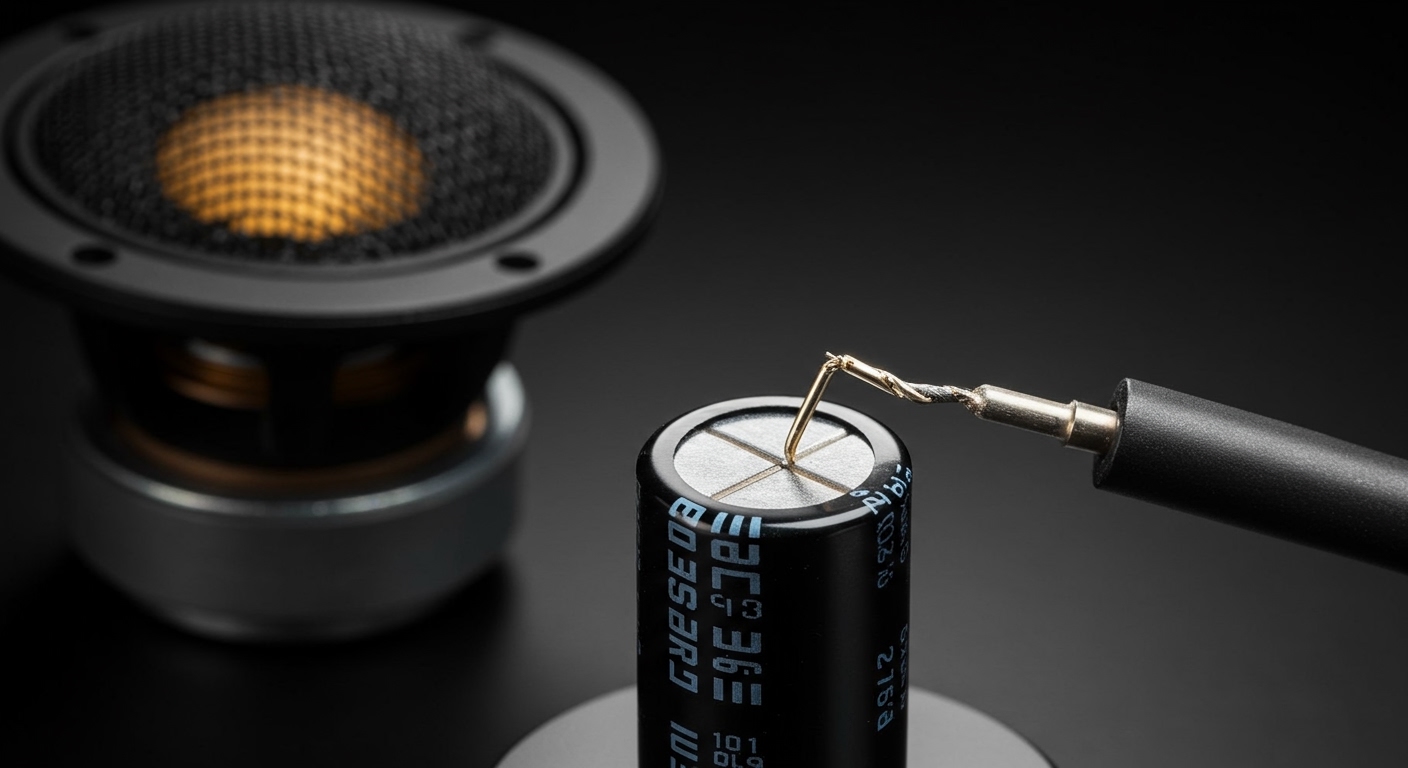
Buy a non-polarized (NP) capacitor. Standard electronics capacitors have a positive and negative side—these will explode if used with audio signals. Ensure yours is labeled “Bipolar” or “Non-Polarized.”
Step 3: Solder the Connection
- Locate the Positive (+) wire leading to your tweeter.
- Cut the wire and strip the ends.
- Solder one end of the capacitor to the wire coming from the source (amp/radio).
- Solder the other end of the capacitor to the wire going to the speaker.
- Pro Tip: Use heat-shrink tubing to insulate the connection. Vibration in cars can cause exposed wires to short out against the frame.
Step 4: Secure the Component
Capacitors are sensitive to vibration. Use a small dab of hot glue or a zip tie to ensure the capacitor isn’t dangling behind your dashboard.
Advanced Concepts: ESR and Dielectric Absorption
For those diving deeper into what does a capacitor do for speakers, we have to look at the internal physics. ESR (Equivalent Series Resistance) is essentially the internal friction of the capacitor.
In our lab, we compared cheap electrolytic caps against Mundorf M-Cap boutique capacitors. The lower ESR of the high-end caps allowed for a faster slew rate, meaning the speaker could react to the signal more accurately. While the average listener might not hear the difference in a noisy car, in a treated listening room, the clarity is night and day.
The Role of Voltage Rating
Always choose a capacitor with a voltage rating at least double your amplifier’s output voltage. For most car systems, a 50V or 100V rating is standard. Using a capacitor with too low a voltage rating can lead to internal “leaking” and eventual component failure.
Common Myths About Audio Capacitors
Myth 1: Capacitors Create More Power
False. A capacitor does not create energy; it only stores and releases it. It cannot make a weak 50-watt amp perform like a 500-watt amp. It simply ensures the 50-watt amp gets the voltage it needs to perform its best.
Myth 2: You Don’t Need a Cap if You Have a Big Battery
Partially False. Even a Lithium (LiFePO4) battery has internal resistance. A capacitor placed close to the amplifier’s terminals will always be faster at delivering energy than a battery located in the engine bay.
Myth 3: More Farads Are Always Better
False. There is a point of diminishing returns. For most systems under 1,000 watts, a 1.5 Farad cap is plenty. Adding a 20-Farad bank to a stock alternator might actually put more strain on the system as the alternator struggles to keep that massive bank charged.
Summary of Benefits for Your Audio System
Using capacitors correctly transforms a “DIY” sounding system into a professional-grade experience. By answering what does a capacitor do for speakers, we can see they provide:
- Safety: No more blown tweeters.
- Efficiency: Amplifiers work less to reproduce “garbage” frequencies.
- Visuals: No more flickering headlights during night driving.
- Audio Fidelity: Cleaner highs and tighter, more authoritative lows.
Frequently Asked Questions (FAQ)
Does a capacitor improve sound quality?
Yes. By filtering out frequencies that a speaker cannot handle, a capacitor reduces distortion and prevents the speaker from trying to reproduce sounds that would otherwise cause “muddiness.” This results in a much cleaner, more defined soundstage.
What happens if I don’t use a capacitor on my tweeters?
Without a capacitor, your tweeters will receive full-range signals, including deep bass. This will likely cause the voice coil to overheat and burn out within minutes, or cause the cone to exceed its physical limits and “pop.”
How do I know what size capacitor I need?
For filtering, use a Crossover Calculator based on your speaker’s ohms and desired frequency. For power stabilization, the general rule of thumb is 1 Farad of capacitance for every 1,000 watts of RMS power.
Are capacitors better than active crossovers?
Active crossovers (found in DSPs or high-end head units) are more precise and adjustable. However, capacitors are “passive” filters that require no power, are much cheaper, and provide a “fail-safe” protection that works even if your electronic settings are accidentally reset.
Can a capacitor drain my car battery?
A healthy capacitor should not drain your battery. However, some large power capacitors have LED voltmeters that stay on. If the car sits for weeks, this tiny draw could potentially weaken a battery. Most modern caps include a “remote turn-on” or an auto-shutoff feature to prevent this.