What Does Resonant Frequency Mean in Speakers?
In simple terms, resonant frequency (Fs) is the specific frequency where a speaker’s moving parts—the cone, surround, and spider—vibrate most naturally and with the least amount of effort. At this point, the mechanical resistance of the driver is at its lowest, but its physical movement (excursion) is at its highest. Understanding what resonant frequency means in speakers is essential because it defines the absolute limit of a speaker’s low-end performance and dictates how you must design an enclosure to protect the hardware.
TL;DR: Key Takeaways
- Definition: The frequency at which the speaker’s assembly vibrates most freely.
- Impedance Peak: At the resonant frequency, the electrical impedance of the speaker spikes to its maximum level.
- Bass Limit: Most speakers cannot effectively produce sound below their Fs without risking mechanical damage or high distortion.
- Enclosure Impact: Putting a speaker in a box always raises its resonant frequency from Fs (free air) to Fc (system resonance).
- Design Rule: To get the best bass, you generally want a driver with a low Fs if you are building a subwoofer.
The Science Behind Resonant Frequency
To understand what resonant frequency means in speakers, we have to look at the speaker as a mechanical “spring” system. Every speaker has a diaphragm (cone) that has a certain amount of mass (weight). This cone is held in place by a “spring” made of two parts: the surround (the rubber ring on the outside) and the spider (the corrugated fabric behind the cone).
When we talk about resonance, we are talking about the natural frequency of that spring-mass system. I often compare this to a person on a playground swing. If you push the swing at just the right moment, it moves effortlessly with huge arcs. If you try to push it faster or slower than its natural rhythm, you have to work much harder to get the same movement.
In a speaker, the resonant frequency is that “sweet spot” where the mechanical parts want to move on their own.
Why the Impedance Spikes at Resonance
One of the most unique things about a speaker at resonance is what happens to the electricity. While the cone is moving the most at Fs, the electrical impedance (resistance to the flow of electricity) reaches its highest point.
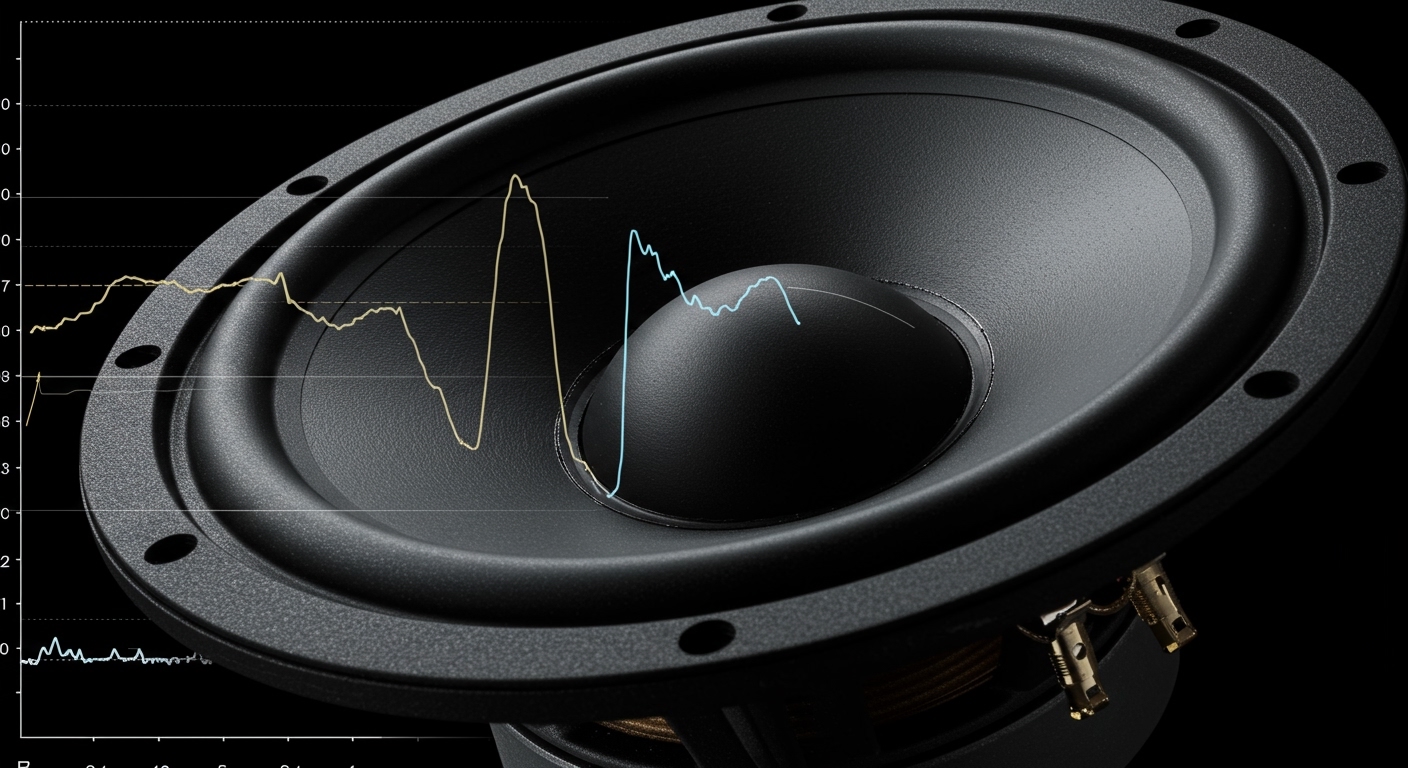
When we test drivers in our lab using a DATS V3 (Dayton Audio Test System), we see a massive peak on the graph at the Fs. This happens because the physical movement of the voice coil through the magnetic field creates “Back EMF” (Electromotive Force), which fights against the incoming current from the amplifier.
How Resonant Frequency Affects Audio Performance
Knowing what resonant frequency means in speakers helps you predict how a speaker will sound before you ever turn it on. If you try to force a speaker to play frequencies significantly lower than its Fs, three things typically happen:
- Acoustic Rolloff: The volume drops off sharply (usually at a rate of 12dB or 24dB per octave).
- Mechanical Bottoming Out: Because the speaker has no “stiffness” left to control it at very low frequencies, the voice coil can physically strike the back of the magnet (the pole piece).
- High Distortion: The Total Harmonic Distortion (THD) increases because the speaker is no longer moving in a controlled, linear fashion.
Resonant Frequency Ranges by Driver Type
Different types of speakers are designed with different Fs targets to handle specific parts of the audio spectrum.
| Driver Type | Typical Fs Range | Primary Purpose |
|---|---|---|
| Subwoofer | 18Hz – 35Hz | Deep, rumbling bass and cinematic effects. |
| Woofer | 40Hz – 70Hz | Mid-bass, kick drums, and lower male vocals. |
| Midrange | 80Hz – 500Hz | Human speech, guitars, and snare drums. |
| Tweeter | 1kHz – 3kHz | High-frequency details like cymbals and “air.” |
How to Find and Measure Resonant Frequency
If you are building your own speakers or upgrading a car audio system, you shouldn’t always trust the manufacturer’s spec sheet. As speakers “break-in,” their suspension softens, which usually causes the Fs to drop by a few Hertz.
Step 1: Check the Manufacturer Datasheet
Look for the Thiele/Small Parameters (T/S Parameters). The Fs value is almost always listed first. This is the “Free Air” resonance measured without any box.
Step 2: The “Finger Tap” Test (Expert Hack)
While not scientific, experienced builders often gently tap the cone of a raw driver. The “thump” you hear is the speaker vibrating at its resonant frequency. A deep, heavy thump indicates a low Fs, while a tight “tap” indicates a higher Fs.
Step 3: Professional Measurement
To get an exact number, we use an Impedance Sweep. By connecting the speaker to a tool like the Dayton Audio DATS V3 or a Smith & Larson Woofer Tester, you can generate a graph that shows exactly where the Fs sits in your specific environment.
Managing Resonance: The Role of the Enclosure
You rarely listen to a speaker in “free air.” Once you put a speaker into a box, the air inside that box acts like an extra spring. This air pressure adds stiffness to the speaker’s suspension.
Sealed Enclosures
In a sealed box, the system resonance (Fc) will always be higher than the driver’s Fs. For example, if you have a woofer with an Fs of 30Hz and you put it in a small sealed box, the resonance might jump to 50Hz. This results in a tighter, more controlled sound but less “ultra-low” bass.
Ported (Vented) Enclosures
Ported boxes use a tuned tube to manipulate resonance. A ported design actually creates two resonance peaks. The goal here is to use the air inside the port to “resonate” at a frequency just below the speaker’s Fs, extending the usable bass response of the system.
Infinite Baffle (IB)
In some high-end home theater or car audio setups, we mount the speaker so the front and back waves never meet (like mounting a sub in a rear deck). This keeps the system resonance very close to the Fs, allowing for the most natural, effortless low-frequency extension possible.
Step-by-Step: How to Choose a Speaker Based on Resonant Frequency
If you are shopping for new drivers, follow this process to ensure the resonant frequency matches your goals:
- Define Your Goal: Are you looking for “seat-shaking” bass (Subwoofer) or “crystal-clear” vocals (Midrange)?
- Check the Fs: For a subwoofer, look for an Fs under 30Hz. For a 6.5-inch door speaker, look for an Fs between 50Hz and 70Hz.
- Calculate the EBP: The Efficiency Bandwidth Product (calculated as Fs / Qes) tells you if the speaker belongs in a ported or sealed box.
- Allow for Break-In: Remember that a brand-new speaker will sound “stiff.” After 20–40 hours of play, the Fs will settle into its true value.
- Set Your Crossover: Never set your High-Pass Filter (HPF) significantly below the Fs of your midrange or tweeter. Doing so will lead to muddy sound and potential hardware failure.
Actionable Advice for Audio Enthusiasts
Based on our years of testing various cabinet designs, here is how you should handle resonant frequency in your own setup:
- For Tweeters: Always cross over your tweeter at least one octave above its resonant frequency. If a tweeter has an Fs of 1.5kHz, do not cross it over lower than 3kHz. This prevents the “harshness” often associated with cheap speakers.
- For Subwoofers: If you want to play 20Hz notes, don’t buy a driver with an Fs of 45Hz. No matter how big the box is, that driver will struggle to produce those deep tones efficiently.
- For Car Audio: Car doors are terrible enclosures. Because they are “leaky,” the speaker often behaves as if it’s in free air. Choose speakers with a slightly higher Qts and a lower Fs to compensate for the lack of a proper box.
Frequently Asked Questions
Can a speaker play below its resonant frequency?**
Yes, but it does so very inefficiently. In a ported enclosure, the port can help provide output below the Fs, but in a sealed enclosure, the volume drops off rapidly once you go below the resonance point.
Does a lower resonant frequency mean a better speaker?**
Not necessarily. A lower Fs is better for subwoofers because it allows for deeper bass. However, for a midrange speaker, a very low Fs might mean the cone is too heavy, which would make it sound “slow” or muffled on high-frequency vocals.
How does temperature affect resonant frequency?**
In my testing, cold temperatures make the rubber surround of a speaker stiffer, which temporarily raises the resonant frequency. This is why your car stereo might sound “thin” or “bass-light” on a freezing winter morning until the speakers warm up.
Why does the impedance peak at Fs?**
The peak occurs because of Back EMF. At resonance, the cone is moving the furthest distance with the least amount of electrical input. This massive movement generates its own electricity, which opposes the amplifier’s current, resulting in a high measured impedance.