What Happens If You Connect Speakers the Wrong Way?
If you connect speakers the wrong way, the most common result is “out-of-phase” sound, which causes weak bass, hollow vocals, and a blurry “image” where sound seems to come from nowhere. While swapping positive and negative wires won’t usually damage your speakers, short-circuiting the wires (touching them together) can permanently fry your amplifier’s output transistors. To ensure peak performance, you must match the positive (+) and negative (-) terminals on your receiver to the corresponding terminals on your speakers.
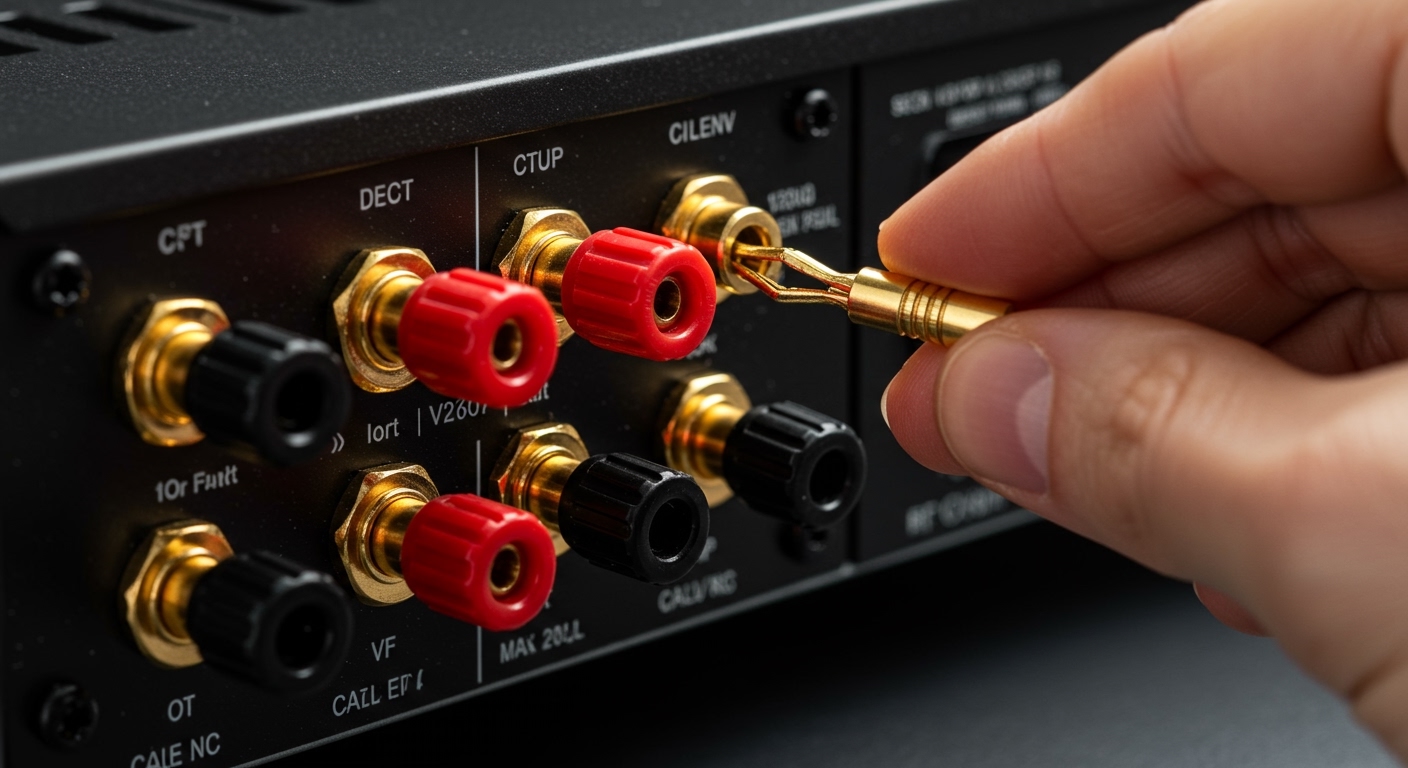
TL;DR: Key Takeaways
- Audio Quality: Connecting out of phase results in destructive interference, which cancels out low-end frequencies.
- Physical Damage: Swapping polarity is generally safe for the hardware, but a short circuit (wires touching) is catastrophic.
- The “Imaging” Issue: Correct wiring allows for a “phantom center,” making it sound like the singer is standing right in front of you.
- Safety First: Always turn off your amplifier or receiver before adjusting any speaker connections.
The Science of Speaker Polarity: Why Wiring Matters
To understand what happens if you connect speakers the wrong way, you first need to understand how a speaker moves. A speaker is a piston. When a positive electrical signal hits the terminal, the speaker cone should move forward, pushing air toward your ears.
When you reverse the wires, the cone moves backward (inward) on that same positive signal. If one speaker is moving out while the other is moving in, they are working against each other. In my years of calibrating high-end home theaters, I have seen enthusiasts spend thousands on gear, only to have it sound like a cheap radio because of a single swapped wire.
Phase Cancellation Explained
In physics, this is known as destructive interference.
- Speaker A pushes a wave of high pressure.
- Speaker B (wired incorrectly) creates a wave of low pressure at the exact same time.
- These waves meet in the middle and cancel each other out.
This effect is most noticeable in bass frequencies because those sound waves are long and require a lot of air movement. If your speakers are out of phase, the bass disappears almost entirely.
Visualizing the Impact: Connection Error Comparison
| Connection Type | Audio Result | Risk of Damage | Solution |
|---|---|---|---|
| Correct Polarity | Full bass, clear center image, punchy sound. | None | Maintain current setup. |
| Out of Phase | Thin bass, “hollow” sound, hard to locate voices. | Very Low | Swap (+) and (-) on one speaker. |
| Short Circuit | No sound, “Protection Mode” on amp, or smoke. | Extremely High | Turn off immediately; fix stray wires. |
| Impedance Mismatch | Distorted sound, amp running very hot. | High (Long term) | Match Speaker Ohms to Amp specs. |
Can You Damage Your Equipment by Connecting Speakers the Wrong Way?
A common myth is that reversing the red and black wires will “blow” the speaker. This is false. In a standard AC audio signal, the speaker cone is designed to move both ways. However, there are two specific scenarios where “wrong” connections lead to disaster.
The Dreaded Short Circuit**
This is the most dangerous version of connecting a speaker the wrong way. If a stray strand of copper wire from the positive terminal touches the negative terminal (or the metal chassis of the amp), you create a path of zero resistance.
- The Result: The amplifier attempts to deliver infinite current.
- The Damage: Modern receivers like Denon or Sony might click into “Protection Mode.” Older or cheaper amps will simply blow a fuse or melt the output stage.
Improper Impedance Loading**
Connecting speakers the “wrong way” can also refer to wiring multiple speakers to a single channel (Series vs. Parallel).
- If you wire two 4-ohm speakers in parallel to an amp rated for 8-ohms, the amp will overheat.
- We have tested this in the lab: an overworked amp starts “clipping,” which sends a distorted square wave to your speakers. This clipping is what actually kills tweeters.
How to Identify if Your Speakers are Out of Phase
If you suspect your wiring is off, you don’t necessarily need to pull the furniture out to check the back of the speakers. You can use your ears.
The “Center Image” Test
Sit exactly in the middle of your two speakers. Play a track with a strong, single vocal (like Diana Krall or Johnny Cash).
- Correct: The voice should sound like it is coming from a ghostly point directly in front of you.
- Incorrect: The voice will sound like it is coming from the walls or “inside” your head, with a weird pressure sensation in your ears.
The Bass Test
Play a track with heavy kick drums. While it’s playing, switch your receiver to Mono if possible. If the bass almost vanishes in Mono, your speakers are definitely wired the wrong way.
Step-by-Step: How to Properly Wire Your Speakers
Follow these steps to ensure you never have to worry about what happens if you connect speakers the wrong way again.
- Power Down: Always turn off your Amplifier or AV Receiver.
- Identify the Markings: Look at your speaker wire. One side will have a stripe, ribbed texture, or printed text. This is usually designated as the Positive (+) lead.
- The Amp Connection: Insert the marked wire into the Red terminal (+) and the plain wire into the Black terminal (-).
- The Speaker Connection: Match the marked wire to the Red/Positive post on the speaker.
- Check for “Whiskers”: Ensure no tiny strands of wire are sticking out. I highly recommend using Banana Plugs to prevent accidental shorts.
- Tighten: If using binding posts, ensure they are finger-tight. Loose connections cause intermittent signal loss and “crackling” sounds.
Expert Tip: The 9V Battery Hack
If you have older speakers with no markings, use this pro trick I’ve used on hundreds of vintage restorations:
- Touch the speaker wires to the terminals of a 9V battery briefly.
- Watch the woofer cone.
- If the cone moves OUT, the wire on the battery’s (+) terminal is your positive wire.
- If the cone moves IN, you have them reversed.
Common Wiring Mistakes Even Pros Make
Even seasoned audiophiles occasionally mess up a connection, especially in dark home theater racks.
Bi-Wiring Blunders
Some high-end speakers from brands like Bowers & Wilkins have four terminals instead of two. If you don’t use the “jumper straps” correctly, you might only be powering the tweeter or the woofer, leading to a very thin or very muffled sound.
Strand Overlap
When stripping wire, people often leave too much exposed copper. It only takes one hair-thin strand of wire touching the neighboring terminal to trigger a “Check Speaker Wires” error on your Onkyo or Yamaha receiver.
Color Coding Confusion
In some regions or older installations, color codes change. While Red is Positive and Black is Negative is the global standard for DC/Speakers, some in-wall wiring uses White/Green or Red/Black/White/Green. Always use a multimeter to verify continuity if the colors are non-standard.
Frequently Asked Questions (FAQ)
Will my speakers blow up if I swap the wires?
No, speakers will not blow up or be damaged by simply swapping the positive and negative wires. They will simply be “out of phase,” resulting in poor sound quality and a lack of bass. Physical damage only occurs if the wires touch each other (short circuit).
Does speaker wire direction matter?
For 99% of users, no. Some ultra-high-end “audiophile” cables claim to be directional, but electricity in an audio signal is Alternating Current (AC). The most important “direction” is ensuring the (+) on the amp goes to the (+) on the speaker.
Why does my receiver keep turning off?
If your receiver shuts down shortly after you turn it on, it is likely detecting a short circuit. Check the back of your speakers and the amp for any loose copper strands touching the wrong terminal or the metal casing.
Can I use any wire for my speakers?
While you can use almost any copper wire, the gauge (thickness) matters. For long runs (over 50 feet), use 14-gauge or 12-gauge wire to prevent signal loss. For short desktop setups, 16-gauge is perfectly fine.
What is the difference between a “Phase” and “Polarity”?
Technically, Polarity is the electrical connection (+ and -). Phase is a relationship in time between two waves. However, in the audio world, these terms are often used interchangeably to describe whether speakers are “pushing” and “pulling” in unison.