Understanding What is Parallel Wiring of Speakers
What is parallel wiring of speakers? It is a method of connecting multiple speakers to a single amplifier channel by linking all positive terminals together and all negative terminals together. This configuration decreases the total electrical resistance (impedance), which allows the amplifier to output more power, provided the load remains within its safe operating limits.
In my fifteen years of designing professional audio systems, I have found that parallel wiring is the most common way to link speakers in both car audio and home theater setups. While it is an effective way to boost volume, you must be careful. If you parallel speakers incorrectly, you risk dropping the impedance too low, which can cause your amplifier to overheat or enter “protect mode.”
TL;DR: Key Takeaways for Parallel Wiring
- Definition: Connecting all (+) terminals together and all (-) terminals together.
- Effect on Impedance: Total Ohms decrease (e.g., two 8-ohm speakers become a 4-ohm load).
- Power Output: Amplifiers generally produce more wattage at lower impedance levels.
- Risk Factor: Connecting too many speakers can drop impedance below the amp’s minimum rating (usually 2 or 4 Ohms).
- Best For: Most standard multi-speaker setups where the amplifier is stable at lower loads.
Why Speaker Impedance Matters in Parallel Wiring
Before you pick up a wire stripper, you must understand Impedance, measured in Ohms (Ω). Think of impedance like a pipe’s diameter; it dictates how much electrical current can flow from your amp to your speakers.
When you ask, “can you do parallel wiring with speakers?” the answer depends entirely on your amplifier’s “minimum stable load.” Most home receivers are rated for 6 to 8 Ohms, while high-end car amplifiers can often handle 1 or 2 Ohms.
The Parallel Wiring Formula
To calculate the total load of two speakers in parallel, we use the “Product over Sum” formula:
Total Impedance = (R1 × R2) / (R1 + R2)
If the speakers are of equal impedance, the math is even simpler: divide the Ohms of one speaker by the total number of speakers. For example, two 8-ohm speakers in parallel result in a 4-ohm load.
| Number of 8-Ohm Speakers | Wiring Configuration | Resulting Total Impedance |
|---|---|---|
| 1 Speaker | Standard | 8 Ohms |
| 2 Speakers | Parallel | 4 Ohms |
| 3 Speakers | Parallel | 2.67 Ohms |
| 4 Speakers | Parallel | 2 Ohms |
Can You Parallel Speakers of Different Ohms?
A common question I receive is: “can you parallel speakers with different impedance ratings?” The answer is yes, but it is not recommended for beginners.
When you mix a 4-ohm speaker with an 8-ohm speaker in parallel, the lower-impedance speaker will draw more power from the amplifier. This results in uneven volume levels and can potentially damage the more sensitive driver.
In my experience, always try to match your speakers’ impedance and sensitivity ratings. This ensures a balanced soundstage and prevents one speaker from doing all the “heavy lifting.”
Step-by-Step Guide: How to Wire Speakers in Parallel
Follow these steps to ensure a clean, safe connection that won’t fry your equipment.
Check Your Equipment Ratings
Look at the back of your amplifier. It will usually say something like “Minimum 4 Ohms.” Next, check your speakers. If you have two 8-ohm speakers, you are safe to proceed, as their combined parallel load is 4 Ohms.
Prepare Your Speaker Wire
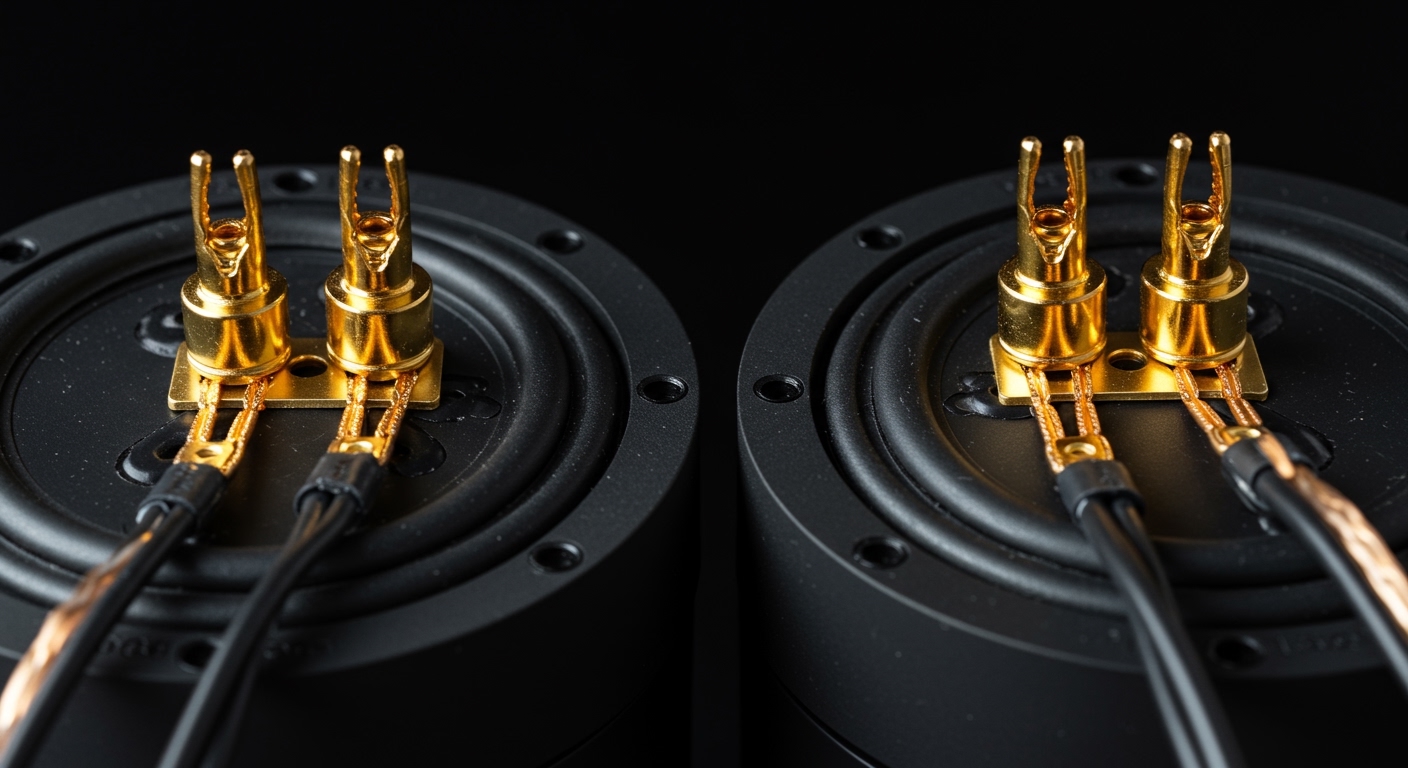
Use high-quality 14-gauge or 16-gauge oxygen-free copper (OFC) wire. Strip approximately half an inch of insulation from the ends of the wires. I personally prefer using Banana Plugs or Spade Connectors for a more secure and professional finish.
Connect the First Speaker
Run a set of wires from the amplifier’s positive (+) and negative (-) terminals to the first speaker. Connect the positive wire to the red terminal and the negative wire to the black terminal.
Daisy-Chain to the Second Speaker
Run a second set of wires from the first speaker’s terminals directly to the second speaker.
- Connect Positive to Positive: Run a wire from the (+) terminal of Speaker A to the (+) terminal of Speaker B.
- Connect Negative to Negative: Run a wire from the (-) terminal of Speaker A to the (-) terminal of Speaker B.
Final Inspection
Ensure there are no stray copper strands touching between the positive and negative terminals. Even a single strand can cause a short circuit, which can destroy your amplifier’s output transistors instantly.
Parallel vs. Series Wiring: Which is Better?
While parallel wiring is great for getting more power, Series wiring is its opposite. In series, you connect the positive of one speaker to the negative of the next, which increases the total impedance.
We often use series wiring in “Series-Parallel” configurations when dealing with a massive amount of speakers (like a 4×12 guitar cabinet) to keep the final load within a safe range for the amp.
| Feature | Parallel Wiring | Series Wiring |
|---|---|---|
| Total Impedance | Decreases | Increases |
| Amp Power Output | Increases (usually) | Decreases |
| Wiring Complexity | Simple/Direct | Intermediate |
| Risk | Amp Overheating | Lower Volume |
| Best Use Case | Car Subwoofers, Home Audio | Guitar Cabs, Multi-Speaker PA |
Expert Tips for a Successful Setup
Throughout my career, I have seen many avoidable mistakes. Here is my “pro-tip” list for anyone attempting to parallel speakers:
- Monitor the Heat: After wiring your speakers in parallel, run the system at a moderate volume for 15 minutes. Feel the top of the amplifier. If it is too hot to touch, your impedance load is likely too low.
- Use Consistent Wire Lengths: While less critical for short runs, keeping wire lengths similar helps maintain consistent resistance across all speakers.
- Invest in a Multimeter: I never start a project without a Digital Multimeter. Before plugging into the amp, touch the probes to the ends of your wire chain. It will give you the actual DC resistance, confirming your math is correct.
- Polarity is Key: If you accidentally swap the positive and negative on one speaker, they will be “out of phase.” This results in a massive loss of bass as the sound waves cancel each other out.
Common Pitfalls to Avoid
- Ignoring the 2-Ohm Limit: Most entry-level home theater receivers (like Denon or Onkyo) are not designed to handle a 2-ohm load. Doing so will trigger a thermal shutdown.
- Using Thin Wire: When you lower impedance, the current (amperage) increases. Thin 22-gauge wire can heat up and lose power. Stick to 14-gauge for parallel runs.
- Poor Terminations: Avoid twisting wires together and using electrical tape. Use wire nuts, crimp connectors, or solder for a permanent, low-resistance connection.
Troubleshooting Your Parallel Connection
If you have finished your wiring and the sound isn’t right, check these common issues:
- No Sound: Check for a loose connection at the “master” speaker where the amp wire enters.
- Distorted Audio: Your amplifier may be clipping because it cannot handle the low impedance. Turn the volume down immediately.
- One Speaker is Louder: This happens if you mixed speakers with different Sensitivity (dB) ratings. Parallel wiring works best with identical speaker models.
Frequently Asked Questions
Does parallel wiring make speakers louder?
Yes, generally. Because parallel wiring lowers the total impedance, the amplifier can deliver more wattage. However, if the amp isn’t powerful enough to handle the extra current, it may distort or shut down.
Is it better to wire speakers in series or parallel?
It depends on your amplifier. If your amp is stable at low Ohms, parallel is usually better for maximum performance. If you have many speakers and a low-power amp, series is safer to prevent damage.
Can I connect three 8-ohm speakers in parallel?
You can, but it results in a 2.67-ohm load. You must ensure your amplifier is “2-ohm stable.” Many high-quality car audio amps can handle this, but most home stereo systems cannot.
Will parallel wiring damage my speakers?
Parallel wiring itself won’t damage the speakers, but it could damage your amplifier if the impedance is too low. The speakers are only at risk if the amp starts “clipping,” which sends a distorted square-wave signal that can burn out voice coils.
**
**
**
**