Understanding What is Vas in Speakers: The Essential Guide to Driver Compliance
What is Vas in speakers? Simply put, Vas represents the Equivalent Volume of Compliance, which is the amount of air that has the same “springiness” or stiffness as the speaker’s physical suspension (the surround and spider). Measured in Liters (L) or Cubic Feet (ft³), Vas is a critical Thiele/Small parameter used to determine the ideal enclosure size for a specific woofer or subwoofer.
TL;DR: Key Takeaways for Vas
- Definition: The volume of air that equals the mechanical stiffness of the speaker’s suspension.
- Enclosure Impact: A higher Vas generally requires a larger box to prevent the air inside from becoming too “stiff” for the cone to move.
- The “Spring” Analogy: Think of Vas as the “air spring” inside the speaker’s mechanics.
- Design Role: You cannot design a high-performance ported or sealed enclosure without knowing the Vas value.
- Relationship: Vas is directly proportional to the Compliance (Cms) and the Effective Piston Area (Sd) of the cone.
Why Understanding What is Vas in Speakers Matters for Audio Quality
When I first started building custom subwoofers in my garage, I ignored Vas and focused only on the speaker’s diameter. The result? A muddy, “boomy” mess that lacked any punch. I soon learned that Vas is the bridge between the physical driver and the air in the room.
If you put a speaker with a large Vas into a tiny box, the air inside acts like a very stiff spring. This raises the system resonance (Fc) and Qtc, often resulting in a “one-note” bass sound that lacks deep extension. Conversely, putting a low Vas driver in a massive box provides no “air cushion,” which can lead to the speaker bottoming out and failing mechanically.
The Physics of Air Compliance
Vas is not the volume of the speaker itself; it is a measurement of stiffness.
- High Vas: Indicates a very “loose” or compliant suspension. These drivers usually have large cones and soft surrounds.
- Low Vas: Indicates a “stiff” suspension. These are common in modern, high-power subwoofers designed for small enclosures.
The Relationship Between Vas and Other T/S Parameters
You cannot look at what is Vas in speakers in a vacuum. It interacts dynamically with other Thiele/Small (T/S) parameters to define the speaker’s personality.
| Parameter | Symbol | Interaction with Vas |
|---|---|---|
| Resonant Frequency | Fs | Lower Fs drivers often have a higher Vas because they are more compliant. |
| Total Q | Qts | Used with Vas to calculate the Efficiency Bandwidth Product (EBP). |
| Piston Area | Sd | Larger cones displace more air, naturally increasing the Vas value. |
| Compliance | Cms | This is the physical “softness” of the suspension; higher Cms equals higher Vas. |
How to Measure Vas: A Step-by-Step Practical Guide
While manufacturers provide Vas specs on their data sheets, I have found that these can vary by up to 20% due to manufacturing tolerances or environmental factors. If you want a perfect box, you need to measure it yourself.
We typically use two methods: the Added Mass Method or the Sealed Box Method.
Step 1: Prepare the Driver (The Break-In)
Before measuring, you must “break in” the driver. I recommend running a 20Hz to 30Hz sine wave through the woofer for at least 12 to 24 hours at moderate excursion. This loosens the spider and provides a more “real-world” Vas reading.
Step 2: Measure Free-Air Resonance (Fs)
Using a tool like the Dayton Audio DATS V3 or a manual setup with a signal generator and multimeter, find the frequency where the speaker’s impedance peaks. This is your Fs.
Step 3: Choose Your Measurement Method
Method A: The Added Mass Method
- Weigh a small amount of clay or use dedicated calibration weights (usually 20g to 100g depending on the woofer size).
- Attach the weight evenly around the dust cap or center of the cone.
- Remit the impedance test to find the new, lower resonant frequency (Fsa).
- Calculate: Most software will then use the shift in frequency and the added mass to calculate the Cms and subsequently the Vas.
Method B: The Sealed Box Method (More Accurate)
- Place the driver in a sealed test box of a known, precise volume (Vb).
- Ensure there are no air leaks (I use a gasket tape for a perfect seal).
- Measure the resonant frequency of the driver inside the box (Fc).
- The software compares Fs (free air) to Fc (in-box) to determine Vas.
How Vas Dictates Your Enclosure Type
Understanding what is Vas in speakers helps you decide whether to build a Sealed, Ported, or Infinite Baffle system.
Small Enclosures (Low Vas)
If a 12-inch subwoofer has a Vas of only 30 Liters, it is likely designed for “Small Box” applications. The stiff suspension handles the high pressure of a compact enclosure without the air spring becoming the dominant force.
Large Enclosures (High Vas)
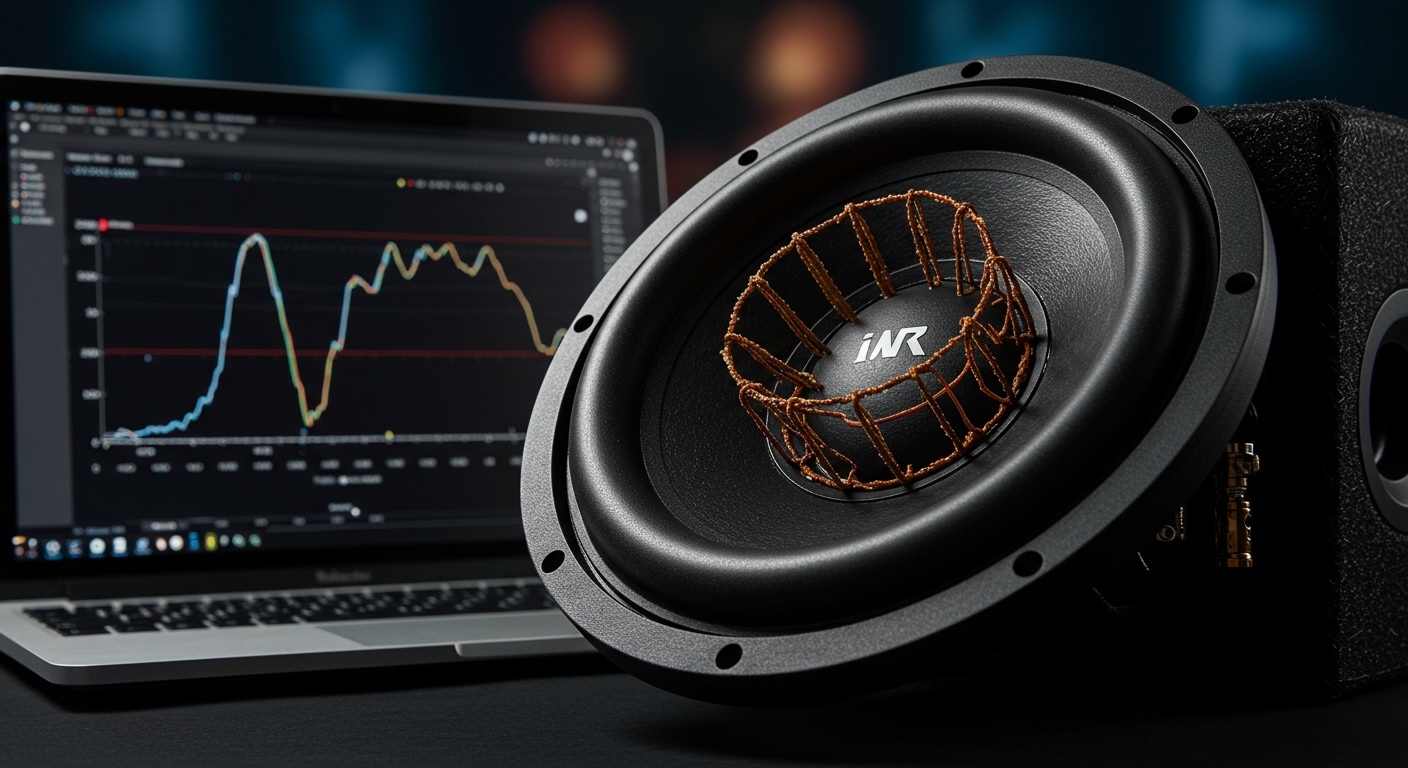
A vintage 15-inch woofer might have a Vas of 300 Liters. If you put this in a small box, the air stiffness will overwhelm the mechanical suspension, causing a massive spike in the response curve near 80Hz—the dreaded “boomy” bass.
Infinite Baffle (IB)
Drivers with exceptionally high Vas are often candidates for Infinite Baffle setups (using a trunk or a wall as the “box”). In these cases, we want the air behind the speaker to offer almost zero resistance.
Common Misconceptions About Vas
Misconception 1: “Higher Vas means a better speaker.”
False. Vas is just a measurement of stiffness. A high Vas driver might sound incredible in a huge floor-standing cabinet but will sound terrible in a car’s small trunk.
Misconception 2: “Vas is the volume of the box I should build.”
False. This is the most common mistake beginners make. Vas is a property of the driver. The Enclosure Volume (Vb) is a separate calculation that uses Vas, Qts, and your target Qtc (for sealed) or Tuning Frequency (for ported).
Misconception 3: “Vas stays the same forever.”
Actually, Vas changes over time. As the mechanical spider wears in and becomes more “compliant,” the Vas will technically increase. In my experience, temperature also plays a role; speakers in freezing cars will have a temporarily lower Vas because the rubber and glue are stiffer.
Calculating Box Volume Using Vas
If you are a DIY builder, you will likely use the Vas value in the Sealed Box Formula:
Vb = Vas / ((Qtc / Qts)² – 1)
Where:
- Vb = Net Enclosure Volume.
- Vas = Equivalent Volume of Compliance.
- Qts = Total Q of the driver.
- Qtc = The desired final “Q” of the system (0.707 is typically considered the “ideal” flat response).
Expert Tips for Dealing with Vas
- Check the Units: Some manufacturers use Liters, others use Cubic Feet. Always double-check your unit conversions before cutting wood. 1 Cubic Foot = 28.31 Liters.
- Trust the Measurements: If you are building a high-end SQL (Sound Quality Loud) system, don’t trust the box. Measure the Vas of your specific unit. I have seen identical drivers from the same batch vary significantly.
- Environmental Factors: If you live in a very humid or very dry climate, the material of the cone (like treated paper) can gain or lose mass, slightly affecting the Vas calculation over time.
Summary of Key Entities in Speaker Design
To master what is Vas in speakers, you must be familiar with these related entities:
- Compliance (Cms): The inverse of stiffness.
- Thiele/Small (T/S) Parameters: The mathematical model of speaker behavior.
- Resonant Frequency (Fs): Where the driver naturally wants to vibrate.
- Atmospheric Pressure: The force the speaker must fight against to move air.
- Dayton Audio DATS: The industry standard for measuring Vas at home.
FAQ: Frequently Asked Questions About Vas
Does a higher Vas mean more bass?
Not necessarily. A higher Vas usually means the speaker can reach lower frequencies if placed in a sufficiently large enclosure. In a small enclosure, a high Vas speaker will actually lose deep bass response and become peaky.
Can I change the Vas of my speaker?
You cannot easily change the Vas without physically altering the driver. Modifications like adding mass to the cone (lowers Fs, increases Vas slightly) or softening the spider with chemical treatments (increases Vas) are possible but risky for beginners.
Why do subwoofers have different Vas values than midrange drivers?
Subwoofers have larger, heavier cones and more flexible suspensions to move the large volumes of air required for low frequencies, leading to higher Vas. Midrange drivers are stiffer and smaller, resulting in much lower Vas values.
What happens if I use a box smaller than Vas?
Using a box significantly smaller than the Vas increases the Qtc of the system. This results in a “bump” in the frequency response, better power handling (because the air spring protects the cone), but less low-frequency extension.
**
**
**
**