What Size Are Tweeter Speakers? A Quick Direct Answer
Most tweeter speakers feature a diaphragm size ranging from 0.5 inches to 1.5 inches, with 1 inch (25mm) being the global industry standard for both car and home audio systems. However, the physical mounting size—which includes the housing and bezel—is typically larger, often requiring a cutout between 1.75 inches and 2.5 inches.
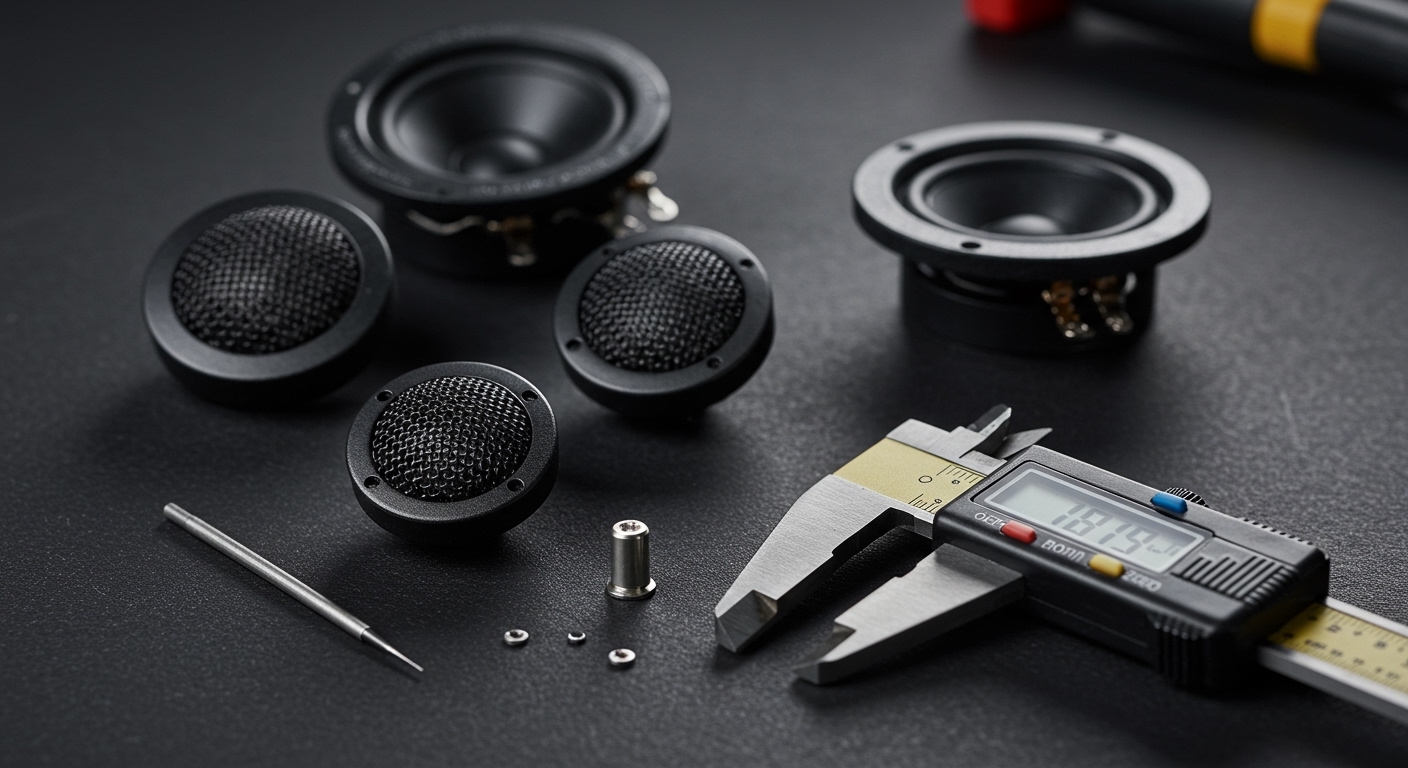
Understanding what size are tweeter speakers involves distinguishing between the voice coil/diaphragm diameter and the overall frame diameter. While a 1-inch tweeter provides the best balance of power handling and high-frequency extension, smaller 0.75-inch models are preferred for tight spaces, while larger 1.5-inch “super tweeters” are designed for high-output Pro Audio applications.
TL;DR: Key Takeaways for Tweeter Sizing
- Standard Size: 1-inch (25mm) is the most common size found in component speaker sets.
- Measurement Trap: Diaphragm size (e.g., 1″) does not equal the installation hole size (usually 1.8″–2″).
- Mounting Depth: Most tweeters require 0.5 to 1.0 inches of depth behind the mounting surface.
- Material Impact: Silk dome tweeters are often slightly larger in housing than Aluminum or Titanium versions.
- Fitment Tip: Always check the flush mount vs. surface mount dimensions before cutting your door panels or A-pillars.
Understanding the Difference Between Diaphragm and Housing Size
When you ask what size are tweeter speakers, you are usually looking for one of two measurements: the driver size or the installation size. In my years of custom car audio fabrication, I have seen many DIYers buy a “1-inch tweeter” only to realize it requires a 2-inch hole in their dashboard.
The Diaphragm Diameter
The diaphragm is the part that moves to create sound. Common sizes include:
- 0.5-inch to 0.75-inch: Found in budget coaxial speakers or ultra-compact factory locations.
- 1-inch: The “sweet spot” for High-Fidelity audio.
- 1.1-inch to 1.5-inch: Larger formats used to achieve a lower Resonant Frequency (Fs), allowing the tweeter to “sing” lower into the midrange frequencies.
The Mounting (Overall) Diameter
This is the measurement of the plastic or metal housing that holds the tweeter. For a standard 1-inch silk dome tweeter, the overall diameter is often around 1.8 to 2.1 inches. This allows for the surround, the voice coil gap, and the mounting flange where the screws or clips attach.
Standard Tweeter Size Comparison Table
To help you visualize how these dimensions translate to real-world hardware, refer to this comparison of common tweeter formats I frequently install.
| Tweeter Type | Diaphragm Size | Typical Cutout Diameter | Mounting Depth | Best Use Case |
|---|---|---|---|---|
| Micro Tweeters | 0.5″ – 0.75″ | 1.2″ – 1.5″ | 0.4″ – 0.6″ | Stealth factory replacements |
| Standard Component | 1.0″ (25mm) | 1.75″ – 2.0″ | 0.7″ – 0.9″ | High-end SQ (Sound Quality) |
| Large Format Dome | 1.1″ – 1.2″ | 2.1″ – 2.4″ | 1.0″ – 1.2″ | Audiophile / 2-way active setups |
| Bullet / Pro Audio | 1.0″ – 1.5″ | 3.0″ – 4.0″ | 2.0″ – 3.5″ | High-volume SPL builds |
How Tweeter Size Affects Sound Quality and Performance
Choosing what size are tweeter speakers for your build isn’t just about fitment; it’s about physics. I’ve tested hundreds of configurations, and the size of the driver directly dictates the frequency response and dispersion pattern.
Small Tweeters (0.5″ – 0.75″)
Pros:
- Excellent off-axis response. Because the diaphragm is small, high-frequency sound waves don’t “beam” as much, meaning they sound good even if they aren’t pointed directly at your ears.
- Easier to hide in factory A-pillars or sail panels.
Cons:
- Higher Resonant Frequency (Fs). They cannot play low notes. You typically have to cross them over above 4,000Hz, which can leave a “hole” in your music if your mid-bass woofer can’t reach that high.
Standard Tweeters (1.0″)
Pros:
- The industry standard for a reason. They can usually play down to 2,500Hz safely.
- Higher power handling thanks to larger voice coils.
- Available in the widest variety of materials like Silk, Aluminum, Beryllium, and Carbon Fiber.
Cons:
- Slightly more “beaming” at very high frequencies (above 15kHz).
- Requires significant space for flush mounting.
Large Format & Bullet Tweeters (1.25″+)
Pros:
- Extreme Volume: Bullet tweeters use a horn-loaded design to reach massive volume levels.
- Low Crossovers: Some 1.1-inch audiophile tweeters can play down to 1,800Hz, which brings the “soundstage” up onto your dashboard.
Cons:
- Very difficult to install without custom fiberglass work.
- Can be “harsh” if not tuned correctly with a DSP (Digital Signal Processor).
Step-by-Step Guide: How to Measure What Size Your Tweeters Are
If you are replacing factory speakers, you need to measure correctly to avoid buying the wrong replacements. Here is the process I use in my shop:
- Remove the Grille: Use a plastic trim tool to avoid scratching your interior.
- Measure the Cutout: Use a digital caliper to measure the width of the hole where the tweeter sits. This is your Cutout Diameter.
- Check the Depth: Stick a ruler into the hole until it hits the window glass or metal brace. This is your Maximum Mounting Depth.
- Identify the Mount Type:
Material Science: Does the Size Change Based on Material?
Interestingly, the material often influences the perceived “size” of the tweeter. Silk dome tweeters usually have a larger “roll” or surround to allow for more excursion, making the overall unit slightly bulkier.
In contrast, Metal dome tweeters (Aluminum or Titanium) often utilize a more compact “inverted dome” design (popularized by brands like Focal). This allows them to fit into shallower locations while maintaining a 1-inch diaphragm surface area.
Installation Expert Tips: Fitting “Over-Sized” Tweeters
When the answer to what size are tweeter speakers is “too big for my car,” don’t panic. We often encounter this when upgrading to high-end components.
- Use Back-Straps: If your new tweeter is smaller than the factory hole, use a metal plumber’s strap (back-strap) to bridge the gap and secure the tweeter from behind.
- PVC Hole Adapters: You can buy or 3D-print adapter rings that convert a 2.5-inch factory hole into a perfect 1.75-inch mount for your new tweeters.
- Avoid Obstructions: Remember that a 1-inch tweeter with a large Neodymium magnet might be wide but shallow. A Ferrite magnet tweeter will be much deeper. Always check the magnet type before buying.
The Role of Crossovers in Tweeter Sizing
The size of the tweeter dictates where the crossover frequency should be set. If you install a small 0.75-inch tweeter, you must set your high-pass filter higher (e.g., 5,000Hz). If you use a 1-inch tweeter, you can go lower (e.g., 3,000Hz).
Setting a crossover too low for a small tweeter is the #1 cause of “blown” speakers I see in the field. The small voice coil simply cannot dissipate the heat generated by lower-frequency waves.
Frequently Asked Questions (FAQ)
Can I put 1-inch tweeters in a 0.75-inch factory hole?**
Yes, but it usually requires modification. You will likely need to use a Dremel tool to slightly enlarge the mounting hole or use a surface-mount pod provided with your tweeter kit.
What is the most common tweeter size for cars?**
The most common size is 1 inch (25mm). Most aftermarket component sets from brands like JL Audio, Rockford Fosgate, and Alpine use this size because it offers the best performance-to-size ratio.
How do I know if a tweeter will fit my A-pillar?**
You must check the Mounting Depth. Most A-pillars have limited space before you hit the metal frame of the car. Look for tweeters with a depth of 0.75 inches or less for the easiest installation.
Does a bigger tweeter mean louder sound?**
Not necessarily. A bigger diaphragm usually means the tweeter can play lower frequencies, but “loudness” (Sensitivity) is determined by the magnet strength and voice coil efficiency. Bullet tweeters are the exception—they are large and designed specifically for extreme volume.
Are “Super Tweeters” a different size?**
Yes. Super tweeters are often 3 to 4 inches in total diameter. They are designed to play ultra-high frequencies (up to 40kHz) and are typically used in specialized high-SPL (Sound Pressure Level) systems.