What Speakers Are Used at Festivals?
Large-scale music festivals primarily use Line Array Systems—specifically large-format, modular speakers designed to be flown (suspended) in vertical columns. Leading brands like L-Acoustics, d&b audiotechnik, and Meyer Sound dominate the industry because they provide the high Sound Pressure Levels (SPL) and long-throw capabilities needed to cover tens of thousands of attendees. These systems use specialized wave-guides to ensure audio remains clear and consistent from the front row to the very back of the field.
Quick Summary: Festival Audio at a Glance
If you are looking for a fast answer on what speakers are used at festivals, here are the industry standards our team sees at almost every major event:
- Primary System Type: Active or Passive Line Arrays (Vertical columns of speakers).
- Gold Standard Brands: L-Acoustics (K Series), d&b audiotechnik (SL-Series), and Meyer Sound (PANTHER).
- The Low End: High-output Subwoofers (often 18-inch or 21-inch drivers) arranged in cardioid arrays to prevent “bass bleed” behind the stage.
- Supporting Gear: Front fills for the audience at the barrier and Delay towers for people standing 100+ meters away.
- Power & Processing: High-wattage DSP Amplifiers (Digital Signal Processing) and networked audio protocols like Dante or Milan/AVB.
The Anatomy of a Festival Sound System
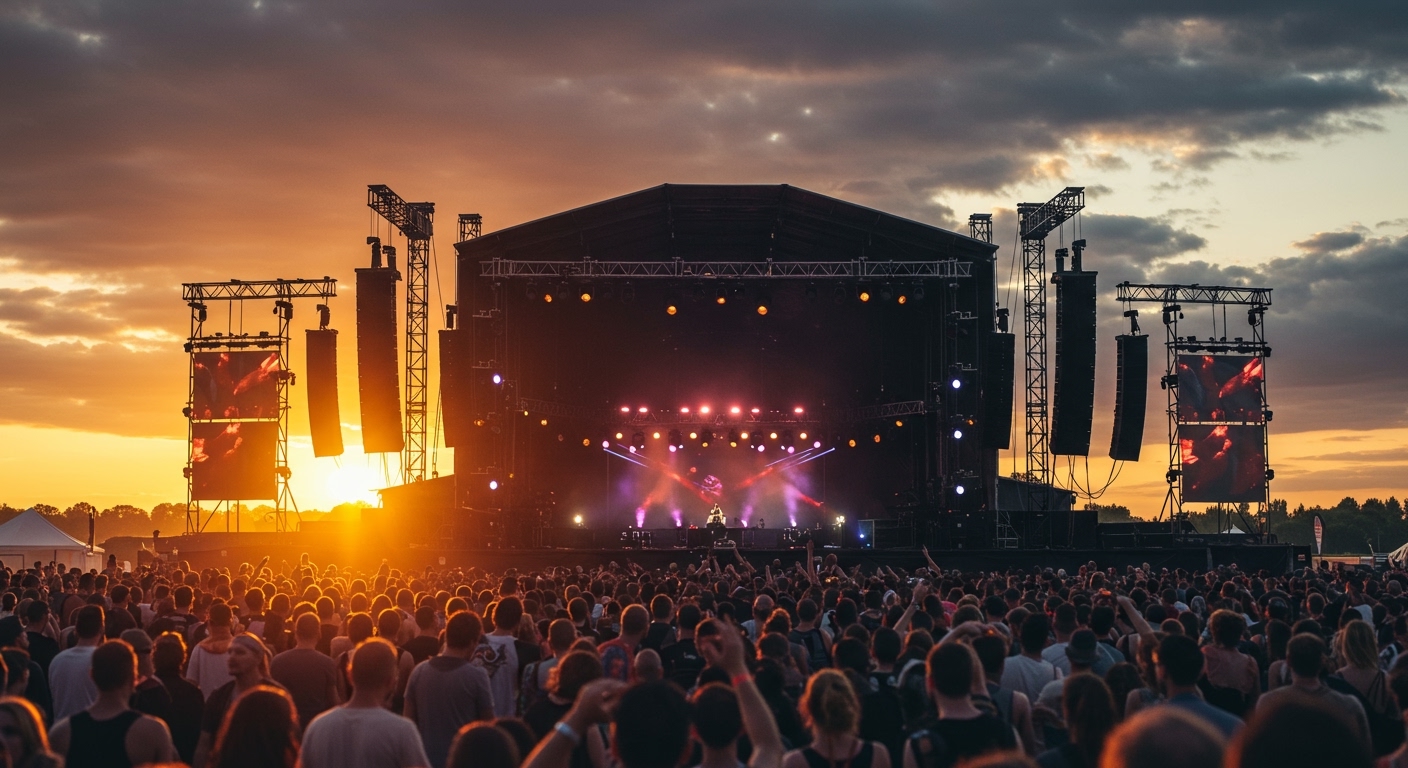
When you walk onto a festival site, the most striking visual elements are the massive “bananas” of speakers hanging on either side of the stage. These are Line Arrays. Unlike traditional “Point Source” speakers you might use in a home theater, Line Arrays are designed to minimize the Inverse Square Law—the physics principle where sound drops by 6dB for every doubling of distance.
Why Line Arrays Are the Industry Standard
The reason what speakers do they use at festivals is almost always “Line Arrays” comes down to physics and Cylindrical Wavefronts. By stacking speakers vertically and spacing the drivers closely together, the sound waves interact to create a coherent beam.
- Vertical Control: Sound is directed at the audience, not the sky or the ground.
- Throw Distance: Line arrays can “throw” audio much further than traditional boxes before the sound becomes muffled.
- Scalability: We can add more boxes to the “hang” depending on the size of the crowd.
The Role of Subwoofers in Outdoor Settings
No festival experience is complete without feeling the bass in your chest. At festivals, Subwoofers are usually placed on the ground in front of the stage. We often use Cardioid Subwoofer Arrays, which involve turning some subwoofers backward and using digital delays to cancel out the sound behind the stack. This keeps the stage quiet for the artists while projecting maximum energy into the crowd.
Top Brands: What Speakers Do They Use at Festivals?
In the professional touring world, there are “Rider-Friendly” brands. These are the manufacturers that A-list artists (like Taylor Swift, Metallica, or Tiesto) trust to deliver high-fidelity sound.
L-Acoustics (The Industry Leader)
Based in France, L-Acoustics is credited with inventing the modern line array (the V-DOSC). Their current flagship, the K1 and K2, is the most common sight at festivals like Coachella and Tomorrowland.
d&b audiotechnik (The German Engineering Powerhouse)
Known for incredible clarity and sophisticated software, d&b audiotechnik is a staple at Glastonbury and many electronic music festivals. Their GSL and KSL systems offer “full-bandwidth directivity control,” meaning they are incredibly quiet behind the speakers, reducing noise complaints in nearby residential areas.
Meyer Sound (The American Innovator)
Meyer Sound is unique because they focus on Self-Powered (Active) systems. While most festival speakers require separate racks of amplifiers, Meyer’s PANTHER and LYON speakers have the amplifiers built directly into the box. This reduces the amount of heavy cabling needed across the stage.
Comparison of Top Festival Speaker Systems
| Feature | L-Acoustics K1/K2 | d&b GSL-Series | Meyer Sound PANTHER |
|---|---|---|---|
| Origin | France | Germany | USA |
| Power Type | Passive (External Amps) | Passive (External Amps) | Active (Internal Amps) |
| Key Advantage | Signature “Warm” Sound | Superior Noise Control | Lightweight & High Output |
| Common Use | Major Rock & Pop Tours | EDM & Large Festivals | Touring & Large Arenas |
| Best For | Extreme Throw Distance | Sensitive Noise Sites | Eco-friendly/Low Weight |
Step-by-Step: How Festival Audio is Set Up
Setting up a massive festival rig is a feat of engineering. Having worked on dozens of these builds, I can tell you it’s a precise process that starts months before the first note is played.
Step 1: Acoustic Simulation
Before any gear leaves the warehouse, engineers use software like Soundvision (L-Acoustics) or ArrayCalc (d&b) to build a 3D model of the festival grounds. We input the stage height, the slope of the land, and the expected humidity. The software tells us exactly how many speakers we need and at what angle each box should be tilted.
Step 2: Rigging and Flying the Arrays
Once on-site, the “hangs” are assembled. We use massive motors (chain hoists) to lift the speakers into the air. Safety is paramount here; each point is load-tested, and wind speed sensors are installed to ensure the stage structures can handle the weight during a storm.
Step 3: Time Alignment and Tuning
Even the best speakers will sound terrible if they aren’t “in time.” We use specialized measurement microphones and software (like Smaart) to ensure the sound from the subwoofers arrives at your ears at the exact same millisecond as the sound from the line arrays.
Step 4: Monitoring for the Artist
The speakers pointed at the crowd are only half the story. What speakers are used at festivals for the performers?
- Wedge Monitors: Angled speakers on the floor facing the artist.
- Side Fills: Large stacks on the wings of the stage so the band can hear the “full mix.”
- In-Ear Monitors (IEMs): Wireless earbuds that allow the artist to hear a studio-quality mix while moving around.
Technical Factors Affecting Festival Sound Quality
Large outdoor environments present unique challenges that you don’t find in indoor theaters. If you’ve ever noticed the sound “drifting” at a festival, it isn’t the speakers failing—it’s physics.
- Wind and Air Gradient: High-frequency sound waves can be “bent” by the wind. If the wind blows against the stage, it can push the sound down or to the side.
- Humidity: Dry air absorbs high frequencies more than humid air. Professional system technicians (System Techs) constantly adjust the EQ throughout the day as the temperature shifts.
- Noise Pollution: Many festivals use Digital Beam Steering to keep sound within the festival perimeter. This prevents the “thump-thump” of the bass from traveling three miles into a nearby town.
Beyond the Main Stage: Delay Towers and Fill Speakers
For massive crowds, the main stage arrays aren’t enough. As you move 75 to 100 meters away, the sound loses its “impact.” To solve this, we use Delay Towers.
These are secondary sets of line arrays placed further back in the crowd. We calculate the speed of sound (approx. 343 meters per second) and “delay” the audio going to these towers so it syncs perfectly with the sound traveling through the air from the main stage.
Front Fills are also essential. Because the main arrays are hung high and wide, the people right at the front barrier would actually be underneath the sound “coverage.” We place smaller speakers (like L-Acoustics Kara or d&b V7P) along the edge of the stage to “fill” that gap for the front-row fans.
Practical Advice for Festival Attendees & Aspiring Techs
If you are interested in the world of professional audio, or just a fan who wants the best experience, keep these tips in mind:
- Stand Near the FOH (Front of House): The sound engineer sits at a tent or platform in the middle of the crowd. This is where the festival sounds the best because it’s where the mix is being monitored.
- Wear Hearing Protection: Even the most advanced festival speakers can output over 110dB. High-fidelity earplugs (like Eargasm or Loop) will protect your hearing without muffling the music quality.
- Watch the Rigging: If you see a speaker array swaying significantly in the wind, the festival “Stage Manager” will likely lower the volume or the speakers themselves for safety.
Frequently Asked Questions (FAQ)
What are the loudest speakers used at festivals?
While many brands are loud, the L-Acoustics K1 and d&b audiotechnik GSL are widely considered the kings of high-SPL (Sound Pressure Level) output while maintaining low distortion. These systems can easily reach 145dB+ at the source.
How much do festival speaker systems cost?
A full-scale festival audio rig for a main stage can cost anywhere from $500,000 to over $2 million. This includes the speaker boxes, amplifiers, digital consoles (like DiGiCo), and the miles of specialized fiber-optic and power cabling.
Why are festival speakers hung in a curved shape?
This shape is called a J-Curve. The top speakers are relatively straight to throw sound to the back of the crowd, while the bottom speakers are angled more sharply downward to cover the people closer to the stage.
Are active or passive speakers better for festivals?
Both have pros and cons. Passive systems (like d&b) keep the heavy electronics on the ground in racks, making the speakers lighter to hang. Active systems (like Meyer Sound) eliminate the need for long speaker cable runs, which can reduce signal loss.
**
**
**
**