Understanding the Sound Behind the Screen: What Speakers Do Movie Theaters Use?
Have you ever wondered why a movie theater sounds so much more powerful and immersive than even the most expensive home setup? The secret lies in a specialized category of audio hardware designed for massive scale and pinpoint accuracy. What speakers do movie theaters use? Most commercial cinemas rely on professional-grade, high-output horn-loaded speakers from industry leaders like JBL Professional, QSC, Meyer Sound, and Klipsch. These systems are engineered to deliver high Sound Pressure Levels (SPL) while maintaining clarity across hundreds of seats.
🚀 Expert Summary: Key Takeaways
Brand Dominance: JBL Professional and QSC are the most common brands found in global cinema chains like AMC and Regal.
Placement Strategy: The most critical speakers (Left, Center, Right) are hidden behind an acoustically transparent screen.
Technology: Cinemas use horn-loaded compression drivers to throw sound over long distances without losing high-frequency detail.
System Architecture: A standard setup includes Screen Channels, Surround Speakers, and massive Subwoofers for Low-Frequency Effects (LFE).
The Core Components: What Speakers Do Theaters Use?
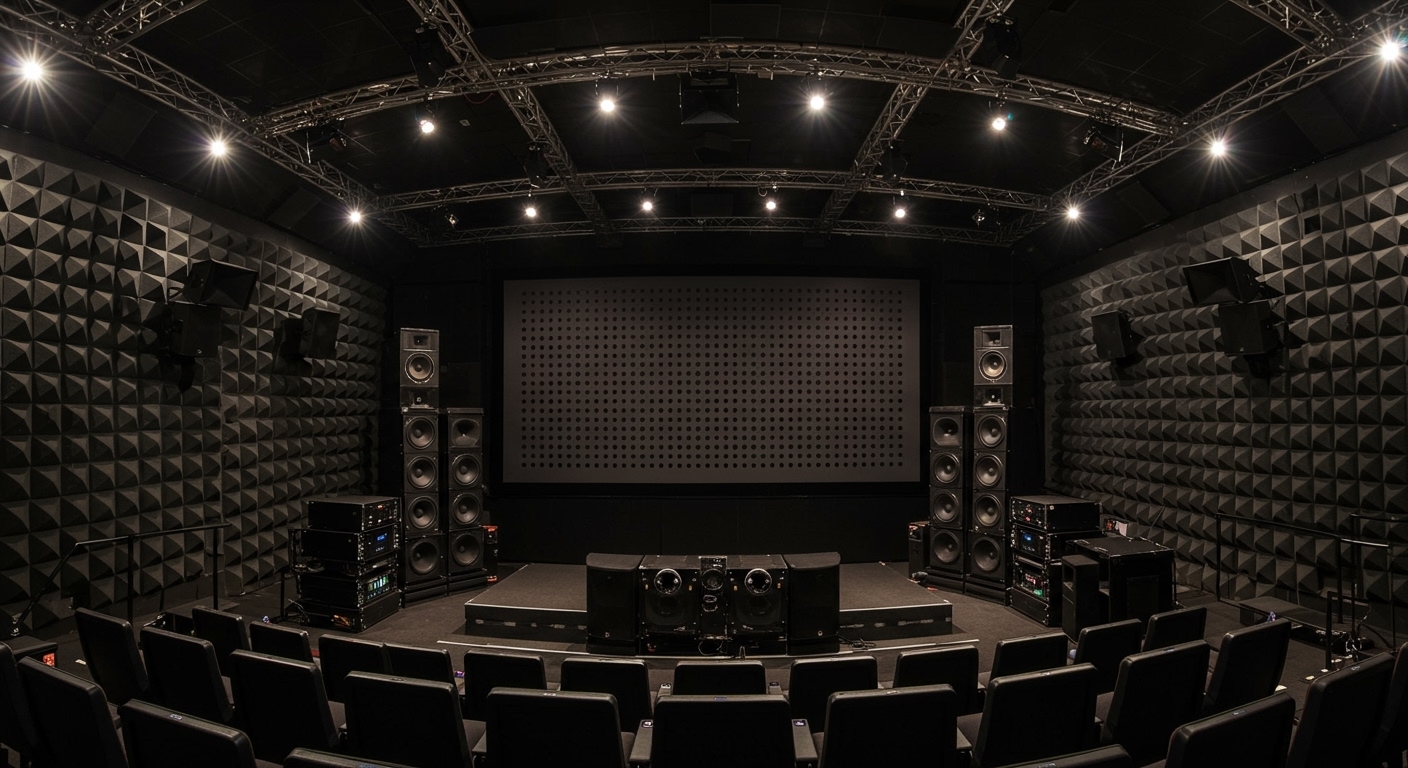
To understand what speakers do theaters use, we have to look at the three distinct zones of a cinema audio system. Unlike home theaters, these components are often larger than a refrigerator and require massive power amplification.
The Screen Channels (L-C-R)
The “behind-the-screen” speakers are the workhorses of the cinema. They handle approximately 90% of the dialogue and on-screen action.
Placement: Positioned directly behind the perforated screen.
Function: The Center Channel is dedicated almost entirely to dialogue to ensure voices come directly from the actors’ mouths.
Popular Models: The JBL 5742 or QSC SC-444 are industry standards for large-format rooms.
Surround Channels
These are the speakers you see mounted on the side and rear walls.
Function: They create the “atmosphere” or “ambience,” such as the sound of rain, wind, or a car zooming past the viewer.
Evolution: In Dolby Atmos theaters, these are also mounted on the ceiling to create a 3D “hemisphere” of sound.
Subwoofers (The LFE Channel)
Cinema subwoofers are not like home subs. They are designed for “tactile” sound—the kind you feel in your chest.
Size: Usually 18-inch drivers housed in massive wooden cabinets.
Quantity: Large theaters may use between 4 and 16 subwoofers to ensure even bass distribution.
How to Set Up a Cinema-Grade Audio System (Step-by-Step)
If you are looking to replicate the professional experience or are designing a commercial space, follow these expert steps.
Step 1: Analyze Room Acoustics and Dimensions
Before buying hardware, you must understand the “throw distance.” Cinema speakers are rated by how far they can project sound before the volume drops significantly.
Measure: Determine the distance from the screen to the back row.
Calculate: Use the Inverse Square Law to ensure the speakers can reach 85dB (the standard reference level) at every seat.
Step 2: Select High-Sensitivity Transducers
When asking what speakers do cinemas use, the answer always involves “sensitivity.” Cinema speakers need to be highly efficient.
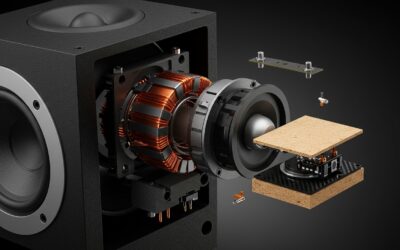
Choose Horns: Look for Compression Drivers mated to Constant Directivity Horns.
Why? Horns allow for controlled coverage, meaning the sound goes to the audience and doesn’t bounce off the ceiling or floor.
Step 3: Implement an Acoustically Transparent Screen
You cannot achieve a cinema-quality “phantom center” without putting speakers behind the screen.
Material: Use a woven or micro-perforated screen.
Gap: Leave at least 6–12 inches between the speaker face and the screen to prevent “screen flap” from air movement.
Step 4: Configure the Processing and Amplification
Cinema speakers are usually “passive,” meaning they need external brains and brawn.
DSP (Digital Signal Processing): Use a processor like the Q-SYS system to apply crossovers and EQ.
Power: Professional theaters use dedicated racks of high-wattage amplifiers (e.g., Crown or QSC DCA Series).
Step 5: Calibrate to the X-Curve
Professional cinemas follow a specific frequency response curve called the X-Curve (ISO 2969).
The Goal: This curve accounts for the way sound behaves in large rooms, slightly rolling off the high frequencies to prevent the audio from sounding too “bright” or piercing.
Comparison Table: Leading Cinema Speaker Brands
| Brand | Key Strength | Common Usage | Notable Technology |
|---|---|---|---|
| JBL Professional | Versatility & Reliability | Global chains (AMC, Regal) | ScreenArray technology |
| QSC | Integrated Ecosystem | Modern multiplexes | Q-SYS networking & DCA amps |
| Meyer Sound | High-end Accuracy | Boutique & Premium Large Format | Self-powered (Active) speakers |
| Klipsch | Efficiency & Value | Independent & Home Cinemas | Tractrix Horn technology |
| Christie | Ribbon Driver Clarity | High-end Dolby Atmos rooms | Vive Audio line arrays |
Expert Insights: Why Cinema Speakers Are Different
Having consulted on numerous high-end audio installations, I can tell you that the biggest difference in what speakers do movie theaters use vs. home speakers is Headroom.
Dynamic Range: A theater system must go from a whisper (30dB) to a jet engine (105dB+) instantly without distortion.
Directivity: In a home, sound spreads wide. In a theater, we use Constant Directivity to “aim” sound at the seats and away from reflective walls.
Durability: These speakers are built to run 12+ hours a day, 365 days a year, at high volumes.
Common Mistakes to Avoid in Cinema Audio
Underpowering the Subwoofers: Many theaters lack the “impact” because they don’t have enough surface area (drivers) to move the necessary air.
Ignoring the “Comb Filtering” Effect: Placing speakers too close to walls or behind the wrong screen material can cause muddy sound.
Poor Surround Aiming: Many installers point surround speakers directly at each other across the room. They should be tilted slightly downward toward the audience.
- Mixing Brands: For the best results, the Front Soundstage (L-C-R) should consist of identical speakers from the same manufacturer to maintain “timbre matching.”
FAQs: What Speakers Do Cinemas Use?
Can I buy the same speakers theaters use for my home?
Yes, brands like JBL Synthesis and Klipsch Heritage offer consumer versions of their cinema hardware. However, true commercial cinema speakers are often too large and visually unappealing for a standard living room.
Why do movie theaters use horns?
Horns act like a megaphone. They increase the efficiency of the speaker, allowing it to play much louder with less power and lower distortion. They also allow engineers to “steer” the sound specifically at the seating area.
What is the most popular speaker brand in theaters?
JBL Professional is widely considered the market leader. They have been the standard since the early days of “talkies” and their ScreenArray series is the benchmark for modern cinema sound.
How many speakers are in a typical modern theater?
A standard 7.1 setup uses 10-14 speakers. However, a Dolby Atmos cinema can have up to 64 unique speaker feeds, including multiple overhead arrays and subwoofers in the back of the room.
Why is the sound so loud in theaters?
Theaters aim for a “Reference Level” of 85dB with 20dB of headroom. This is designed to mimic real-world sound levels (like a real car crash or explosion), providing the most immersive experience possible.
Conclusion: The Future of Cinema Sound
When you ask what speakers do movie theaters use, you are looking at a blend of massive power and delicate engineering. From the hidden ScreenArray towers behind the screen to the Atmos modules on the ceiling, every piece of hardware is chosen to transport you into the story.
If you are building your own “pro-sumer” space, focus on horn-loaded drivers and acoustical transparency. By following the standards set by JBL and QSC, you can achieve that spine-tingling theater sound in any environment.
Ready to upgrade your audio? Start by exploring professional-grade processors and high-sensitivity drivers to bring the magic of the multiplex home.