Understanding What Type of Speakers Are Used in Mobile Phones
Most modern smartphones primarily use micro-dynamic speakers (moving-coil transducers) for both the earpiece and the main loudspeaker. These miniature components rely on electromagnetic induction, where a voice coil vibrates a tiny diaphragm to create sound waves. In high-end flagship devices, you may also find MEMS (Micro-Electro-Mechanical Systems) speakers or piezoelectric actuators used for specialized audio or “sound-on-display” technology.
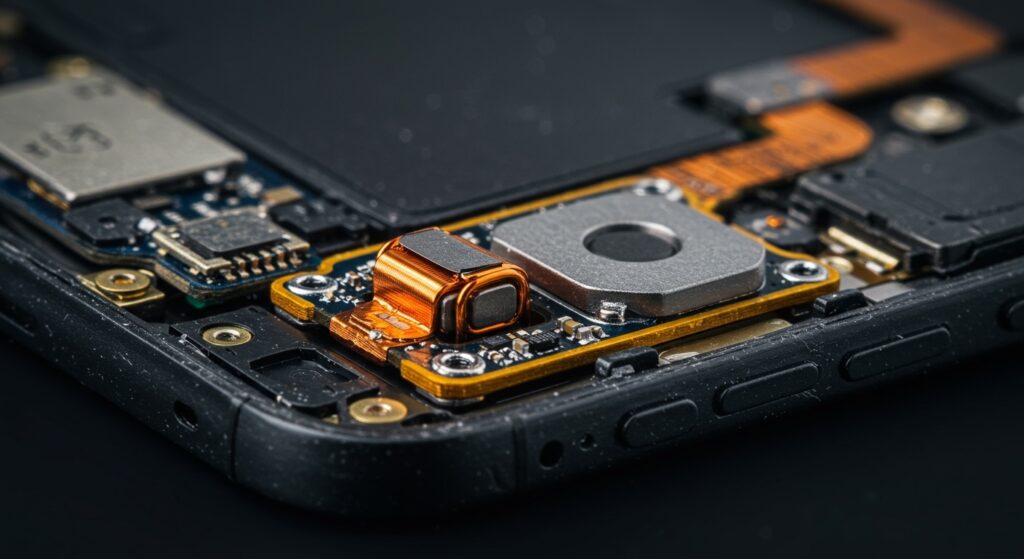
Throughout my years of testing mobile hardware and performing device teardowns, I have observed a massive shift in how manufacturers balance thinness with audio quality. While the fundamental physics of sound hasn’t changed, the engineering behind these tiny drivers has become incredibly sophisticated to meet consumer demands for “bass” in a device less than 8mm thick.
🚀 Key Takeaways: Mobile Audio at a Glance
- Primary Technology: Over 95% of phones use micro-dynamic drivers due to their cost-effectiveness and relatively wide frequency response.
- Dual-Functionality: Many modern phones use the earpiece speaker as a secondary channel to create a stereo soundstage.
- Advanced Materials: High-end speakers utilize Neodymium magnets and multi-layer polymer diaphragms for better clarity.
- Emerging Tech: MEMS speakers are the “future,” offering better water resistance and much smaller footprints than traditional coils.
- Audio Processing: The quality of sound is heavily dependent on the DAC (Digital-to-Analog Converter) and the internal amplifier (often integrated into the SoC).
The Anatomy of a Mobile Speaker: How It Works
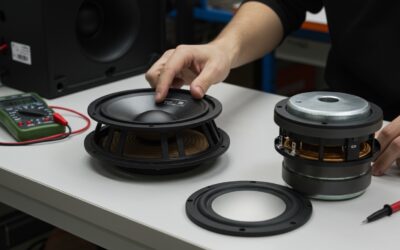
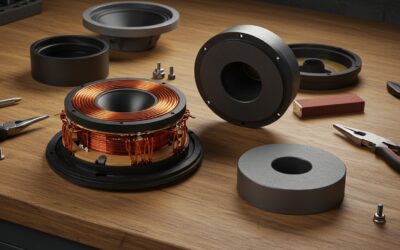
To understand what type of speakers are used in mobile phones, we must look at the internal components. Even though they are small enough to fit on the tip of your finger, they contain the same basic elements as a massive floor-standing hi-fi speaker.
The Permanent Magnet
Most mobile speakers use high-strength Neodymium (NdFeB) magnets. These are used because they provide the strongest magnetic field for their size, allowing the speaker to be powerful without adding excessive weight to the handset.
The Voice Coil
This is a tiny coil of copper (or sometimes copper-clad aluminum) wire. When an electrical signal from your phone’s audio amplifier passes through this coil, it creates a fluctuating magnetic field that interacts with the permanent magnet.
The Diaphragm (The Cone)
In a phone, the diaphragm is usually made of a flexible polymer or composite plastic. It is attached to the voice coil. As the coil moves back and forth, it pushes and pulls the diaphragm, vibrating the air and creating the sound you hear.
The Acoustic Chamber
This is perhaps the most overlooked part of what type of speakers are used in mobile phones. Because the speakers are so small, they need a “back volume” or an airtight box to prevent the sound waves from the back of the diaphragm from canceling out the waves from the front. Manufacturers often use acoustic balls (tiny plastic beads) inside this chamber to artificially increase the perceived volume of the air, making the speaker sound “bigger” than it actually is.
Primary Speaker Types Found in Modern Devices
Micro-Dynamic Drivers (The Industry Standard)
This is the “workhorse” of the mobile world. If you are wondering what type of speakers are used in mobile phones like the iPhone 15 or Samsung Galaxy S24, it is this. They are reliable, produce a decent amount of volume, and can cover a wide range of frequencies from about 300Hz to 15kHz.
Piezoelectric Speakers (Sound-on-Display)
Some manufacturers, like Xiaomi and Huawei, have experimented with piezoelectric transducers. These don’t use magnets or coils. Instead, they use materials that deform when electricity is applied.
These are often placed directly against the glass of the screen, turning the entire display into a speaker. While this saves space and eliminates the need for a visible speaker grille, the sound quality often lacks the “warmth” and bass of dynamic drivers.
MEMS Speakers (The Future of Audio)
MEMS (Micro-Electro-Mechanical Systems) speakers are the newest innovation. These are built on silicon wafers, similar to computer chips.
Why MEMS are revolutionary:
- Size: They are significantly thinner than dynamic drivers.
- Durability: No moving voice coil means they are less prone to mechanical failure.
- Speed: They respond to signals much faster, leading to incredible high-frequency clarity and lower “phase shift.”
Comparing Mobile Speaker Technologies
| Feature | Micro-Dynamic | Piezoelectric | MEMS |
|---|---|---|---|
| Common Use | Main Loudspeaker / Earpiece | Under-display audio | High-end earbuds / Future phones |
| Mechanism | Magnet & Voice Coil | Material Deformation | Silicon Membrane |
| Bass Quality | Good (Relative to size) | Poor | Limited (Improving) |
| Space Required | High (Needs chamber) | Very Low | Minimal |
| Water Resistance | Moderate (Requires mesh) | High | Excellent |
Stereo vs. Mono: The Dual-Speaker Setup
When discussing what type of speakers are used in mobile phones, we have to address the configuration. In the past, phones had a single speaker at the bottom. Today, “Stereo” is the standard for mid-to-high-range devices.
How “Hybrid Stereo” Works
Since there is limited space at the top of the phone (due to cameras and sensors), most brands use a Hybrid Stereo setup.
- Bottom Speaker: A larger, “full-range” dynamic driver that handles the majority of the volume and lower frequencies.
- Earpiece Speaker: A smaller, front-firing driver that handles the high frequencies (tweeter) and provides the second channel for stereo separation.
In my experience, the Google Pixel and iPhone series have some of the best-tuned hybrid setups, using software algorithms to balance the volume levels between the unequal top and bottom speakers.
Actionable Guide: How to Maintain and Clean Your Phone Speakers
Regardless of what type of speakers are used in mobile phones, they all suffer from the same enemy: Debris. Dust, pocket lint, and earwax can significantly muffle the sound of a high-quality driver.
Step 1: Dry Brushing
Use a soft-bristled toothbrush or a dedicated electronics cleaning brush. Hold the phone with the speaker ports facing down so the gravity helps the debris fall out rather than pushing it deeper.
Step 2: Adhesive Putty
I highly recommend using reusable adhesive putty (like Blu-Tack). Gently press the putty into the speaker grille and pull it back quickly. This is the most effective way to remove fine metal dust that sticks to the internal magnets.
Step 3: Isopropyl Alcohol (Advanced)
If the mesh is clogged with oils or wax, lightly dampen a cotton swab with 99% Isopropyl Alcohol. Do not soak it. Lightly dab the grille to dissolve the blockage, then use the dry brush again.
⚠️ Warning: Never use compressed air directly into a mobile speaker port. The high pressure can easily rupture the delicate polymer diaphragm of a micro-dynamic driver, permanently ruining your audio.
The Role of Software in Mobile Audio Quality
The hardware is only half the story. When you ask what type of speakers are used in mobile phones, you are also asking about the DSP (Digital Signal Processor).
Modern phones use “Smart Amps” that monitor the speaker’s temperature and excursion (how far the diaphragm moves) in real-time. This allows the phone to push the speaker to its absolute limit without blowing it out. Technologies like Dolby Atmos and DTS:X Ultra use psychoacoustic processing to make the tiny speakers sound like the audio is coming from a wider area than the phone itself.
The Future: Where is Mobile Audio Heading?
We are moving toward a “portless” future. As manufacturers try to make phones more waterproof and durable, the traditional speaker grille is a liability.
- Magnetic Induction through the Frame: Future phones may vibrate the entire metal frame of the device to produce sound.
- MEMS Arrays: Instead of one big speaker, we might see 5 or 10 tiny MEMS speakers scattered throughout the chassis to create true 360-degree spatial audio.
- Advanced AI Upscaling: Software will continue to fill in the gaps of physical hardware, using AI to “reconstruct” bass frequencies that small speakers physically cannot produce.
Frequently Asked Questions
Why does my phone speaker sound “tinny”?
Small speakers lack the physical size (surface area) to move enough air for deep bass frequencies. While micro-dynamic drivers are efficient, they cannot replicate frequencies below ~200Hz effectively. Software enhancements usually “boost” the mids to give the illusion of fuller sound.
Can water damage my phone speakers permanently?
Most modern phones have IP68 ratings with hydrophobic meshes. However, if water gets past the mesh, it can weigh down the diaphragm or cause corrosion on the voice coil. If your phone gets wet, use a “clear wave” or “eject water” sound frequency app to vibrate the water out of the chamber.
Are “Sound-on-Display” speakers better than regular ones?
In terms of design, yes, they allow for a cleaner look. However, in terms of audio fidelity, traditional micro-dynamic speakers are still superior. Sound-on-display often lacks directional clarity and can make the entire phone vibrate uncomfortably in your hand at high volumes.
What is the difference between an earpiece and a loudspeaker?
The earpiece is designed for low-volume, close-proximity listening (300Hz to 3.4kHz range for voice). The loudspeaker is designed for high-excursion and higher volume (media playback). In many modern phones, the earpiece is upgraded to a “dual-purpose” driver to assist in stereo playback.