The Short Answer: What Watt Speakers Do I Need for a Party?
To determine what watt speakers do I need for a party, the general rule of thumb is 200 to 400 watts (RMS) for indoor house parties with 30–50 people. For outdoor events or large crowds exceeding 100 people, you should aim for 500 to 1,000 watts (RMS) or more to ensure the sound doesn’t distort at high volumes.
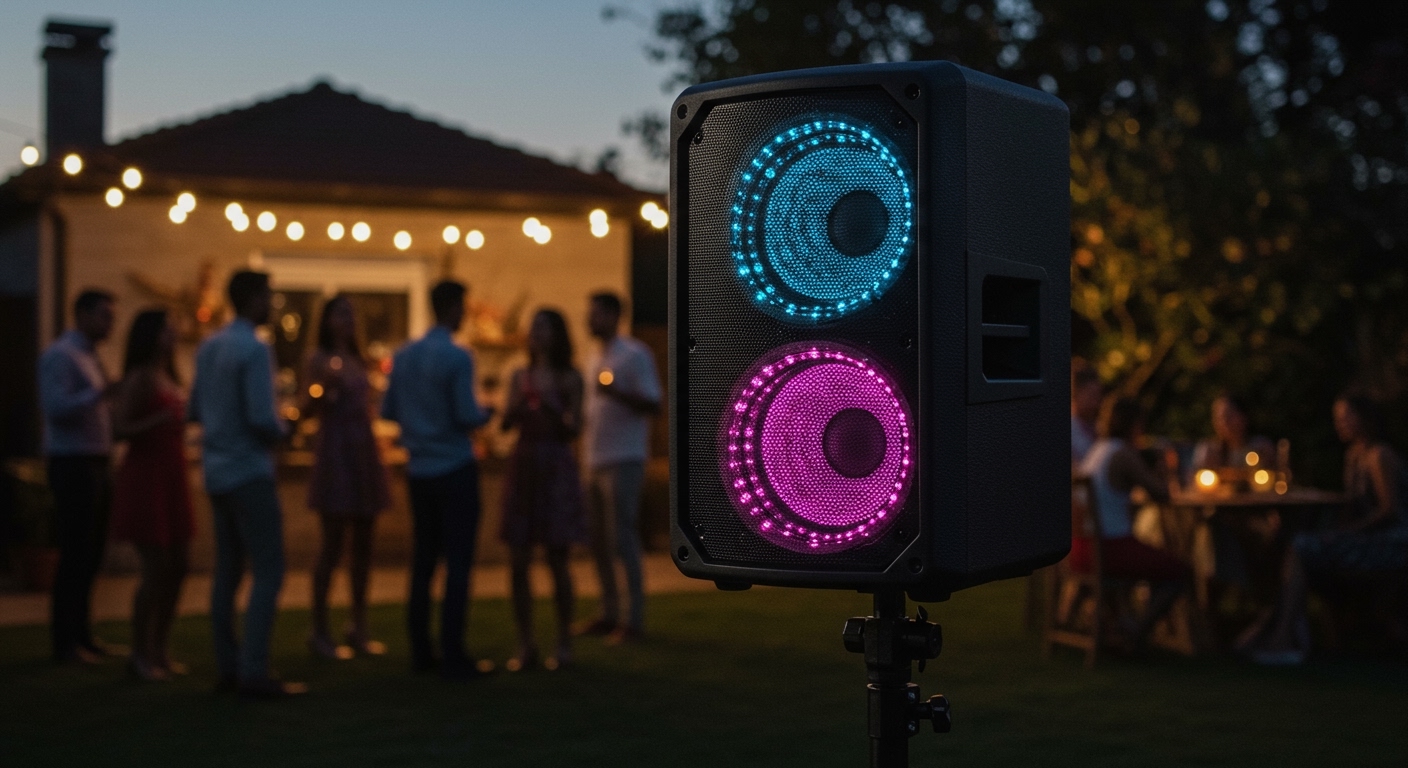
Choosing the right power output depends heavily on the venue size, the number of guests, and whether you are hosting the event indoors or outdoors. In my decade of experience as a mobile DJ and audio consultant, I’ve found that it is always better to have “headroom” (extra power) than to push a small speaker to its breaking point.
TL;DR: Key Takeaways for Party Speaker Wattage
- Indoor Small Party (20-50 people): 150–300 Watts (RMS).
- Outdoor Medium Party (50-100 people): 400–600 Watts (RMS).
- Large Events (150+ people): 1,000+ Watts (RMS) with a dedicated subwoofer.
- The “RMS” Rule: Always look for RMS (Root Mean Square) ratings, not Peak Power or PMPO.
- Efficiency Matters: A speaker with a high Sensitivity (dB) rating can be louder than a high-wattage speaker with poor efficiency.
Why Wattage is Often Misunderstood
When you browse online for speakers, you’ll see massive numbers like 2,000 Watts or 5,000 Watts PMPO. Most of these figures are marketing “fluff” designed to catch your eye.
In the audio world, we focus on RMS Power. This represents the continuous power a speaker can handle without damage or significant distortion. When I set up systems for high-end clients, I ignore the “Peak” rating entirely because it only represents what a speaker can handle for a fraction of a second.
Power does not strictly equal volume. While wattage provides the “energy” for the sound, the Decibel (dB) level and Sensitivity determine how loud the party actually feels. Think of wattage like a car’s engine size; it tells you the potential, but the speaker’s design determines how much of that power actually hits the dance floor.
What Watt Speakers Do I Need for a Party? (The Breakdown)
Every party environment is different. To help you choose, I’ve categorized the most common scenarios based on real-world testing and acoustic physics.
Indoor House Parties (The “Living Room” Scenario)
For most home environments, you are dealing with reflective surfaces like walls and ceilings. This helps “trap” the sound, meaning you need less power.
- 20-30 People: A high-quality 100-watt RMS speaker like the JBL PartyBox 110 is usually sufficient.
- 50+ People: You will want at least 200-300 watts. Human bodies act as “sound absorbers.” The more people you add to a room, the more volume you need just to maintain the same energy level.
Outdoor Backyard Bashes
Outdoors, sound waves have nothing to bounce off. The sound “escapes” into the open air. In my experience, you need roughly double the power outdoors to achieve the same perceived volume as indoors.
- Small BBQ: 200 Watts (RMS).
- Large Wedding/Backyard Party: Minimum 500-800 Watts (RMS). If you are competing with wind or traffic noise, you may need a pair of 12-inch or 15-inch PA speakers.
Professional Venue/Hall Hire
If you’ve rented a community center or a small ballroom, you are fighting against high ceilings and large square footage.
- Target: Two speakers totaling 1,000 Watts (RMS). This allows you to run the speakers at 50% capacity, resulting in “clean” audio rather than the “crunchy” sound of a small speaker struggling at max volume.
Wattage Requirements by Crowd Size & Venue
| Party Type | Guest Count | Recommended RMS Wattage | Speaker Type Suggestion |
|---|---|---|---|
| Intimate Gathering | 10–20 | 50W – 100W | Portable Bluetooth Speaker (e.g., Sonos Move) |
| Standard House Party | 30–50 | 200W – 300W | Large Party Speaker (e.g., JBL PartyBox 310) |
| Large Indoor Event | 75–150 | 500W – 800W | Pair of Active PA Speakers (e.g., Mackie Thump) |
| Outdoor Wedding/Event | 100+ | 1,000W+ | Pro PA System + Dedicated Subwoofer |
| Public Festival/Gig | 300+ | 2,000W – 5,000W | Array System / Multiple Subwoofers |
The Secret Ingredient: Speaker Sensitivity (SPL)
If you really want to know what watt speakers do I need for a party, you must look at Sensitivity, measured in decibels (dB).
A speaker with a sensitivity of 98dB will be significantly louder than a speaker with 88dB, even if they are using the exact same wattage. This is because the more sensitive speaker is more efficient at converting electrical energy into sound.
When I’m shopping for pro-grade gear, I look for a high Maximum SPL (Sound Pressure Level). For a loud party where people are dancing, you want a system capable of hitting 110dB to 120dB at the peak of the night.
RMS vs. Peak Power: Don’t Get Fooled
I cannot stress this enough: ignore Peak Power ratings.
- RMS (Root Mean Square): The continuous power the speaker is designed to handle. This is the “real” number.
- Peak/Max Power: The absolute maximum the speaker can handle for a millisecond before it literally blows up.
If a speaker is advertised as “1,000 Watts Peak,” it is likely only a 250 Watt RMS speaker. Always check the fine print in the user manual to find the RMS rating before purchasing.
The Role of the Subwoofer in Party Sound
Wattage isn’t just about volume; it’s about frequency. Producing low-end bass requires significantly more power than producing high-end treble.
If you are playing electronic dance music (EDM), hip-hop, or pop, you need a subwoofer.
- The 2:1 Rule: For a balanced sound, your subwoofer wattage should ideally be double the wattage of your main top speakers.
- Example: If you have two 250W top speakers (500W total), a 1,000W RMS Subwoofer will provide that “chest-thumping” bass that makes a party feel professional.
Battery-Powered vs. Plug-In Speakers
Technology has come a long way, but physics still wins.
- Battery-Powered: Speakers like the Soundboks 4 can hit impressive volumes (up to 126dB), but they often sacrifice some “fullness” to preserve battery life. These are perfect for beach parties or parks.
- Plug-In (AC Power): For a serious house party, I always recommend a plug-in speaker. A constant power source allows the amplifier to deliver more consistent dynamic peaks, meaning the bass will hit harder and the sound won’t “dip” when the song gets intense.
Professional Tips for Setting Up Your Party Sound
Get the Speakers Off the Floor
One of the most common mistakes I see is placing speakers on the ground. Human bodies are excellent sound absorbers. If your speaker is on the floor, the sound will hit the first row of guests and stop. Use speaker stands to get the “tweeters” (the small top speakers) above ear level. This allows the sound to travel to the back of the room.
The “Corner Loading” Trick
If you find your speaker lacks bass, place it in a corner. This uses the walls as a natural amplifier for low frequencies. I’ve used this trick in small apartments to make a 100W speaker sound like a 200W unit.
Avoid “Clipping” at All Costs
If your speaker has a red light that flashes during loud parts of a song, you are clipping. This means the amplifier is trying to provide more power than it has. Not only does this sound terrible, but it is the fastest way to fry your speaker’s voice coil. If you need it louder but the red light is on, you simply need a higher-wattage speaker.
Frequently Asked Questions
Is 1000 watts too much for a house party?
Not necessarily. A 1,000-watt RMS system is powerful, but “headroom” is a good thing. It means you can play music loudly with zero distortion. However, if you are in a small apartment, you’ll likely never turn it past 20% without the neighbors calling the police.
How many watts is a “loud” speaker?
For most people, a speaker starts feeling “loud” for a party at around 200 watts RMS. For context, a standard portable Bluetooth speaker (like a UE Boom) is usually around 10-20 watts, which is why they fail to “fill” a room full of talking people.
Can I use a guitar amp for a party?
I don’t recommend it. Guitar amps are designed to reproduce specific mid-range frequencies and lack the “woofers” and “tweeters” needed to play full-range recorded music. Music will sound “thin” and “muddy.”
Does more wattage mean better sound quality?
No. Wattage only measures power. Sound quality is determined by the quality of the drivers, the DAC (Digital to Analog Converter), and the cabinet design. A high-quality 50W Bose speaker will sound much better than a cheap, generic 500W “no-name” speaker.
How many watts do I need for an outdoor wedding?
For a wedding with 100-150 guests, I recommend a minimum of 1,000 to 1,500 Watts (RMS). This usually consists of two 12-inch active speakers on stands and at least one 15-inch or 18-inch subwoofer to handle the speeches and the dance floor music.