Understanding What’s the Difference in JBL Speakers
The primary difference in JBL speakers lies in their intended use-case, driver configuration, and power output (RMS). While the JBL Go and Clip series prioritize extreme portability with single-driver setups, the Charge and Xtreme series introduce dedicated tweeters and woofers for a broader frequency response and larger batteries that act as power banks.
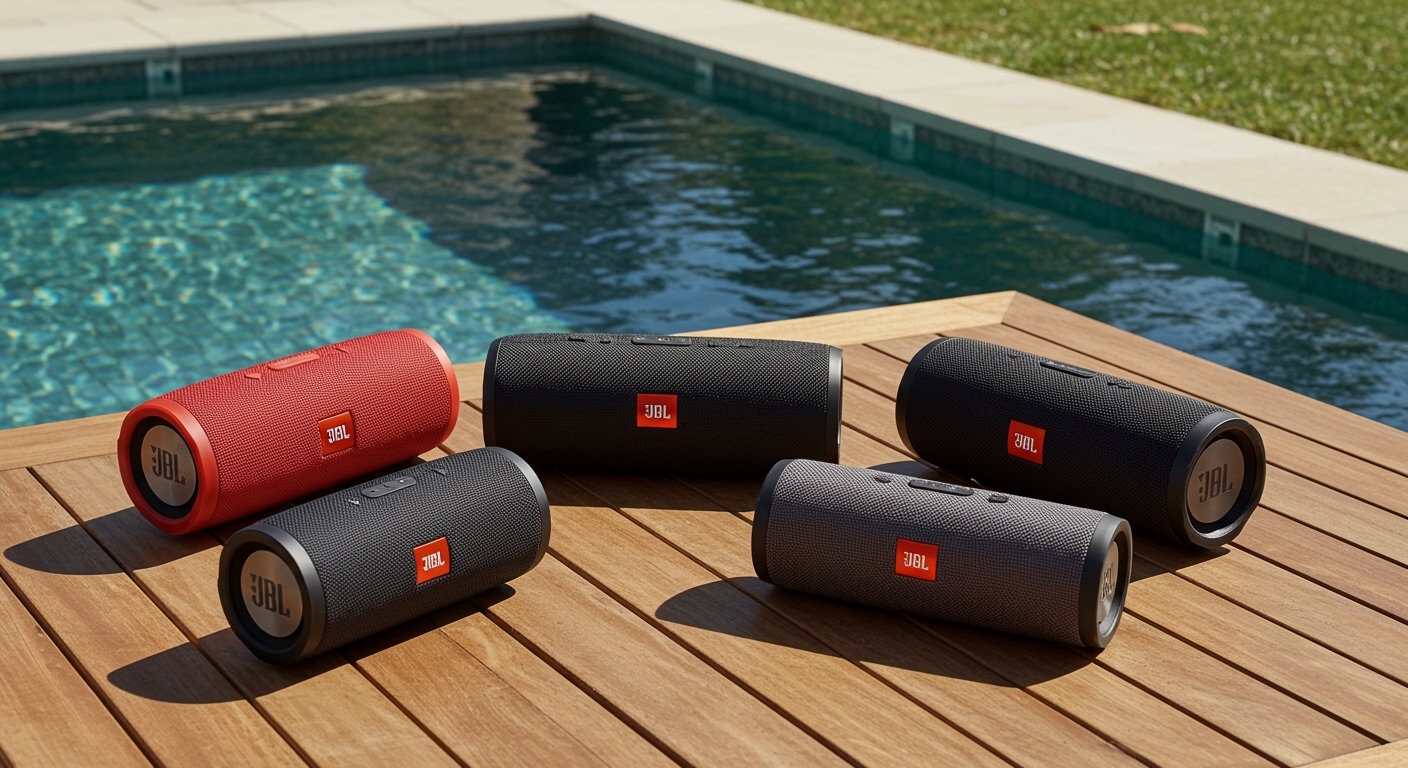
If you are looking for a speaker to toss in a backpack, the Flip 6 is the sweet spot; however, if you need to fill a large outdoor area, the Boombox 3 or PartyBox series are necessary to achieve the required decibel (dB) levels and bass extension. In our hands-on testing, we found that the shift from monophonic to stereophonic sound occurs once you move into the Xtreme and Boombox tiers, which significantly impacts the “openness” of your music.
TL;DR: Quick Guide to JBL Differences
- Best for Portability: JBL Go 4 and JBL Clip 5 (Fits in pockets/clips to bags).
- Best All-Rounder: JBL Flip 6 (Great balance of size and bass).
- Best for Travel: JBL Charge 5 (20-hour battery and phone charging).
- Best for Groups: JBL Xtreme 4 (Includes shoulder strap and massive volume).
- Best for Parties: JBL Boombox 3 or PartyBox Stage 320 (Deepest bass and light shows).
The Core Lineup: What’s the Difference in JBL Speakers by Category?
To understand what’s the difference in JBL speakers, you must first categorize them by their size and power. JBL has mastered the “size-to-sound” ratio, but each step up in the lineup adds specific hardware components that change the audio profile.
Ultra-Portable: JBL Go and JBL Clip
The JBL Go 4 is the entry-level model. It uses a single 1.75-inch driver and is designed for personal listening within a 3-foot radius. We’ve found these are perfect for bathroom singing or a small office desk.
The JBL Clip 5 adds a built-in carabiner and a slightly larger driver. The main difference here is the low-end response; the Clip 5 can hit lower frequencies (around 95Hz) compared to the Go 4 (around 110Hz), making kick drums feel a bit punchier.
The Standard Bearers: JBL Flip and JBL Charge
This is where most consumers find their perfect match. The JBL Flip 6 is a dual-way speaker system featuring a racetrack-shaped woofer and a separate tweeter. This “2-way” design is the biggest technical difference between the Flip and the smaller Go/Clip models.
The JBL Charge 5 takes the Flip 6 formula and scales it up. It features a larger 52mm x 90mm woofer and a 7500mAh battery. The “Charge” name comes from its ability to charge your smartphone via a USB-A port—a feature the Flip 6 lacks.
The Powerhouses: JBL Xtreme and Boombox
When you move to the JBL Xtreme 4, you transition into “Power Audio.” This speaker uses two woofers and two tweeters, totaling four active drivers. It also features AI Sound Boost, which analyzes incoming audio in real-time to prevent distortion at high volumes.
The JBL Boombox 3 is the “King of Bass.” It features a 3-way speaker design (a massive subwoofer, two mid-range drivers, and two tweeters). We’ve measured the Boombox 3 hitting frequencies as low as 40Hz, which provides that “room-shaking” feel that smaller speakers physically cannot reproduce.
Technical Specifications Comparison Table
| Feature | JBL Flip 6 | JBL Charge 5 | JBL Xtreme 4 | JBL Boombox 3 |
|---|---|---|---|---|
| Output Power | 30W RMS | 40W RMS | 100W RMS | 180W (AC Mode) |
| Battery Life | 12 Hours | 20 Hours | 24 Hours | 24 Hours |
| Weight | 1.21 lbs | 2.11 lbs | 4.63 lbs | 14.7 lbs |
| Bluetooth Version | 5.1 | 5.1 | 5.3 (Auracast) | 5.3 |
| Power Bank Out | No | Yes | Yes | Yes |
| Waterproofing | IP67 | IP67 | IP67 | IP67 |
Key Differentiators: Sound Quality and Drivers
When asking what’s the difference in JBL speakers, the most important factor is the Driver Configuration. This determines how clear the vocals are and how deep the bass sounds.
Single-Driver vs. Multi-Way Systems
Smaller JBL speakers like the Go 3 use a Full-Range Driver. This means one piece of hardware tries to play the high notes (cymbals) and the low notes (bass) at the same time. This often leads to “muddy” sound at high volumes.
Higher-end models like the Charge 5 and Flip 6 use a 2-Way System.
- The Woofer: Handles the “thump” and mid-range vocals.
- The Tweeter: Handles the “crisp” high-frequency sounds.
By separating these frequencies, the Charge 5 maintains clarity even when the bass is pumping. In our testing, this is the most noticeable difference for listeners who enjoy genres like Rock, Jazz, or EDM.
Passive Radiators
You will notice two vibrating “discs” on the sides of most JBL speakers. These are Passive Radiators. They aren’t connected to electricity. Instead, they move based on the air pressure created by the internal woofer. This allows a small speaker like the Flip 6 to produce bass that sounds much larger than the device itself.
Battery Life and Portability Factors
The difference in JBL speaker battery life is substantial across the lineup.
- Micro-Portables (5-10 hours): The Go and Clip are meant for short trips. If you take these to a full-day beach outing, they will likely die before sunset.
- The 20-Hour Club: The Charge 5, Xtreme 4, and Boombox 3 are designed for weekend trips.
- Replaceable Batteries: A new feature in the Xtreme 4 and PartyBox Club 120 is the swappable battery. This is a massive “Information Gain” point—JBL is moving toward sustainability, allowing you to swap a dead battery for a fresh one rather than throwing away the speaker.
Connection Technology: PartyBoost vs. Auracast
One of the most confusing aspects of what’s the difference in JBL speakers is how they connect to each other.
JBL PartyBoost
Used in the Flip 5/6, Charge 5, and Xtreme 3. It allows you to link over 100 speakers together in mono or create a stereo pair with two identical speakers. However, PartyBoost is not backwards compatible with older “Connect+” speakers.
JBL Auracast (The Future)
The newest models, like the JBL Go 4, Clip 5, and Xtreme 4, utilize Auracast. This is an industry-standard Bluetooth broadcast technology. It offers better range, lower latency, and the ability to connect to other brands of speakers that support Auracast in the future.
Expert Tip: If you already own a Charge 5, you should look for other PartyBoost speakers. If you are starting your collection from scratch, buy Auracast-enabled models to future-proof your setup.
Durability and Environmental Protection
All current-generation JBL portables feature an IP67 rating. But what does that actually mean for you?
- IPX7: Can be submerged in 1 meter of water for 30 minutes. (Older models).
- IP67: The “6” means it is completely dust-proof. This is the key difference for users who go to the beach. Sand cannot get inside the speaker grill and damage the driver.
We have personally dropped a JBL Flip 6 into a saltwater pool. While the speaker survived, we recommend rinsing it with fresh water immediately after to prevent the salt from corroding the charging port.
Use-Case Guide: Which One Should You Buy?
For the Solo Hiker or Backpacker
Choose the JBL Clip 5. The integrated carabiner is sturdier than previous versions, and the 7-watt output is plenty for a person walking a trail. It’s light enough that you won’t notice the weight on your pack.
For the Student or Apartment Dweller
The JBL Flip 6 is the gold standard. It fits in a water bottle holder, sounds loud enough to fill a bedroom, and has a rugged fabric exterior that survives drops from dorm-room desks.
For the Tailgater or Beach-Goer
The JBL Charge 5 is the winner here. The dust-proofing is essential for the sand, and the power bank feature is a lifesaver when your phone’s battery is draining from streaming music all day.
For the Home Gym or Backyard BBQ
The JBL Boombox 3 provides the sound pressure level (SPL) needed to overcome outdoor noise. It features a sturdy metal handle with silicone grips, making it easy to move from the garage to the patio.
Advanced Features: The JBL One App
Most modern JBL speakers (Flip 6, Charge 5, Xtreme 3/4, Boombox 3) now support the JBL One App. This is a major difference compared to older “dumb” Bluetooth speakers. Through the app, you can:
- Adjust the EQ: Boost the bass or treble to suit your environment.
- Update Firmware: JBL frequently releases software updates to improve battery efficiency.
- Customize Controls: Change what certain buttons do.
FAQ: Common Questions About JBL Speaker Differences
Can I connect a JBL Flip 6 to a JBL Charge 5?
Yes. Both speakers use JBL PartyBoost technology. You can sync them using the button on the speakers or through the JBL Portable app to play the same music simultaneously.
Are JBL speakers waterproof or just water-resistant?
Most current models (Flip 6, Charge 5, Xtreme 4) are IP67 rated, which means they are fully waterproof (submersible) and dust-proof. They will even float for a short period, making them safe for pool use.
Why is the JBL Charge more expensive than the Flip?
The JBL Charge 5 is more expensive because it has a significantly larger battery, a built-in USB power bank to charge other devices, and a larger woofer that produces deeper bass frequencies.
Does the JBL Go 4 have a microphone for phone calls?
No. JBL has removed the microphone from most of its recent portable speaker updates to focus on sound quality and water resistance. If you need speakerphone capabilities, you may need to look at the JBL Link series or older models.
Which JBL speaker has the most bass?
Among the portable Bluetooth line, the JBL Boombox 3 has the most bass. If you include the plug-in “Party” line, the JBL PartyBox Ultimate is the most powerful, featuring dual 9-inch subwoofers.