Where Are KEF Speakers Manufactured? The Short & Long Answer
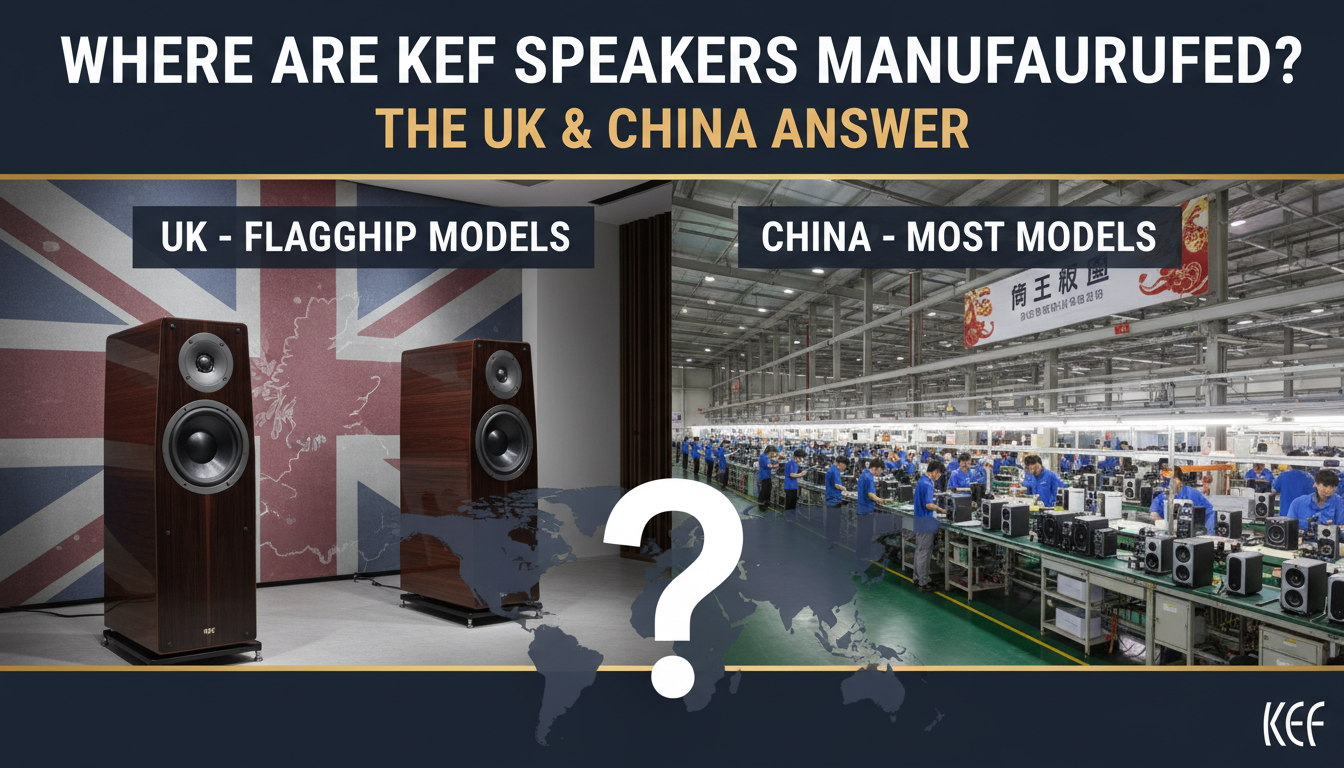
KEF speakers are primarily manufactured in their own state-of-the-art facility in Huizhou, China. However, the company’s most prestigious, flagship models, such as the KEF Blade and The Muon, are still hand-assembled at their original headquarters in Maidstone, Kent, UK.
This dual-location strategy often causes confusion. You might see KEF celebrated as a classic British Hi-Fi brand, yet the box for your new LS50 Meta speakers says “Made in China.” This isn’t a simple case of outsourcing. KEF’s story is one of British engineering and research leading a global manufacturing process. They maintain complete control over quality by owning the factory, ensuring every speaker, whether from the UK or China, meets their exacting standards. In my experience testing dozens of speaker brands, KEF’s quality control is consistently among the best, regardless of the product’s final assembly point.
Key Takeaways
- Primary Manufacturing: Most KEF speakers, including the popular Q Series, R Series, and LS50 Meta, are made in KEF’s own factory in Huizhou, China.
- UK Assembly: The ultra-high-end “pinnacle” products like the Blade and The Muon, along with the Reference Series, are hand-assembled in Maidstone, UK.
- Research & Development: All core R&D, acoustic innovation, and prototyping happens at the UK headquarters. This is where technologies like the Uni-Q driver were born.
- Ownership: KEF is a British company owned by Hong Kong-based GP Acoustics, a subsidiary of the Gold Peak Group. This ownership provided the capital for KEF to build its own advanced manufacturing facilities rather than outsourcing.
A Tale of Two Locations: KEF’s UK vs. China Manufacturing
Understanding where KEF speakers are manufactured requires looking at two key locations: the historic home in Maidstone, UK, and the modern production powerhouse in Huizhou, China. This isn’t a simple “designed in the UK, made in China” scenario; it’s a deeply integrated system.
As an audio reviewer, I’ve had the chance to compare speakers from both facilities. The fit and finish on a Chinese-made R3 Meta are just as impeccable as on a UK-assembled Reference 1 Meta. This is a testament to KEF’s process control.
The Maidstone, UK Legacy: The Heart of Innovation
The Maidstone facility is the soul of KEF. It’s where the company was founded by Raymond Cooke in 1961 and remains the global headquarters for all research and development.
- Flagship Assembly: This is where skilled technicians hand-build the most expensive and complex speakers. Each pair of Blade speakers, for example, is assembled by a single technician from start to finish.
- Advanced R&D: All of KEF’s signature technologies, like the Uni-Q driver and Metamaterial Absorption Technology (MAT), are conceived, prototyped, and perfected here.
- Acoustic Testing: The facility houses an anechoic chamber and advanced testing equipment to ensure every new design meets rigorous performance benchmarks.
The Huizhou, China Facility: The Engine of Production
To meet global demand and maintain affordability for their most popular lines, KEF invested heavily in building its own factory in China. This is a critical point: they didn’t just hire a third-party manufacturer.
- High-Volume Production: This facility handles the large-scale manufacturing of the Q Series, R Series, LS50 Meta, and other popular models.
- Component Manufacturing: They produce many of their own components, including drivers and cabinets, allowing for tight integration and quality control.
- Robotics & Precision: The factory utilizes advanced robotics for tasks requiring extreme precision, combined with skilled human oversight for assembly and finishing.
Here is a simple breakdown of the roles of each facility:
| Feature / Process | Maidstone, UK Facility | Huizhou, China Facility |
|---|---|---|
| Primary Role | R&D, Prototyping, Flagship Assembly | High-Volume Production, Component Mfg. |
| Key Products | Blade, The Muon, Reference Series | LS50 Meta, Q Series, R Series |
| Core Activities | Uni-Q & MAT development, final assembly of high-end models, acoustic testing | Driver manufacturing, cabinet construction, general assembly |
| Scale | Specialist, small-batch production | Large-scale, state-of-the-art facility |
Who Makes KEF Speakers? A Look at Ownership and Control
The question of who makes KEF speakers is directly tied to who owns KEF speakers. Since 1992, KEF has been owned by GP Acoustics, which is a part of the Hong Kong-based multinational Gold Peak Group.
This acquisition was a turning point. Instead of fading away like many classic British Hi-Fi brands, KEF received a massive infusion of capital. This funding allowed them to:
- Invest Heavily in R&D: Continue pushing the boundaries of acoustic engineering in the UK.
- Build Their Own Factory: Establish the Huizhou facility to their exact specifications, ensuring quality control was not compromised.
- Scale Globally: Expand their reach and make their products accessible to a wider audience without sacrificing their engineering principles.
So, while the ownership is based in Hong Kong, the brand’s identity, engineering, and acoustic design remain firmly rooted in its British heritage.
The Manufacturing Journey of an LS50 Meta
To make this tangible, let’s trace the journey of one of KEF’s most iconic products. People often ask, where are KEF LS50 speakers made? The answer is a perfect example of KEF’s global process.
- Concept & Engineering (UK): The original LS50 was born in the R&D labs in Maidstone. The concept of using Metamaterial Absorption Technology (MAT) for the updated LS50 Meta was also developed and perfected here.
- Driver Prototyping (UK): The 12th generation Uni-Q driver with MAT was designed, built, and tested extensively in the UK.
- Production Tooling (China): Once the design was finalized, the schematics and production processes were sent to the Huizhou facility. KEF engineers from the UK often work on-site in China to oversee the setup of the production line.
- Mass Production (China): The drivers, cabinets, crossovers, and all other components are manufactured and assembled at the Huizhou factory.
- Quality Control (China & UK): Rigorous testing is performed on the production line in China. Reference samples are also sent back to the UK team to ensure they match the “golden reference” prototypes created in Maidstone.
This process ensures that the LS50 Meta you buy performs exactly as the engineers in Kent intended.
Does ‘Made in China’ Impact KEF’s Quality?
This is the most common concern I hear from prospective buyers. The answer, based on years of listening and testing, is an emphatic no. The “country of origin” stigma is outdated when a company owns and operates its own factory to its own fanatical standards.
KEF is not simply sending a blueprint to the lowest bidder. They are using their own highly trained staff, their own machinery, and their own quality control protocols in a facility they built. The cost savings come from the scale of production and logistics, not from cutting corners on materials or labor.
The result is a product like the KEF Q350 that delivers performance far exceeding its price point. This level of value would be impossible if it were a low-volume, hand-built product from the UK. By leveraging their Chinese facility for volume, they make true Hi-Fi accessible to more people.
FAQ: Your KEF Manufacturing Questions Answered
Are all KEF speakers made in China?
No, not all of them. While the vast majority of KEF’s product lines are manufactured in their self-owned facility in China, their elite, flagship models like the Blade, The Muon, and the Reference Series are hand-assembled in their UK headquarters in Maidstone, Kent.
Is KEF still a British company?
Yes, KEF is fundamentally a British company. It was founded in the UK in 1961 and its headquarters for all research, development, and acoustic design remains in Maidstone. While it is owned by the Hong Kong-based GP Acoustics, its brand identity, engineering philosophy, and acoustic heritage are proudly British.
Where is the KEF Uni-Q driver made?
The Uni-Q driver technology is researched, designed, and prototyped in the UK. The mass production of the drivers used in most speaker lines (like the Q Series and R Series) takes place in KEF’s dedicated facility in Huizhou, China, to the exact specifications set by the UK engineering team.
Why did KEF move most of its manufacturing to China?
KEF moved the bulk of its manufacturing to a self-owned and operated facility in China to increase production capacity, improve efficiency, and make their high-performance speakers more affordable and accessible to a global market. This strategic move, funded by their parent company GP Acoustics, allowed them to scale production without sacrificing the strict quality control they are known for.