Who Made Realistic Speakers? The Definitive History of RadioShack Audio
Tandy Corporation, the parent company of RadioShack, designed and marketed Realistic speakers, but the actual manufacturing was primarily outsourced to Foster Electric (Fostex) in Japan. While Tandy handled the branding and retail distribution, various high-quality Original Equipment Manufacturers (OEMs) like Hitachi, Pioneer, and several specialized Japanese factories produced the internal drivers and cabinets that defined the sound of the 1970s and 80s.
Quick Takeaways: The Realistic Legacy
- Primary Manufacturer: Foster Electric (Fostex) was the main OEM partner for many iconic models.
- Parent Company: RadioShack (Tandy Corporation) owned the Realistic trademark from 1954 until the late 1990s.
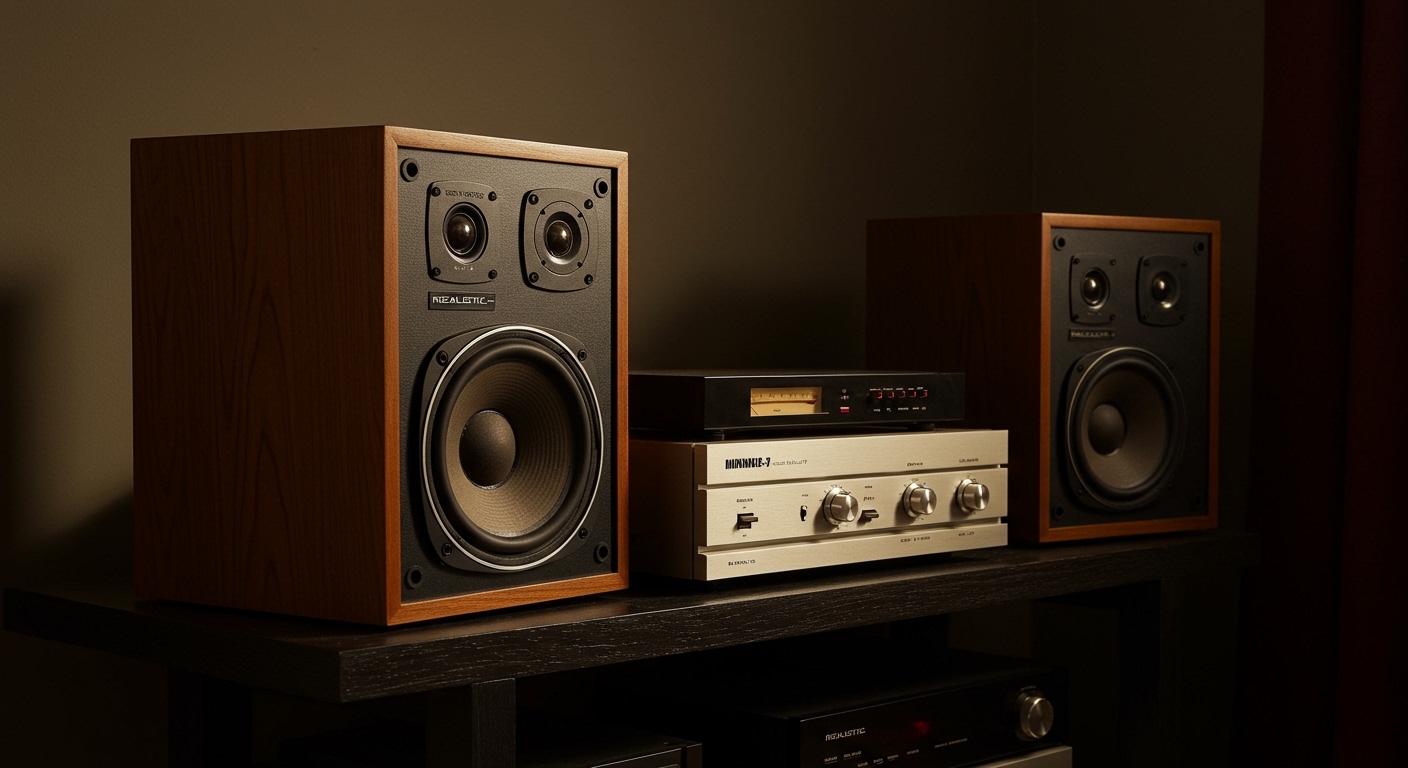
- Key Models: The Minimus-7, Mach One, and Mach Two remain the most sought-after vintage units today.
- Build Quality: Early models featured genuine wood veneers and heavy-duty magnets, outperforming many contemporary boutique brands.
- Global Sourcing: While most production happened in Japan, later models were produced in Korea, Taiwan, and the USA.
The Evolution of Who Made Realistic Speakers
When you look at the back of a vintage Realistic speaker, you won’t see a single “Made By” factory stamp that tells the whole story. As someone who has restored dozens of these units, I can tell you that the magic of Realistic lay in Tandy’s ability to source world-class components from the best Japanese engineering firms during the “Golden Age” of Hi-Fi.
In the 1960s, RadioShack transitioned from a mail-order hobbyist shop into a retail giant. To compete with brands like JBL and KLH, they needed speakers that sounded premium but sold at a “neighborhood store” price. This led them to Foster Electric.
Foster Electric (now known worldwide as Fostex) was the backbone of the Realistic lineup. If you open a Minimus-7—the legendary “giant killer” bookshelf speaker—you will almost always find Foster stamped on the back of the woofer magnet.
The Japanese Connection: Why It Mattered
During the 1970s, Japanese audio engineering was arguably the best in the world for mass production. By partnering with firms like Foster and Pioneer, Realistic was able to offer:
- High-Efficiency Magnets: Providing better sound with lower-powered receivers.
- Consistent Quality Control: The failure rate on Realistic speakers was famously low compared to other “house brands.”
- Innovative Materials: They were among the first to use die-cast aluminum enclosures for small-form-factor speakers.
Identifying Your Realistic Speakers: OEM Guide
If you are trying to figure out exactly who made realistic speakers sitting in your living room, you need to look at the EIA codes and internal markings. Based on my years of “dumpster diving” for vintage gear and repairing crossovers, here is a breakdown of the likely manufacturers.
Common Manufacturers for Realistic Models
| Model Series | Primary Manufacturer | Notable Features |
|---|---|---|
| Minimus Series | Foster Electric (Japan) | Metal cabinets, high-power handling, Fostex drivers. |
| Mach One / Two | Tandy (USA/Japan Sourced) | Massive 15-inch woofers, horn mid-ranges, liquid-cooled. |
| Optimus Series | Pioneer / Hitachi | Transitioned from Realistic branding; higher-end finishes. |
| Nova Series | Foster / Various Japanese | Real wood lattice grilles; “warm” 1970s acoustic suspension. |
| Solo / MC Series | Various (Global) | Entry-level, often paper-cone drivers for budget setups. |
Expert Tip: If you see a “Custom Manufactured in Japan for RadioShack” sticker, 90% of the time, the internal components were sourced from Foster Electric.
The Legend of the Minimus-7: A Case Study in Quality
You cannot talk about who made Realistic speakers without mentioning the Minimus-7. I remember the first time I hooked a pair of these up to a modern Class D amplifier. I was stunned. For a speaker the size of a loaf of bread, the imaging was incredible.
These were the “Engineered in the USA, Built in Japan” flagship of the Realistic brand. Foster Electric used a long-throw woofer and a soft-dome tweeter that could handle surprisingly high wattage.
Why they are still popular:
- Heavy Die-Cast Enclosure: Reduces cabinet resonance significantly.
- Modification Potential: Enthusiasts often swap the internal capacitors for high-grade Polypropylene versions to “unlock” the sound.
- Versatility: They work as desktop monitors, rear surrounds, or even garage speakers.
The Mach One: Who Made the King of Bass?
While the Minimus dominated the small-scale market, the Realistic Mach One was the “big dog” of the lineup. These were designed to compete with the Cerwin-Vega and JBL “rock and roll” speakers of the era.
Contrary to popular belief, the Mach One wasn’t just a cheap knock-off. The 30-4024 and 30-4024A versions featured:
- Multicellular Horns: For wide-dispersion high frequencies.
- Heavy Woofers: 15-inch drivers with massive magnets.
- Solid Cabinets: Real walnut veneer that is rarely seen in modern consumer electronics.
The internal drivers for the Mach One were often sourced from Hitachi or Pioneer, depending on the production year and the specific “revision” of the speaker.
Step-by-Step: How to Identify the Manufacturer of Your Realistic Speaker
If you want to play detective and find out exactly who made realistic speakers in your collection, follow these steps.
Step 1: Check the Back Plate
Look for the Catalog Number (usually looks like 40-2030). You can cross-reference this on “RadioShack Catalogs” (a massive online archive) to find the original MSRP and manufacturing country.
Step 2: Inspect the Date Code
Most Realistic speakers have a small date code (e.g., 12A7). This usually indicates the month and year of manufacture.
- A = 1970s or 80s depending on the decade prefix.
- Manufacturers often changed based on the production year.
Step 3: Open the Cabinet (The “Deep Dive”)
Using a Phillips head screwdriver, carefully remove the woofer. Look at the back of the magnet.
- Stamp “Foster”: You have a Fostex-made unit.
- EIA Code 119: This is the manufacturer code for Foster Electric.
- EIA Code 130: This indicates Gilman, often found in US-assembled units.
- EIA Code 285: This indicates Pioneer.
Step 4: Analyze the Crossover
The crossover components (the electronics that split the sound) often have brand names on the capacitors. Seeing Japanese-made Rubycon or Nichicon caps is a hallmark of the high-quality Japanese production runs.
Why the “RadioShack” Name Hidden the Quality
In my experience, many audiophiles “snubbed” Realistic because they were sold next to batteries and RC cars. However, the Tandy Corporation was a powerhouse of vertical integration.
They didn’t just buy “off-the-shelf” junk. They worked with Foster Electric to specify exact parameters for their drivers. This meant that while a Realistic speaker might look like a generic box, the “engine” inside was often identical to speakers costing three times as much.
Key Statistics for Realistic Enthusiasts:
- Peak Popularity: 1974–1982.
- Number of Minimus-7s sold: Estimated in the millions.
- Resale Value: A mint pair of Mach Ones can now fetch $500 – $800, far exceeding their original retail price when adjusted for inflation.
The Transition to “Optimus” and the End of Realistic
In the early 1990s, RadioShack began phasing out the Realistic name in favor of Optimus. This was a marketing move to make the brand sound more “modern” and “high-end.”
During this era, manufacturing moved increasingly toward RCA (which Tandy also owned for a time) and Linaeum. The Optimus PRO LX5, for example, featured a Linaeum dipole tweeter that offered a 360-degree soundstage. While these were technically no longer “Realistic” branded, they shared the same DNA of high-value, outsourced Japanese engineering.
Common Questions About Realistic Speakers
Are Realistic speakers actually good?
Yes, many models are excellent. While they made some “budget” items, their core Hi-Fi line (Nova, Mach, Minimus) is highly respected by vintage audio collectors for its durability and warm, “musical” sound signature.
Is Foster Electric the same as Fostex?
Foster Electric is the parent company and OEM manufacturer. Fostex is their high-end brand name. When you find a Foster driver in a Realistic cabinet, you are getting the same engineering found in professional studio monitors.
Where can I find parts for old Realistic speakers?
The best source for replacement parts is eBay or specialized sites like Simply Speakers for foam surround kits. Because RadioShack used standard driver sizes, it is relatively easy to find modern replacements or repair kits.
Why did RadioShack stop making Realistic speakers?
Tandy/RadioShack shifted their business model toward cellular phones and computers in the late 90s. As the “Golden Age of Audio” faded and consumers moved toward cheap home-theater-in-a-box systems, the high-quality manufacturing required for the Realistic line became less profitable.
Final Verdict: The Value of the Realistic Brand
Knowing who made realistic speakers changes the way you look at them at a garage sale. They aren’t just “shack speakers”—they are often hidden Foster or Pioneer gems in a walnut-veneered disguise.
If you find a pair of Minimus-7s or Nova-8Bs for under $50, buy them. You are getting a piece of Japanese audio history that sounds as good today as it did forty years ago.